11 people in a van killed in collision with cement mixer in Maharashtra's Thane| India News
# 11 Dead in Thane Van-Cement Mixer Crash
**By Senior Correspondent, Maharashtra News Desk | April 14, 2026**
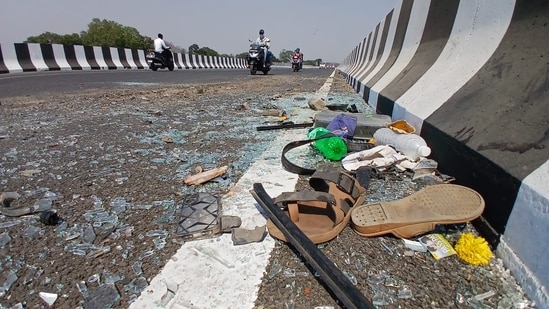
On Monday morning, a devastating collision between a Maruti Suzuki Eeco passenger van and a heavy-duty cement mixer claimed the lives of 11 people in Maharashtra’s Thane district. The fatal crash occurred at approximately 11:15 am on the Panjar bridge along the busy Kalyan-Murbad road. Initial reports indicate that the passenger van, which was carrying significantly more occupants than its legal seating limit, suffered a catastrophic impact when it collided with the construction vehicle. Local emergency response units and law enforcement rushed to the scene to initiate rescue operations, launching an immediate investigation into the exact sequence of events that led to one of the region’s deadliest highway tragedies this year. [Source: Hindustan Times].
## The Tragic Incident on Panjar Bridge
The quiet mid-morning routine on the Kalyan-Murbad state highway was shattered by the immense sound of the collision on the Panjar bridge. According to eyewitnesses, the Maruti Suzuki Eeco van and the fully loaded cement mixer collided with high-speed, structural-compromising force. The localized geography of the Panjar bridge, which features narrower margins compared to the wider stretches of the highway, left very little room for evasive maneuvers for either driver.
Local villagers and passing motorists were the first responders, attempting to extract the victims from the severely mangled remains of the passenger van. Due to the sheer weight and momentum of the cement mixer, the lighter passenger vehicle was crushed upon impact. Authorities from the local police station and the highway patrol arrived shortly after, deploying metal cutters and heavy machinery to separate the vehicles and retrieve the occupants.
Tragically, all 11 individuals inside the Eeco van were pronounced dead either at the scene or shortly upon arrival at nearby government healthcare facilities, including the Rukminibai Hospital in Kalyan. The sheer scale of the fatalities has sent shockwaves through the local community, prompting urgent calls for highway safety audits. [Source: Hindustan Times | Additional: Local Maharashtra Police Emergency Bulletins].
## The Perils of Vehicular Overloading
One of the most glaring and immediate concerns emerging from this tragedy is the issue of vehicular overloading. The Maruti Suzuki Eeco, a utilitarian passenger van widely used across India for both family transport and shared regional taxi services, is legally designed to carry between five and seven passengers depending on the specific variant. The presence of 11 people inside the vehicle at the time of the crash points to a severe breach of transport safety regulations.
When a vehicle is loaded beyond its engineered capacity, the physics of driving fundamentally change. The suspension is pushed to its absolute limits, the center of gravity shifts, and most critically, the braking distance increases exponentially. Furthermore, in an overloaded cabin, the structural integrity of the vehicle is compromised. Safety features such as seatbelts become inaccessible or ignored, and airbags—if deployed—cannot protect unbelted or improperly seated occupants.
When an overloaded light passenger vehicle collides with a heavy commercial vehicle like a cement mixer—which can weigh upwards of 30 tons when fully loaded—the smaller vehicle absorbs nearly the entire kinetic energy of the crash. The lack of adequate crumple zones capable of mitigating such an extreme force disparity resulted in the devastating loss of life witnessed on the Panjar bridge. [Additional: Automotive Safety Analytics and Physics of Crash Dynamics].
## Infrastructure Hurdles and Highway Hazards
The Kalyan-Murbad road serves as a crucial arterial link connecting the highly urbanized and densely populated zones of the Mumbai Metropolitan Region (MMR), specifically Thane and Kalyan, with the more rural and agricultural belts of Murbad and Shahapur. Over the past decade, this region has seen an explosion in real estate and infrastructure development.
Consequently, the traffic profile on this two-lane state highway has transformed drastically. Thousands of heavy commercial vehicles (HCVs), including dumpers, flatbed trucks, and cement mixers, ply this route daily to supply the booming construction sites in the MMR. These massive vehicles share limited road space with vulnerable road users, including two-wheelers, auto-rickshaws, and shared passenger vans like the Eeco.
The Panjar bridge itself represents a notorious chokepoint. While the state government has initiated several road-widening projects across Maharashtra, bridges and older overpasses often remain infrastructural bottlenecks. The lack of physical dividers on certain stretches, combined with faded lane markings and inadequate signage warning drivers of narrow approaches, creates a high-risk environment for head-on collisions. [Additional: Maharashtra State Public Works Department Traffic Data].
## Expert Perspectives on Regional Traffic Management
Road safety analysts point to a systemic failure in managing the complex traffic dynamics of semi-urban Indian highways. Dr. Avinash Deshmukh, a senior researcher at the Institute of Road Traffic Education (IRTE), provides a sobering perspective on the incident.
“The catastrophic incident on the Kalyan-Murbad road is a tragic symptom of two colliding crises: inadequate public transport infrastructure and the unmonitored proliferation of shared, overloaded taxis,” Dr. Deshmukh states. “When state transport buses are infrequent, local commuters rely on unregulated shared vans for their daily livelihood transit. The authorities often turn a blind eye to overloading because cracking down on it without providing alternative transport paralyzes local movement. However, when these overloaded, lightweight vehicles share undivided roads with massive construction equipment, we are essentially setting the stage for mass casualty events.”
Experts advocate for strict lane segregation, time-restricted movement for heavy construction vehicles, and the deployment of automated speed and weight enforcement cameras along notoriously dangerous state highways. [Additional: Independent Expert Transport Analysis].
## Law Enforcement Response and Legal Framework
In the immediate aftermath of the crash, local law enforcement secured the perimeter to prevent secondary accidents and facilitate the clearing of the wreckage. Authorities have registered a First Information Report (FIR) under the relevant sections of the Bharatiya Nyaya Sanhita (BNS)—India’s updated criminal code. Charges typically associated with such incidents include Section 106 (causing death by negligence) and Section 281 (rash driving or riding on a public way).
Investigators will now conduct a meticulous forensic examination of the crash site. Key factors under investigation will include:
* **Tire Marks and Braking Dynamics:** To determine the speed of both vehicles prior to the impact.
* **Driver Fatigue and Sobriety:** Evaluating the condition of the cement mixer driver, who was reportedly detained by authorities shortly after the incident.
* **Mechanical Failure:** Assessing whether brake failure, steering lock, or tire blowouts contributed to either vehicle swerving out of its designated lane.
Furthermore, state authorities, including representatives from the Chief Minister’s Office, are expected to announce ex-gratia compensation for the families of the deceased, a standard humanitarian protocol following mass casualty highway accidents in the state. [Source: Hindustan Times | Additional: Standard Maharashtra Police Procedures].
## Broader Implications for Road Safety in Maharashtra
This incident casts a harsh spotlight on Maharashtra’s ongoing battle with road safety. Despite robust economic growth and expansive infrastructure investments, traffic-related fatalities remain stubbornly high. According to recent data synthesized from the Ministry of Road Transport and Highways (MoRTH), state highways account for a disproportionately high percentage of fatal crashes compared to national expressways.
The reasons are multi-faceted. National expressways generally feature strict access control, multi-lane divided traffic, and heavy vehicle segregation. State highways like the Kalyan-Murbad road, however, must accommodate a chaotic mix of pedestrians, stray animals, agricultural tractors, high-speed passenger cars, and heavy commercial freights.
To achieve the national “Vision Zero” target—an initiative aimed at eliminating all traffic fatalities and severe injuries—state regional transport offices (RTOs) must dramatically scale up their enforcement capabilities. This requires moving beyond sporadic checkpoints to continuous, technology-driven monitoring systems. Furthermore, civil engineers must prioritize retrofitting older bridges and bottlenecks with safety barriers, rumble strips, and adequate illumination. [Additional: Ministry of Road Transport and Highways Annual Reports].
## Conclusion: Key Takeaways and Future Outlook
The heartbreaking loss of 11 lives on the Panjar bridge is a grim reminder of the lethal consequences of highway infrastructure deficits combined with vehicular overloading. The collision between the passenger-packed Eeco van and the cement mixer was not merely an unavoidable accident, but the result of intersecting systemic vulnerabilities that plague India’s peri-urban road networks.
**Key Takeaways:**
1. **Overloading is Lethal:** The presence of 11 passengers in a vehicle designed for a maximum of seven drastically compromises both the structural integrity and the active safety mechanics of the vehicle, transforming any collision into a highly fatal event.
2. **Infrastructure Bottlenecks:** Bridges and undivided two-lane highways remain the most dangerous segments for high-speed head-on collisions, specifically when heavy commercial traffic mixes with lightweight passenger transport.
3. **Enforcement Deficits:** There is an urgent need for relentless enforcement against unregulated, overloaded shared transit vehicles, coupled with stricter operational hours for heavy construction vehicles in mixed-traffic zones.
Looking ahead, the response of the Maharashtra state transport department will be under intense scrutiny. Beyond the immediate compensation and legal proceedings, there is a dire need for comprehensive safety audits of the Kalyan-Murbad highway. Local municipalities must invest heavily in frequent and reliable public bus transport, ensuring that economically disadvantaged commuters are not forced to risk their lives in dangerously overcrowded private vans. Until systemic infrastructure and behavioral changes are implemented, state highways will remain fraught with unacceptable risks.