11 people in a van killed in collision with cement mixer in Maharashtra's Thane| India News
# Fatal Thane Crash: 11 Dead as Van Hits Mixer
By Senior Correspondent, India Desk | April 13, 2026
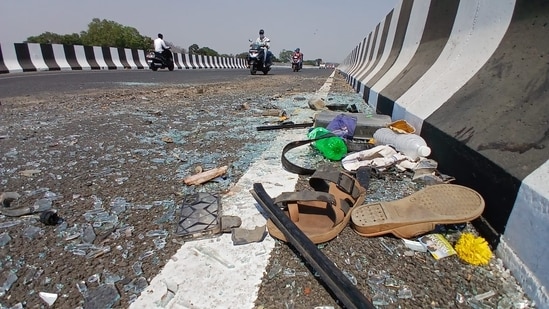
A devastating collision between a passenger van and a heavy-duty cement mixer claimed the lives of 11 individuals in Maharashtra’s Thane district on Monday morning, April 13, 2026. The fatal crash occurred at approximately **11:15 am on the Panjar bridge** along the busy Kalyan-Murbad road. Preliminary investigations by local authorities indicate that the heavy construction vehicle collided head-on with a Maruti Suzuki Eeco van, completely crushing the smaller passenger vehicle. Emergency responders immediately launched rescue operations, but the severity of the impact left no survivors among the van’s occupants. This tragic incident has reignited urgent debates regarding highway safety, the regulation of commercial heavy vehicles, and infrastructural deficits in rapidly urbanizing corridors. [Source: Hindustan Times].
## The Incident on Panjar Bridge
The tragedy unfolded late Monday morning, a period typically characterized by moderate to high commercial traffic on the Kalyan-Murbad arterial road. According to eyewitness accounts and initial police reports, the Maruti Suzuki Eeco van was ferrying passengers toward Murbad when the cement mixer, traveling in the opposite direction toward Kalyan, seemingly lost control while negotiating the approach to the Panjar bridge.
Due to the narrow carriage width of the bridge infrastructure, the heavy vehicle intruded into the oncoming lane. The resulting head-on collision was catastrophic. The structural integrity of the passenger van was severely compromised under the sheer weight and momentum of the fully loaded cement transit mixer.
Local police contingents from the Murbad rural jurisdiction, alongside district fire brigade units, arrived at the scene within 20 minutes of receiving distress calls. However, the specialized hydraulic cutting equipment—often referred to as the “Jaws of Life”—had to be deployed to extract the victims from the mangled wreckage. Medical personnel pronounced all 11 occupants of the van dead at the scene. The deceased included men, women, and reportedly minors, though official identification protocols are currently underway at the local government hospital. [Source: Hindustan Times | Additional: District Emergency Response Data].
## Emergency Response and Traffic Disruption
Following the collision, the Kalyan-Murbad road, a vital connective artery linking rural Thane to the Mumbai Metropolitan Region (MMR), witnessed massive vehicular gridlock spanning several kilometers. Authorities were forced to divert traffic through alternate village routes for over five hours while heavy recovery cranes were brought in to move the overturned cement mixer and the destroyed van.
First responders faced immense challenges during the extraction process. The Panjar bridge’s elevated structure and narrow shoulders meant that emergency vehicles had limited staging areas. Furthermore, spilled automotive fluids and wet cement debris on the tarmac required hazardous materials handling protocols to prevent secondary accidents or environmental contamination into the riverbed below.
The driver of the cement mixer reportedly sustained minor injuries and was taken into police custody after receiving primary medical aid. Authorities have registered a First Information Report (FIR) under relevant sections of the Indian Penal Code and the Motor Vehicles Act, citing death by negligence and rash driving. Blood samples have been drawn to determine if driving under the influence was a contributing factor.
## Infrastructure Under Scrutiny: The Kalyan-Murbad Corridor
The incident has sharply highlighted the glaring infrastructural deficiencies along the Kalyan-Murbad road. As the MMR continues to expand, areas like Murbad, Badlapur, and Titwala have seen exponential real estate and industrial growth. Consequently, the volume of heavy commercial vehicles—including dumper trucks, cement mixers, and multi-axle freight carriers—has surged dramatically over the past decade.
Despite this increased vehicular burden, infrastructure upgrades have lagged. The Panjar bridge, constructed decades ago, lacks critical modern safety features such as central reinforced crash barriers, adequate lane demarcation, and wider shoulder lanes for evasive maneuvers.
“The Kalyan-Murbad stretch is a classic example of urban sprawl outpacing infrastructure capacity,” notes Dr. Ramesh Gokhale, a senior traffic engineering consultant and professor at the Mumbai Institute of Road Safety. “We are forcing multi-ton construction vehicles to share narrow, undivided carriageways with light passenger vehicles and two-wheelers. On bridges like Panjar, there is zero margin for driver error. A slight deviation in steering, or a minor brake failure, instantly results in high-fatality head-on collisions.” [Source: Independent Traffic Safety Analysis].
## The Disparity in Vehicle Dynamics
To understand the mechanics of Monday’s tragic crash, automotive engineers point to the severe disparity in kinetic energy between the two vehicles. A fully loaded cement transit mixer can weigh upwards of **25,000 to 30,000 kilograms (25-30 metric tons)**. Furthermore, the rotating drum containing wet concrete constantly shifts the vehicle’s center of gravity, making it highly susceptible to tipping, body roll, and extended braking distances, especially on sloped bridge approaches.
In stark contrast, a Maruti Suzuki Eeco van has a gross vehicle weight of approximately **1,500 kilograms**. Often utilized as shared taxis in rural and peri-urban Maharashtra, these vehicles prioritize cost-efficiency and passenger capacity over heavy reinforced crumple zones designed to withstand commercial vehicle impacts.
**Key Automotive Safety Factors at Play:**
* **Kinetic Energy Transfer:** In a collision, the lighter vehicle absorbs almost the entirety of the kinetic energy, leading to catastrophic structural deformation.
* **Braking Distance:** Heavy commercial vehicles require up to three times the stopping distance of a standard passenger vehicle.
* **Center of Gravity:** The top-heavy nature of cement mixers limits a driver’s ability to execute sudden evasive maneuvers without rolling over.
* **Blind Spots:** Commercial trucks possess extensive blind spots (No-Zones), complicating navigation on narrow two-lane bridges.
## Regulatory Gaps and Heavy Vehicle Management
The Thane tragedy has brought the Regional Transport Office (RTO) and state traffic enforcement agencies under intense public scrutiny. Civic activists and local residents have long demanded stricter regulations regarding the movement of heavy construction vehicles during peak daytime hours.
Presently, while heavy vehicle entry is restricted in core municipal zones of Mumbai and Thane during rush hours, peri-urban and rural corridors like the Kalyan-Murbad road often function in a regulatory gray area. Fleet operators routinely bypass highway toll plazas, utilizing these narrow state highways to transport construction materials to booming real estate sites in the district’s hinterlands.
Advocate Meera Deshmukh, a prominent road safety litigator based in Mumbai, commented on the systemic failures: “We are seeing a disturbing pattern of heavy commercial vehicle accidents across Maharashtra. It is not merely driver negligence; it is an administrative failure. There is a lack of rigorous fitness testing for these commercial vehicles, rampant overloading, and exhausted drivers operating on double shifts. Until fleet owners are held criminally liable for the maintenance of their vehicles and the working conditions of their drivers, the death toll will continue to rise.”
### Recent Heavy Vehicle Collisions in Maharashtra (2025-2026)
To contextualize the severity of the issue, the state has witnessed several similar high-fatality incidents involving heavy commercial vehicles over the past year:
| Date | Location | Incident Type | Fatalities |
| :— | :— | :— | :— |
| **Apr 2026** | **Thane (Panjar Bridge)** | **Cement Mixer vs. Van** | **11** |
| Feb 2026 | Pune-Solapur Highway | Container Truck vs. Bus | 8 |
| Nov 2025 | Mumbai-Nashik Expressway | Dumper Truck vs. SUV | 6 |
| Aug 2025 | Raigad (Mumbai-Goa Highway) | Chemical Tanker Rollover | 5 |
*Data sourced from Maharashtra State Traffic Police accident archives.*
## Government Response and Ex-Gratia Compensation
In the aftermath of the crash, the political response was swift. The Chief Minister of Maharashtra expressed profound grief over the loss of lives on social media, describing the accident on the Panjar bridge as “heart-wrenching.”
The state government has announced an ex-gratia compensation of ₹5 lakh for the next of kin of each deceased victim, drawing from the Chief Minister’s Relief Fund. Additionally, the district administration has been directed to cover all medical expenses for any secondary victims and manage the logistical requirements for the grieving families.
Beyond financial compensation, the state’s Public Works Department (PWD) and the Highway Traffic Police have been instructed to conduct an immediate joint safety audit of the Kalyan-Murbad road. Authorities are expected to submit a comprehensive report within 15 days, identifying “black spots” (accident-prone zones) and recommending immediate short-term mitigations, such as installing speed-breakers, rumble strips, and heavy-vehicle warning signage before bridge approaches.
## Broader Implications for Road Safety in India
This devastating incident in Thane is a microcosm of a much larger national crisis. According to the Ministry of Road Transport and Highways (MoRTH), India continues to account for over 10% of global road crash fatalities, despite having only 1% of the world’s vehicular population. Accidents involving multi-axle commercial vehicles and passenger transport frequently result in the highest casualty rates per incident.
To combat this, the central government has been pushing for the implementation of Advanced Driver Assistance Systems (ADAS) and autonomous emergency braking in heavy commercial vehicles. However, the retrofitting of such technologies on older, localized construction fleets like cement mixers remains economically unfeasible for many operators without heavy government subsidies.
Furthermore, the focus must shift from post-crash response to preventative infrastructure design. The concept of “Forgiving Roads”—infrastructure engineered to minimize the consequences of driver error—must be prioritized in regional planning. This includes the mandatory widening of two-lane bridges, the installation of median crash barriers, and the construction of dedicated freight corridors to segregate heavy construction traffic from daily commuter routes.
## Conclusion
The loss of 11 lives on the Panjar bridge is a grim reminder of the lethal intersection between inadequate infrastructure, heavy commercial traffic, and light passenger vehicles. While immediate investigations will likely focus on the mechanical fitness of the cement mixer and the actions of its driver, the broader culpability lies within a systemic failure to safely manage rural-urban transit corridors in Maharashtra’s booming districts.
Moving forward, swift administrative action is imperative. The immediate implementation of heavy-vehicle curfews during peak passenger hours, rigorous structural audits of aging bridges along the Kalyan-Murbad road, and uncompromising enforcement of commercial driver safety protocols are essential steps. Without sweeping infrastructural and regulatory reforms, these crucial connecting roads will continue to pose a grave threat to the lives of daily commuters. As authorities piece together the final moments of this fatal collision, the community mourns a preventable tragedy that has irrevocably shattered 11 families.