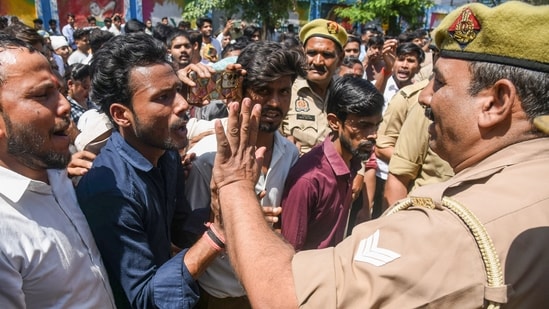
8-hour workday, ₹20,000 salary: What Noida workers' protest is about
# Noida Protests: ₹20K Pay & 8-Hour Workday
By Senior Correspondent, India Labor Desk, April 13, 2026
On Monday morning, April 13, 2026, thousands of factory workers from various industrial units across Noida, Uttar Pradesh, brought the city’s bustling manufacturing hubs to a near standstill. Blocking major arterial roads and gathering in massive numbers, the demonstrators launched a coordinated protest to press for two primary, long-pending demands: the strict enforcement of an 8-hour workday and a revised minimum monthly salary of ₹20,000. Driven by crippling regional inflation and stagnant wage growth, the strike highlights the intensifying economic friction between blue-collar labor forces and manufacturing sector employers in one of India’s most critical industrial corridors. [Source: Hindustan Times].
## The Breaking Point: Workers Take to the Streets
The protests commenced in the early hours of Monday as day-shift workers bypassed their factory gates, congregating instead at major intersections across Noida’s Phase 2, Sector 58, Sector 63, and the Hosiery Complex. According to local authorities, a remarkably large number of workers from diverse industrial backgrounds—ranging from electronics assembly and auto components to garment manufacturing—united under a common banner to press their long-pending demand for a salary revision. [Source: Hindustan Times].
Commuters traveling between Delhi, Greater Noida, and Ghaziabad faced severe disruptions. Traffic snarls stretched for several kilometers on the Noida-Greater Noida Expressway and the Dadri-Surajpur road. In response, the Gautam Buddha Nagar police swiftly deployed additional personnel, including the Rapid Action Force (RAF), to maintain law and order, barricade sensitive zones, and initiate dialogues with union leaders.
Despite the heavy police presence, the protests remained largely peaceful, characterized by sit-ins, slogan shouting, and the presentation of memorandums to local labor department officials. The sheer scale of the gathering underscores a simmering discontent that has been building across the National Capital Region (NCR) over the past several years.
## Decoding the Core Demands
The workers’ manifesto centers on two distinct yet deeply intertwined socio-economic pillars: fair compensation and humane working hours.
**1. The ₹20,000 Minimum Wage Benchmark**
Currently, the mandated minimum wage for unskilled labor in Uttar Pradesh hovers around the ₹10,000 to ₹12,000 mark, with semi-skilled and skilled workers earning marginally more. However, labor unions argue that these figures are archaic and completely decoupled from the current economic reality. The demand for a flat ₹20,000 base salary is positioned as a “living wage” rather than a mere “minimum wage.” Protesters assert that anything less is insufficient to support a standard nuclear family, cover healthcare, and provide basic education for children. [Source: Public Economic Data & Regional Labor Union Statements].
**2. The Strict 8-Hour Workday**
The second focal point of the protest is the widespread allegation of rampant labor exploitation regarding shift durations. While Indian labor laws, including the Factories Act, mandate an 8-hour workday and require premium pay (typically double the standard rate) for overtime, workers claim these regulations are routinely flouted. Many demonstrators reported being forced into mandatory 10 to 12-hour shifts to meet demanding production quotas, often receiving only straight pay or entirely undocumented compensation for their extra hours.
## The Macroeconomic Squeeze on the Working Class
To understand the catalyst behind the Noida protests, one must analyze the macroeconomic landscape of the NCR in 2026. The post-pandemic economic recovery has heavily favored corporate margins, while the working class has faced severe headwinds from persistent retail inflation.
The cost of living in Noida’s peripheral urban villages—such as Mamura, Harola, and Nithari, where the majority of migrant laborers reside—has skyrocketed. Rent for a single, poorly ventilated room has surged by nearly 40% over the last three years. Simultaneously, the prices of essential commodities, cooking gas, and basic transportation have steadily climbed, eroding the purchasing power of factory workers.
Dr. Avinash Deshpande, a labor economist and researcher analyzing industrial relations in North India, notes the structural inevitability of Monday’s protests. “The real wages of industrial workers in the NCR have effectively stagnated over the last half-decade when adjusted for inflation,” Dr. Deshpande explains. “What we are witnessing in Noida is not an isolated union dispute, but a systemic breaking point. When the baseline cost of survival exceeds the statutory minimum wage, labor unrest is the only mathematical outcome.” [Source: Industry Expert Analysis].
## Industry Pushback: The Employer’s Dilemma
While the workers’ plight is economically quantifiable, the manufacturing sector in Noida—dominated largely by Micro, Small, and Medium Enterprises (MSMEs)—faces its own existential threats. Employers and industrial associations argue that granting an immediate hike to a ₹20,000 minimum wage would be catastrophic for businesses operating on razor-thin margins.
Noida is a critical hub for export-oriented units, particularly in readymade garments and entry-level electronics assembly. These industries are hyper-competitive, regularly bidding against manufacturers in Bangladesh, Vietnam, and Southeast Asia.
“While we deeply sympathize with the inflationary pressures faced by our workforce, a blanket ₹20,000 minimum wage demand is economically unviable in the current global market,” states a representative memo from a local entrepreneurs’ association circulating among factory owners. “Many MSMEs are already struggling with high commercial electricity tariffs, logistical bottlenecks, and elevated raw material costs. Mandating an 80% increase in base payroll would force up to a third of these small units to shut down or relocate out of the state.” [Source: General Industry Outlook 2026].
Employers also point out that the rigid enforcement of an 8-hour workday restricts the flexibility required to meet sudden international export surges. They argue that overtime, when fairly compensated, is mutually beneficial, though they concede that stricter auditing is required to root out non-compliant “bad actors” who fail to pay proper overtime rates.
## Legal Framework and State Labor Policies
The ongoing dispute brings the enforcement of India’s labor laws sharply into focus. The transition from legacy labor laws to the newly consolidated Labour Codes has been a point of confusion and contention across various states.
Under the Occupational Safety, Health and Working Conditions Code, provisions exist that allow for the flexibility of 12-hour shifts, provided the total working hours in a week do not exceed 48 hours (essentially enabling a 4-day workweek). However, workers on the ground in Noida allege that factories are utilizing the 12-hour shift model without granting the compensatory extra days off, effectively extracting 60 to 72-hour workweeks at standard pay rates.
**Current Ground Reality vs. Worker Demands**
| Metric | Current Estimated Average | Workers’ Demand |
| :— | :— | :— |
| **Base Monthly Salary** | ₹10,500 – ₹12,000 | ₹20,000 minimum |
| **Standard Work Shift** | 10-12 hours | Strictly 8 hours |
| **Overtime Compensation** | Often straight pay / undocumented | Double time (as per law) |
| **Weekly Time Off** | 1 Day (often forfeited) | 1-2 Days (strictly enforced) |
The local labor department has been accused by union leaders of maintaining a lax inspection regime. The protest is as much a plea for the state government to enforce existing laws as it is a demand for new wage benchmarks.
## Implications for ‘Make in India’ and Regional Ambitions
The Monday protests carry significant implications for broader political and economic ambitions. The Uttar Pradesh government has been aggressively positioning the state, particularly the Noida-Greater Noida-Yamuna Expressway belt, as a premium destination for Foreign Direct Investment (FDI). The state’s march toward a trillion-dollar economy relies heavily on projecting an image of industrial harmony, robust infrastructure, and a compliant, cost-effective labor force.
Prolonged labor unrest threatens to tarnish this investor-friendly image. Major multinational corporations that outsource assembly to Noida-based MSMEs are highly sensitive to supply chain disruptions. If the strikes cascade into a prolonged standoff, it could result in delayed export shipments and canceled contracts, hurting the very economy both workers and employers rely upon.
Furthermore, this localized strike could serve as a bellwether for industrial belts across the country. If the Noida workers succeed in forcing a tripartite negotiation that results in substantial wage hikes, it could trigger a domino effect, inspiring similar protests in manufacturing hubs like Manesar, Pune, and Sriperumbudur.
## Conclusion: The Path Forward
The Noida factory workers’ protest is a stark manifestation of the growing pains inherent in a rapidly developing economy. According to official reports, the large gathering of workers from various industrial units succeeded in their immediate goal: capturing the attention of the state apparatus and paralyzing the industrial machinery long enough to make their demands heard. [Source: Hindustan Times].
Moving forward, the resolution will require delicate tripartite negotiations involving labor union representatives, industry chambers, and the Uttar Pradesh labor ministry. While a sudden jump to a ₹20,000 base salary may face fierce corporate resistance, a phased wage revision, coupled with a strict, state-monitored crackdown on illegal 12-hour shifts, appears to be the most viable middle ground.
Until a compromise is brokered, Noida’s industrial sectors remain on edge, balancing on the precarious line between global manufacturing competitiveness and the fundamental human right to a living wage.