
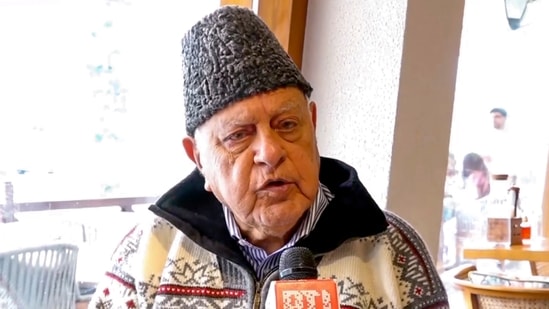
'Thought it was a firecracker': Farooq Abdullah on failed assassination attempt| India News
Farooq Abdullah’s Unheard Danger A Leader’s Startling Recollection
In the volatile landscape of Kashmiri politics, where public life often intertwines with profound personal peril, a recent candid recollection from veteran leader Farooq Abdullah has brought a chilling past incident back into sharp focus. The former Chief Minister of Jammu and Kashmir, a figure synonymous with the region’s complex narrative, recently shared an astonishing detail about a specific moment when his life was under direct threat: he was completely unaware a gun had been fired at him at that very instant.
This revelation from a leader who has navigated decades of political turbulence, including periods of intense insurgency, casts a poignant light on the psychological realities faced by those at the forefront of public service in conflict zones. It underscores not just the physical danger, but also the mind’s often delayed processing of extreme events.
The incident Dr. Abdullah referred to, according to various regional reports and historical accounts, pertains to an attempt on his life in 1990. During a particularly fraught period marked by heightened militant activity, his motorcade was targeted near the picturesque Nishat Garden in Srinagar. The area, usually a serene spot, became the backdrop for a sudden burst of gunfire aimed directly at his vehicle.
What Dr. Abdullah’s recent statement illuminates is his immediate sensory experience of that harrowing moment. He recounted believing the loud bangs were merely firecrackers or perhaps a tire bursting, a common sound in bustling environments, rather than the ominous crack of bullets. This unawareness, he explained, persisted until he was later informed of the true nature of the event by his security detail or aides. The stark reality of a direct attack, initially masked by the chaos and his mind’s swift attempt to normalize an abnormal sound, only registered retrospectively.
For Omni 360 News, this recollection serves as more than just a historical anecdote; it’s a powerful human story about leadership under duress. It highlights the peculiar dissociation that can occur during moments of extreme stress, where the mind, perhaps as a protective mechanism, fails to immediately grasp the full scope of an existential threat. This isn’t just about a political figure; it’s about the human reaction to sudden, life-threatening danger, amplified by the constant shadow of insecurity that has often loomed over leaders in Jammu and Kashmir.
Understanding this incident requires a brief journey back to the political climate of 1990. Jammu and Kashmir was in the throes of escalating militancy, marked by frequent attacks on political figures, security forces, and civilians. Dr. Abdullah, as the then Chief Minister and a prominent voice from the National Conference, was a significant target. His life has been punctuated by numerous threats, yet this specific incident underscores a profound personal dimension—the gap between experiencing an event and fully comprehending its lethal intent.
The layered implications of Dr. Abdullah’s memory are profound. Firstly, it offers a rare glimpse into the personal cost of political leadership in challenging environments. Beyond the policy debates and public appearances, there exists a constant, underlying tension. Secondly, it speaks to the effectiveness, or sometimes the sheer luck, of security arrangements. Even with highly trained personnel, the suddenness and unpredictability of such attacks mean that leaders themselves might not immediately register the grave peril. This incident certainly led to an overhaul of security protocols for VIPs in the region, focusing not just on deterrence but also on immediate, clear communication during an attack.
From a journalistic standpoint, such a revelation compels us to consider the burden of memory and trauma. Decades later, the vividness of this specific recollection suggests its lasting impact, even if the immediate experience was one of detachment. It reminds us that even seasoned politicians, often perceived as stoic and unflappable, are fundamentally human, susceptible to shock and the complex workings of memory.
For search engine visibility, articles discussing Farooq Abdullah, historical security incidents in Kashmir, and the psychological aspects of political threats are highly relevant. This piece, through its focus on a specific, humanizing detail, provides unique content that adds depth to the understanding of a prominent political journey. It connects a personal account with broader themes of regional security, leadership resilience, and the often-unseen realities behind public figures.
Key Takeaways:
* Farooq Abdullah’s recent revelation highlights his initial unawareness during a 1990 gun attack on his motorcade near Nishat Garden, Srinagar.
* He initially mistook the gunfire for firecrackers or a tire burst, only grasping the true danger later.
* This candid recollection offers insight into the psychological impact of living under constant threat and the mind’s protective mechanisms during extreme stress.
* The incident underscores the intense security challenges faced by political leaders in volatile regions like Jammu and Kashmir.
* It serves as a powerful human story, reminding us that even seasoned public figures experience profound personal dimensions to their political lives.
* The incident’s delayed realization prompted reflections on security protocols and leadership resilience in the face of unseen danger.





