
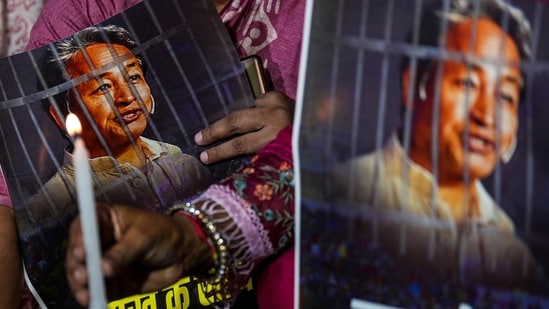
Govt decides to revoke Sonam Wangchuk's detention months after Leh protests| India News
Ladakh’s Voice Sonam Wangchuk Jailed After Leh Unrest NSA Explained Key Takeaways Omni 360 News
In a development drawing significant national attention, renowned climate activist and education reformer Sonam Wangchuk now finds himself detained in Rajasthan’s Jodhpur jail. This detention, carried out under the stringent National Security Act (NSA), comes in the aftermath of violent protests that gripped Leh last September. The incident has ignited widespread debate about the delicate balance between public order, freedom of expression, and the state’s response to regional dissent in India’s sensitive Himalayan frontier.
The Advocate for Ladakh’s Future
Sonam Wangchuk is a name that resonates far beyond the cold deserts of Ladakh. Widely recognized as an inspiring educationist and environmentalist, his pioneering work through the Students’ Educational and Cultural Movement of Ladakh (SECMOL) has transformed educational paradigms in the region. Often dubbed “the real-life Phunsukh Wangdu” – a reference to the character in the popular film “3 Idiots” inspired by him – Wangchuk has dedicated his life to innovative learning and sustainable living.
Beyond his educational endeavors, Wangchuk has emerged as a prominent voice for Ladakh’s unique ecological and cultural heritage. His advocacy efforts have increasingly focused on securing constitutional safeguards for the region, notably demanding its inclusion under the Sixth Schedule of the Indian Constitution. This provision, he argues, is not merely a political demand but a vital necessity for the environmental preservation of Ladakh’s fragile ecosystem and the protection of its indigenous communities’ rights and distinct identity.
Understanding the Leh Protests of Last September
The unrest in Leh last September was not an isolated event but the culmination of deep-seated aspirations and anxieties among Ladakhi residents. The region’s demands for statehood and the implementation of the Sixth Schedule have gained momentum since August 2019, when the erstwhile state of Jammu and Kashmir was bifurcated, and Ladakh was designated a Union Territory (UT) without a legislative assembly.
While some initially welcomed UT status, hopes for greater autonomy quickly turned to concerns over the lack of democratic representation and the potential for unchecked exploitation of Ladakh’s pristine environment. Local communities feared that without the protective layers of an elected body and the Sixth Schedule, their land, resources, and unique culture would be vulnerable to external industrial projects and unregulated tourism, irrevocably altering their way of life.
The protests, initially characterized by peaceful demonstrations, rallies, and public dialogues led by various groups including the Leh Apex Body (LAB) and Kargil Democratic Alliance (KDA), sought to draw the central government’s attention to these demands. However, as frustrations mounted and official responses were perceived as inadequate, some demonstrations reportedly escalated into confrontations, which authorities subsequently described as violent. These incidents led to arrests and the eventual invocation of stringent laws against individuals deemed responsible for inciting or participating in the unrest.
The National Security Act Explained
At the heart of the current situation lies the National Security Act (NSA) of 1980. This formidable piece of legislation grants the government extensive powers to detain individuals without charge for a period of up to 12 months. The stated purpose of the NSA is to prevent any person from acting in a manner prejudicial to the defense of India, the security of India, or the maintenance of public order. It is fundamentally a preventive detention law, meaning an individual can be held to prevent them from committing future offenses, rather than punishing them for past ones.
The NSA differs significantly from ordinary criminal laws, as it allows for administrative detention without the immediate necessity of filing a First Information Report (FIR) or producing the accused before a magistrate within 24 hours. While a review committee is mandated to examine detention orders, critics argue that the law is often misused, serving as a potent tool to curtail civil liberties and suppress dissent, particularly in politically sensitive regions or during periods of heightened social unrest. Its invocation against activists and public figures frequently raises questions about due process and the safeguarding of fundamental rights.
The Detention in Jodhpur
Sonam Wangchuk’s detention and subsequent transfer to Jodhpur jail have sent ripples of concern through activist circles and within Ladakh itself. Authorities have explicitly linked his activism and influence to the events of last September, arguing that his actions or speeches contributed to the volatile atmosphere that characterized parts of the Leh protests. While the precise grounds for his NSA detention remain under scrutiny and subject to legal challenge, the connection drawn by officials is that his continued advocacy, directly or indirectly, incited actions deemed disruptive to public order following the Leh events.
For his supporters and many in Ladakh, Wangchuk’s detention is viewed as an attempt to silence a powerful and credible voice articulating the region’s deepest aspirations. They emphasize his long-standing commitment to non-violent forms of protest, often involving hunger strikes and public awareness campaigns, questioning the necessity and appropriateness of invoking such a stringent law against an individual known for peaceful, constructive activism.
Reactions and Broader Implications
The news of Wangchuk’s detention has evoked strong reactions across various segments of society. Local media outlets and community leaders in Ladakh have expressed dismay and solidarity, describing it as an unprecedented move against a beloved figure. Human rights organizations and civil liberties advocates have also voiced concerns, highlighting the critical need for transparent justification and robust due process whenever the NSA is invoked, particularly against individuals with a track record of peaceful advocacy.
Legal experts have weighed in, underscoring the importance of judicial oversight in such cases to prevent potential abuses of power. The detention sparks a crucial debate about the space for dissent in a democracy and the methods employed by the state to manage public grievances. It raises questions about whether the actions taken genuinely serve to maintain public order or inadvertently escalate tensions by perceived heavy-handedness.
Ladakh’s Enduring Demands
The demand for the Sixth Schedule for Ladakh is far from merely an administrative adjustment; it represents a fight for the very survival of Ladakh’s unique identity and ecology. This constitutional provision aims to safeguard tribal populations by granting them significant autonomy over land, forest management, cultural practices, and local governance. For Ladakhis, securing this status is seen as the primary mechanism to protect their ancestral lands from unchecked development, preserve their distinct Buddhist and other cultural traditions, and empower local communities to chart their own sustainable future. They fear that without these protections, their fragile, high-altitude ecosystem, already under significant stress from climate change, will face irreversible damage from unregulated tourism and industrial projects.
Key Takeaways Omni 360 News
* The detention of Sonam Wangchuk under the National Security Act after the Leh protests marks a significant escalation in the state’s handling of dissent in Ladakh.
* It underscores the ongoing tensions between regional aspirations for constitutional safeguards and self-determination, and the central government’s approach to maintaining public order.
* The invocation of the NSA against a prominent, non-violent activist prompts renewed debate on civil liberties, the right to protest peacefully, and the balance between national security and freedom of expression.
* For Ladakh, the incident amplifies the urgent calls for constitutional safeguards, particularly the Sixth Schedule, to protect its fragile environment and distinct cultural identity.
As Sonam Wangchuk remains lodged in Jodhpur, the situation continues to evolve. His detention has become a focal point, not just for environmental and social activists but for all those observing the evolving landscape of governance and protest in India’s remote Himalayan regions. The coming months will undoubtedly witness continued legal challenges, public discourse, and calls for a resolution that addresses both the concerns of the state and the fundamental rights and aspirations of the people of Ladakh.





