
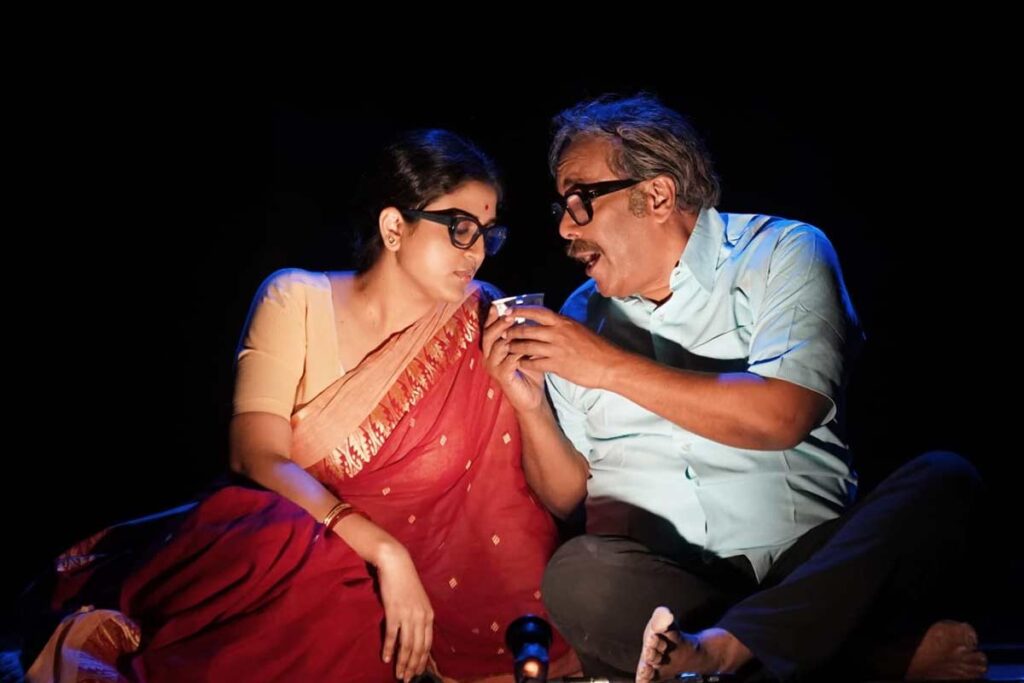
Review of the bengali play based on poet Shakti Chattopadhyay
For decades, the name Shakti Chattopadhyay has echoed through Bengali literary circles, often hailed as the most significant poet after Jibanananda Das. His remarkable command over the Bengali language earned the deep respect of contemporaries, including the celebrated Sunil Gangopadhyay. Chattopadhyay, however, was more than just a poet of profound verse; he was a legend, a bohemian spirit, a wanderer with an insatiable zest for life and an unyielding attachment to poetry and camaraderie. Stories abound of his spontaneous journeys, like stepping out for groceries and ending up in remote bungalows in places like Dhalbhumgarh or Hesadi, momentarily forgetting his family back home, drawn by the irresistible pull of friends, nature, and the Muse. Such a life, so rich in paradox and passion, presents an immense challenge for any dramatic portrayal.
Yet, playwright Ujjwal Chattopadhyay has bravely taken on this formidable task, bringing the enigmatic life of Shakti Chattopadhyay to the stage in the play ‘A-Shakti’. This production, recently showcased at the Purba-Paschim (East-West) theatre festival, endeavors to peel back the layers of a poet whose existence defied convention and whose verse continues to captivate generations. At Omni 360 News, we delve into how this unique stage production illuminates the soul of a Bengali icon.
Unveiling the Poet’s Journey
‘A-Shakti’ does not merely recount the day-to-day happenings of Chattopadhyay’s life. Instead, Ujjwal Chattopadhyay’s narrative transcends the superficial, venturing into the core of the poet’s philosophical underpinnings, his raw emotions, and his unwavering love for poetry. The play traces Shakti’s transformative journey from his humble beginnings in Baharu village to the bustling, intoxicating embrace of Kolkata. It artfully illustrates how the city’s vibrant life, its intellectual ‘addas’ (gatherings), and perhaps even its ‘water and wine’, became integral to the unique texture and evolution of his poetic voice.
The playwright carefully weaves in Chattopadhyay’s interactions with his illustrious circle of friends—Sunil Gangopadhyay, Sandipan Chattopadhyay, Tarapada Ray, Prithwish Neogy—as well as his personal relationships, including his wife Minakshi and companion Swati. Crucially, the play also gives significant space to the poet’s internal struggles and dilemmas, presenting a comprehensive portrait that moves beyond the popular image of a mere ‘mad poet’. It respects his rage, his grievances, and the deep love that underpinned his seemingly reckless existence.
Innovative Stagecraft and Vision
Director Debashish has brought Ujjwal Chattopadhyay’s poignant script to life with remarkable ingenuity, employing what can be described as ‘plastic imagery’ to enhance the narrative’s flow. The Academy stage is thoughtfully divided into three distinct zones, each symbolizing a crucial aspect of Shakti’s world. One zone represents the humble home life of Shakti and Minakshi, with its simple door and window. Another transports the audience to the bustling heart of central Kolkata, featuring its iconic bar-duaris (pubs) and the legendary coffee houses where intellectual debates and artistic camaraderie thrived. This dynamic staging allows for seamless transitions between the poet’s domestic reality, his bohemian escapades, and his contemplative moments.
A particularly striking aspect of the play is the personification of both Kolkata city and Baharu village as living characters. Partha Bhaumik, in his role as Kolkata, acts as a captivating narrator, guiding the audience through Shakti’s journey and connecting various narrative threads. His portrayal of a young Shakti being irresistibly drawn to the metropolis is both beautiful and fluid. Similarly, Aroopratan Ganguly embodies Baharu, appearing at critical junctures to remind Shakti, and the audience, of the village memories he carried within him. This creative choice adds a profound layer of connection to the poet’s roots and his adopted urban landscape.
Masterful Performances
The ensemble cast delivers compelling performances, breathing life into the various figures who shaped Shakti’s world. Notable among these are Kaushik Pradhan as Sunil, Ipshita Gangopadhyay as Swati, Amit Deb as Sandipan, Monojit Das as Prithwish, and Chandanbikash as Tarapada. Soumitra Mitra’s sincere portrayal of editor Sagarmoh Ghosh, visiting Minakshi and sharing a heartfelt conversation, stands out, highlighting a moment of genuine human connection and the editor’s compassionate nature. The gifted voice of Dipen Bhattacharya, who also plays the grandfather, adds another dimension to the musical elements of the play. Ananya’s portrayal of Minakshi, Shakti’s wife, has been particularly lauded, capturing her strength and pathos with remarkable depth.
At the heart of ‘A-Shakti’ is Debshankar Halder’s central performance as Shakti Chattopadhyay. While there might not be an obvious physical resemblance to the poet, Halder dives deep into the character’s psyche, striving to embody Shakti’s inner torment, his dilemmas, and his unique ability to reconcile imagination with the mundane realities of life. Initially, some found his depiction of Shakti’s inner self in the first half to be somewhat subdued. However, in the second act, Halder fully immerses himself, becoming one with the poet’s spirit. A particularly moving moment unfolds when, after his stage ‘death’, Shakti’s voice echoes with a line from his own poetry addressed to Minakshi: “Tomar Kore Tomake Kobhoo Bhabini. Jogote Donhe Eka. Aar To Holo Na Dekha Chirodin Chharachhari.” (“Never thought of you as mine. Both alone in the world. And never met again, separated forever.”) This poignant utterance beautifully conveys the paradox of his loving yet detached spirit, solidifying his portrayal as a truly complex and unforgettable character.
A Resonant Tribute
For those who knew Shakti Chattopadhyay personally, some aspects of his inner life depicted on stage might feel somewhat arranged. However, both Ujjwal Chattopadhyay and director Debashish intentionally focused on the poet’s eternal humanity and his philosophical depth. They celebrated his uncompromising spirit to live life entirely on his own terms, even amidst his apparent bohemianism. The play is not just a recounting of events; it is a profound exploration of a poet who chose freedom over convention, and whose philosophy continues to resonate. The final scene, where the character of Kolkata proclaims, “Ayut Niyut Koti Koti Podya Gaye Mekhe Fire Asbe…” (Countless poems will return adorned on the body…), evokes a heartbreaking sense of Shakti’s final, solitary moments, emphasizing the enduring power of his verse.
‘A-Shakti’ by Purba-Paschim stands as a deeply respectful and masterful tribute to one of contemporary Bengali poetry’s most significant figures. It confirms director Debashish’s skill in weaving together a compelling narrative that is both faithful to its subject and universally resonant. This production is a testament to the enduring legacy of Shakti Chattopadhyay, ensuring his spirit continues to inspire through the powerful medium of theatre.
Key Takeaways
- The play ‘A-Shakti’ offers a profound theatrical exploration of Bengali poet Shakti Chattopadhyay’s bohemian life and philosophical depth.
- Playwright Ujjwal Chattopadhyay and director Debashish skillfully navigate the complexities of Chattopadhyay’s journey, from his village roots to his influential time in Kolkata.
- Innovative staging, including personified characters for Kolkata and Baharu, enhances the narrative’s emotional and historical impact.
- Debshankar Halder delivers a powerful central performance as Shakti, capturing his internal conflicts and enduring poetic spirit.
- The production stands as a significant and heartfelt tribute to one of modern Bengali poetry’s most iconic and unconventional voices.





