
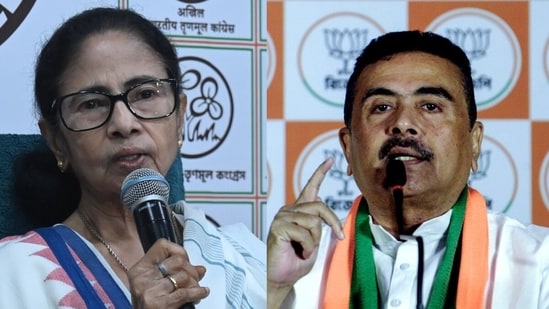
Mamata Banerjee, Suvendu Adhikari to face-off once again in 2026 West Bengal polls as TMC names 291 candidates| India News
Mamata Banerjee Sets Ambitious Election Goal in West Bengal
West Bengal’s political arena is once again buzzing with anticipation following a bold declaration from the Trinamool Congress (TMC) supremo and Chief Minister, Mamata Banerjee. In a recent address that resonated across the state, the seasoned leader exuded unwavering confidence, predicting that her party would secure a remarkable victory, crossing the 226-seat mark in the upcoming assembly elections. This pronouncement has set the stage for what promises to be a fiercely contested electoral battle, inviting analysis from political observers and ordinary citizens alike.
The chief minister’s assertion is not merely a passing comment; it is a clear statement of intent, aiming to galvanize her party’s cadre and signal strength to the electorate. For a clearer picture, West Bengal’s legislative assembly comprises 294 seats. To form a government, a party or coalition needs to win at least 148 seats, which is the simple majority. Mamata Banerjee’s target of 226 seats significantly surpasses this threshold, indicating her ambition for a supermajority, much like the party achieved in previous elections. This level of confidence stems from a deep understanding of the state’s political pulse, honed over decades of grassroots engagement and electoral contests.
Behind this confident projection lies the TMC’s calculated strategy and its deep roots in the state. The party has consistently focused on a robust welfare agenda, often championed as “Duare Sarkar” (government at your doorstep) and schemes like “Lakshmir Bhandar” which provides financial assistance to women, along with numerous other initiatives aimed at various sections of society, from farmers to students. These programs have been meticulously implemented, attempting to build a strong beneficiary base that the party hopes will translate into votes. Local reports often highlight how these schemes, rather than national narratives, often drive conversations at the village level, influencing voter sentiment. The party’s extensive organizational structure, reaching down to booth levels, is also seen as a crucial asset, ensuring effective communication and mobilization of supporters.
However, the path to 226 seats is fraught with challenges. While the TMC’s welfare schemes have garnered significant support, the opposition parties, primarily the Bharatiya Janata Party (BJP) and the Left-Congress alliance, are not standing idle. The BJP, having emerged as the principal opposition in the last assembly elections, has been relentlessly campaigning, raising issues concerning alleged corruption, law and order, and local governance. Their strategy often involves appealing to nationalistic sentiments alongside highlighting perceived failures of the state government. Local news outlets have frequently reported on the BJP’s efforts to consolidate votes in specific regions, particularly in north Bengal and certain tribal belts where they have seen increasing traction.
The Left Front and Congress, though diminished in recent years, are also striving to regain their lost ground. Their alliance aims to present an alternative narrative, focusing on issues like unemployment, industrial stagnation, and the protection of democratic rights, aspects that often resonate with sections of the intelligentsia and the working class. Ground reports suggest that while their presence might not be as widespread as TMC or BJP, they still hold pockets of influence and can act as disruptors in closely contested constituencies. The complexity of West Bengal’s electoral landscape means that even a small shift in votes can have a significant impact on the final outcome in many constituencies.
Historically, West Bengal has witnessed shifts in political power, from decades of Left rule to the current dominance of the TMC. Every election brings its unique set of dynamics, influenced by local grievances, community affiliations, and the performance of incumbent governments. Anti-incumbency, while always a factor, can sometimes be countered by strong leadership and effective party machinery, as the TMC hopes to demonstrate. The forthcoming elections will not just be about the charisma of individual leaders but also about the ability of parties to connect with the everyday concerns of the populace. Omni 360 News will continue to provide comprehensive coverage of these evolving dynamics.
The voter’s viewpoint remains the ultimate decider. Discussions among ordinary citizens often revolve around the delivery of services, economic opportunities, the fairness of local administration, and the ability of their elected representatives to address immediate problems. While a chief minister’s confidence sets the tone, the actual mandate will be shaped by thousands of localized factors, individual candidate strengths, and the last-minute campaign blitzes that characterize Indian elections.
Key Takeaways:
1. Ambitious Target: Mamata Banerjee’s prediction of over 226 seats signals high confidence for a supermajority.
2. Welfare-Driven Strategy: TMC relies heavily on its popular welfare schemes and strong grassroots organization.
3. Vigorous Opposition: BJP and the Left-Congress alliance are actively challenging TMC, focusing on governance and alternative narratives.
4. Complex Electoral Landscape: The election outcome will hinge on a myriad of factors, from local issues to voter sentiment, making the contest unpredictable despite the confident predictions.
Ultimately, Mamata Banerjee’s bold projection has undoubtedly energized her party, framing the upcoming elections as a battle not just for victory, but for a decisive mandate. The weeks and months ahead will reveal whether this confidence translates into electoral success, as West Bengal prepares for another chapter in its vibrant political history.





