
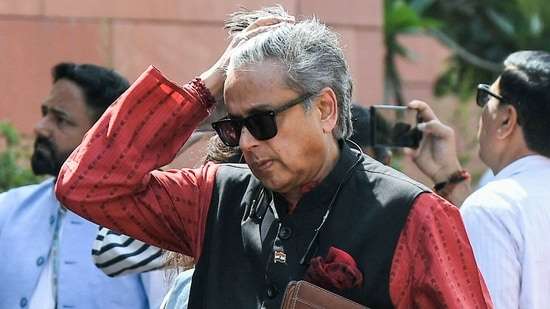
BJP amplifies Shashi Tharoor: What he said about India's stance on US-Iran war| India News
Political Currents Ripple as Shashi Tharoor’s West Asia Comments Stir BJP Congress Debate
The delicate dance of India’s foreign policy found itself squarely in the domestic political spotlight recently, as veteran Congress leader Shashi Tharoor’s remarks advocating for India’s “restraint” in the complex West Asia situation drew sharp criticism from the ruling Bharatiya Janata Party (BJP). This swift political volley underscores the intricate balance between national diplomatic strategy and its perception on the home front, particularly when articulated by opposition voices. Omni 360 News delves into the nuanced layers of this unfolding debate.
At the heart of the controversy were comments made by Mr. Tharoor, widely known for his diplomatic background and eloquent articulation on global affairs. He emphasized India’s historical approach of strategic autonomy – a policy where India makes decisions based on its own national interests, without automatically siding with any major power bloc. In the context of West Asia, this often translates to maintaining good relations with all regional players and advocating for dialogue and de-escalation, rather than overtly supporting one side over another. This “restraint” is rooted in India’s long-standing non-aligned movement principles, which prioritize peace, stability, and safeguarding the interests of its vast diaspora in the region, as well as crucial energy imports.
For a 12th standard student trying to grasp this, imagine India as a wise older sibling in a playground dispute. Instead of yelling and picking a side, the older sibling (India) tries to talk to everyone, calm things down, and ensure no one gets hurt, especially those who rely on them (like Indian citizens working in West Asia or the oil we need). This approach, Tharoor suggested, is crucial for India to maintain its credibility as a potential mediator and to protect its economic and strategic ties across the board.
The BJP, however, wasted no time in seizing upon these comments, portraying them as undermining India’s current foreign policy and implicitly questioning the government’s approach to a sensitive geopolitical region. BJP spokespersons and local leaders swiftly launched an offensive, suggesting Tharoor’s views were out of sync with the national sentiment or even detrimental to India’s standing. Their criticism often highlighted a perceived lack of unity on crucial international matters, painting the Congress party as inconsistent or weak on foreign policy. Statements circulating through regional news channels, for instance, quoted local BJP office-bearers questioning the timing and intent of such remarks, suggesting they could send a confusing signal internationally. The core of the BJP’s argument often revolves around projecting a strong, decisive image of India on the global stage, and any perceived deviation from this is quickly flagged as an opposition misstep.
The Congress party’s response to the BJP’s broadsides was a blend of defense and clarification. While some party members might have subtly distanced themselves from the individual phrasing, the broader party line seemed to uphold the spirit of Tharoor’s argument, emphasizing that India’s foreign policy has historically been about finding common ground and promoting peace. They contended that advocating for “restraint” is not weakness, but a prudent diplomatic strategy that serves India’s national interests best. Party strategists highlighted that maintaining a neutral and balanced stance allows India to engage with all parties, a crucial advantage given its strong economic and cultural links across West Asia. Local Congress units reiterated that their party’s historical legacy in foreign policy was one of independence and peace-building, aligning with Tharoor’s stated position.
This political skirmish holds broader implications for India’s foreign policy discourse. Firstly, it spotlights how deeply domestic politics can influence the narrative around international relations. Public statements by prominent opposition figures, even if intended to articulate a strategic perspective, can quickly be weaponized in the electoral arena. Secondly, it underscores the inherent tension between maintaining a nuanced, non-aligned foreign policy and the pressure to project a clear, decisive stance, especially in times of global flux. India’s ability to navigate complex geopolitical landscapes relies on its diplomatic agility, but such public debates can sometimes complicate that maneuverability. Finally, it reflects India’s evolving role on the global stage. As India seeks greater influence, its every move and statement, from government and opposition alike, are scrutinized more closely, both internationally and at home.
Key Takeaways:
* Tharoor’s Stance: Advocated for India’s traditional “restraint” or strategic autonomy in West Asia, focusing on dialogue and protecting national interests without taking strong sides.
* BJP’s Critique: Criticized Tharoor for allegedly undermining India’s foreign policy, questioning his timing and perceived lack of national unity on a sensitive issue.
* Congress’s Defense: Argued “restraint” aligns with India’s historical non-alignment and prudent diplomacy, serving national interests and maintaining India’s role as a potential mediator.
* Domestic Impact: The incident highlights how foreign policy issues are increasingly politicized within India, influencing public perception and electoral narratives.
* Global Image: Debates like these shape how India’s diplomatic posture is perceived both domestically and internationally, emphasizing the need for clarity and consensus.
The exchange between the BJP and Congress over Shashi Tharoor’s comments is more than just a political spat. It is a vital conversation about the principles guiding India’s engagement with a volatile yet crucially important region. As India continues to ascend on the world stage, the careful articulation and public understanding of its foreign policy will remain a critical challenge for all political parties.





