
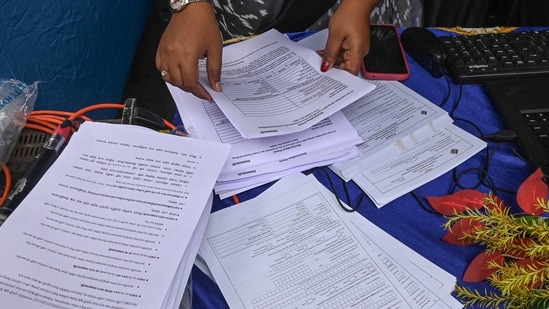
Bengali migrants in New Delhi rush home amid voter list fears ahead of West Bengal polls| India News
West Bengal Migrants Rush Home Amid Voter List Discrepancies
Across India, the vibrant flow of migrant workers forms the backbone of various industries, with countless individuals from West Bengal seeking opportunities in cities like Delhi, Mumbai, and Bengaluru. However, a recent development has sent a ripple of concern through these communities, prompting a sudden and anxious rush back to their home districts. Reports indicate a significant number of these West Bengal migrant workers have encountered issues with the electoral rolls following a recent revision exercise, raising questions about their ability to exercise their fundamental right to vote. Omni 360 News has been tracking these developments, understanding the human element behind these critical administrative processes.
The crux of the matter lies in the state’s electoral roll revision, a routine but crucial exercise conducted by the Election Commission of India to ensure voter lists are accurate and up-to-date. This process involves adding new eligible voters, correcting errors, and removing duplicate or deceased entries. While essential for maintaining a clean and fair election system, this particular revision appears to have inadvertently created hurdles for those residing far from their registered polling booths.
Many migrant workers, particularly those from districts like Purulia, Murshidabad, and Malda, have reported finding their names either completely deleted from the voter list or observing discrepancies in their details, such as incorrect addresses or polling booth allocations. Local news reports from these regions highlight numerous instances where families, receiving calls or information from relatives back home, have learned of these issues. This has led to an understandable panic, as the absence of a name on the electoral roll effectively disenfranchises a citizen.
For a 12th-grade student trying to understand this, imagine your school’s attendance register being updated. If your name mysteriously disappears, or your class details are wrong, you wouldn’t be able to attend lessons until it’s fixed. Similarly, for elections, if your name isn’t on the official list, you can’t cast your vote, even if you are an eligible citizen.
The challenge is amplified for migrant workers. Verifying one’s name or getting corrections made often requires a physical presence at designated offices in their home constituency. This means taking leave from work, incurring significant travel expenses, and losing precious income. For many, these costs are prohibitive, forcing a difficult choice between their livelihood and their democratic right. Communities in areas heavily reliant on migrant labour, like West Bengal, are particularly sensitive to these changes. Local community leaders and civil society groups have voiced concerns, noting the widespread anxiety among families whose breadwinners are far away.
Political parties in West Bengal have also weighed in on the issue. Opposition parties have been quick to accuse the ruling establishment of deliberate deletions, a charge vehemently denied. Both sides, however, acknowledge the severity of the problem and the potential impact on voter turnout and electoral fairness. They have urged their cadres to assist affected individuals in checking their voter status and applying for corrections, though the sheer volume of reported issues presents a formidable task.
The Election Commission has a robust grievance redressal mechanism, including online portals and Booth Level Officers (BLOs) who are local government officials tasked with maintaining the electoral roll. However, for those far from home, navigating these systems remotely remains a challenge. The ideal scenario involves active participation from citizens during the revision period, checking draft rolls for errors. But for migrant workers, this window often passes unnoticed or is inaccessible due to their work schedules and geographical distance.
Ensuring an accurate and inclusive electoral roll is fundamental to any vibrant democracy. Every eligible citizen’s vote holds equal weight and contributes to the collective voice of the nation. When administrative processes, however well-intentioned, create barriers to participation, it can undermine public trust and the very spirit of democratic engagement. The current situation in West Bengal underscores the need for more migrant-friendly mechanisms for electoral roll management, perhaps leveraging digital tools and awareness campaigns specifically targeting transient populations.
Key Takeaways:
* Migrant workers from West Bengal are reporting significant deletions and discrepancies in electoral rolls after a recent revision.
* This forces many to rush back home, incurring financial burdens, to verify and correct their voter status.
* The issue affects democratic participation, particularly for individuals from districts like Purulia, Murshidabad, and Malda.
* Political parties and local communities are highlighting the problem, while the Election Commission’s existing mechanisms face challenges in reaching this specific demographic.
* The situation emphasizes the need for streamlined, accessible processes to ensure all eligible citizens, including migrant workers, can easily maintain their voting rights.
The democratic principle of “one person, one vote” is only truly upheld when every citizen has the unimpeded ability to cast that vote. The ongoing concerns among West Bengal’s migrant workers serve as a critical reminder for continuous improvement in electoral administration, ensuring that no citizen, regardless of their migratory status, is left behind in the democratic process.





