
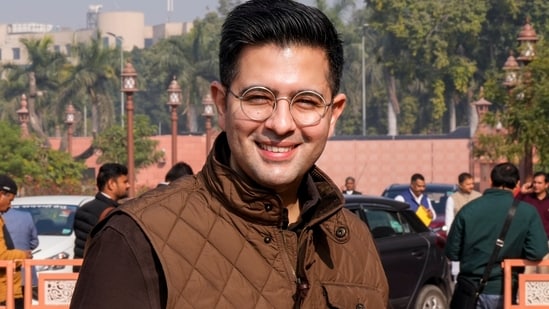
‘Airport samosas’, prepaid recharge: 7 ‘soft’ issues Raghav Chadha raised in Parliament| India News
Raghav Chadha’s Parliament Focus A Look at Public Concerns and Party Views
In the bustling arena of parliamentary debate, where national policies often dominate headlines, the voice of Aam Aadmi Party Member of Parliament Raghav Chadha has increasingly drawn attention for its focus on issues that touch the everyday lives of ordinary citizens. Chadha, a prominent figure from Punjab, has publicly stated he feels “silenced” for consistently bringing up matters directly affecting people’s daily routines. This claim, however, faces a counter-narrative from within his own party, with some Aam Aadmi Party circles reportedly accusing him of indulging in “soft PR.” This examination delves into the specifics of Chadha’s parliamentary interventions and the differing perspectives surrounding his approach.
For many years, the Indian Parliament has served as a crucible for shaping the nation’s future. From economic reforms to security policies, the discussions there are typically grand in scope. Yet, Chadha has carved out a niche by zeroing in on what he terms “kitchen table” issues. These are not obscure legislative technicalities, but rather challenges that most people encounter regularly.
One notable instance involved his vocal criticism of exorbitant prices for basic necessities at airports. He highlighted the disparity where simple items like a samosa or a bottle of water, available cheaply outside, command several times their value within airport premises. This isn’t just about a snack; it reflects a broader concern about consumer exploitation in captive environments, a sentiment many travellers readily share. Similarly, Chadha raised the issue of prepaid mobile recharge minimum validity, where telecom providers effectively force users to recharge with a certain amount, regardless of their actual usage, to keep their numbers active. This practice disproportionately impacts low-income groups and raises questions about fair consumer practices.
His interventions haven’t stopped there. Chadha has consistently spoken on critical aspects of data privacy, particularly concerning the misuse of personal information linked to Aadhaar and social media platforms. In a digitally advancing nation, the security of personal data is a paramount concern for citizens, often feeling vulnerable to breaches and unregulated data collection. He has also addressed the rising tide of online gaming addiction and the urgent need for comprehensive regulation to protect vulnerable individuals, especially youth. Further, he has questioned the often-hidden charges associated with digital transactions and the pervasive impact of Goods and Services Tax (GST) on everyday essential items, seeking clarity and relief for consumers. Even the less discussed problem of dormant bank accounts and the difficulties account holders face in retrieving their funds has found a platform through his parliamentary questioning.
Chadha’s assertion of being “silenced” speaks to a broader political dynamic. In parliamentary settings, an MP’s ability to truly influence policy often depends not just on raising an issue, but on gaining support and moving it towards resolution. If his arguments, though rooted in public sentiment, are not adequately addressed or debated, the feeling of being unheard can understandably arise. He perceives his role as a direct conduit for public grievances, particularly those often overlooked in high-level policy discussions.
However, the narrative from certain factions within the Aam Aadmi Party presents a different angle. Accusations of “soft PR” suggest that while these issues are undoubtedly relatable, they might be viewed as less strategically significant in the grand scheme of national governance or party objectives. The implication could be that while highlighting individual grievances garners public sympathy, a focus on broader legislative reforms or more impactful policy frameworks might be expected from an MP in a national legislature. From this perspective, an MP’s effectiveness might be measured by their contribution to shaping major bills or influencing significant government decisions, rather than merely drawing attention to specific, albeit frustrating, consumer issues.
The debate around Raghav Chadha’s parliamentary focus, as observed by Omni 360 News, brings to light the multifaceted role of a public representative. Is an MP’s primary duty to champion every small grievance of their constituents, ensuring their daily struggles are acknowledged on the national stage? Or should their efforts be predominantly directed towards larger policy formulation, economic strategy, and national security, which ultimately impact millions?
This dichotomy is not unique to India. Legislators globally grapple with balancing immediate constituent needs against broader national imperatives. For citizens, an MP who speaks their language and articulates their everyday frustrations can be a powerful and comforting figure. Such representation builds trust and makes the legislative process feel more accessible and relevant. However, for a political party seeking to govern or influence policy at a national level, the allocation of an MP’s time and voice must also align with strategic goals and larger policy agendas.
Key Takeaways:
* Raghav Chadha focuses on “daily life” issues like airport prices, mobile recharges, and data privacy.
* He claims to be “silenced,” implying his concerns are not getting due parliamentary attention.
* The Aam Aadmi Party reportedly accuses him of “soft PR,” suggesting his focus might be on relatable but less impactful issues from a strategic party perspective.
* This situation highlights the tension between an MP’s role as a voice for individual grievances and their contribution to broader national policy.
* Understanding this debate helps clarify how public representation is perceived and practiced within the Indian political system.





