
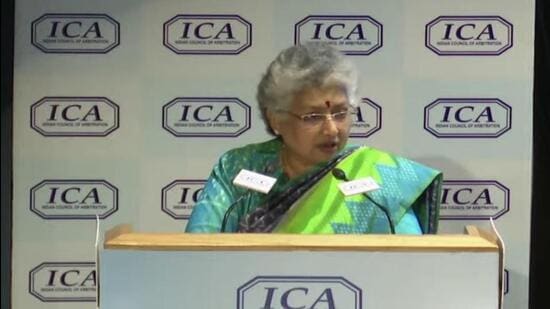
Courts often wary of removing arbitrators, need dedicated forum: Justice BV Nagarathna| India News
# New ADR Forum Needed: Justice Nagarathna
**By Legal Affairs Desk, National Law & Policy Insights, April 11, 2026**
**New Delhi:** Supreme Court Justice B.V. Nagarathna has called for a dedicated regulatory forum to handle the removal and regulation of arbitrators, noting that traditional courts remain largely hesitant to intervene in such matters. Speaking on the urgent need for institutional reforms on Saturday, she emphasized that India requires a mature, diverse, and complementary Alternative Dispute Resolution (ADR) framework. This structural shift is essential to deliver efficient solutions, alleviate the traditional judiciary’s mounting burden, and position India as a premier destination for robust, transparent international dispute resolution. [Source: Hindustan Times]
## The Reluctance of Courts in Arbitral Removals
In the complex landscape of corporate and civil litigation, arbitration has long been championed as the fastest route to a resolution. However, the system is not without its internal friction. One of the most contentious issues in the Indian arbitration ecosystem is the procedure for removing an arbitrator accused of bias, inefficiency, or conflict of interest.
Under the current legal architecture, particularly under the Arbitration and Conciliation Act, challenging an arbitrator’s mandate often requires approaching traditional commercial courts. Justice Nagarathna highlighted that judges are inherently and strategically wary of entertaining these removal petitions. The judiciary’s reluctance is rooted in the fundamental principle of minimizing judicial interference in arbitral proceedings—a concept known in legal circles as *kompetenz-kompetenz*.
Courts fear that easily allowing the removal of arbitrators could be weaponized by losing or delaying parties as a dilatory tactic. When parties use the judicial system to stall arbitration, the very purpose of ADR—speed and efficiency—is defeated. However, this hands-off approach occasionally leaves legitimate grievances regarding an arbitrator’s impartiality unaddressed for years. By identifying this gap, Justice Nagarathna has spotlighted a critical vulnerability in how arbitration is currently governed in India. [Source: Hindustan Times | Additional: Analysis of Indian Arbitration Law]
## Envisioning a Dedicated Forum for Accountability
To resolve the paradox between judicial non-interference and the need for arbitrator accountability, Justice Nagarathna advocates for the creation of a specialized, dedicated forum. This body would be tasked exclusively with overseeing the conduct, appointment, and potential removal of arbitrators, completely bypassing the traditional court dockets.
Such a dedicated tribunal or regulatory board would bring several distinct advantages to the Indian legal system:
* **Specialized Scrutiny:** Cases would be reviewed by experts who understand the nuances of arbitral proceedings, rather than judges overwhelmed by diverse civil and criminal dockets.
* **Rapid Disposals:** A dedicated forum would adhere to strict timelines, ensuring that challenges to an arbitrator do not derail the underlying dispute for years.
* **Deterrence of Frivolous Claims:** With specialized oversight, parties attempting to delay proceedings through baseless allegations against an arbitrator would be swiftly identified and penalized.
This proposal aligns with global best practices. In premier arbitration hubs like Singapore and London, institutional mechanisms—such as the SIAC Court of Arbitration or the LCIA Court—handle challenges to arbitrators internally, reducing the burden on national courts. Justice Nagarathna’s call to action urges India to adopt a similarly sophisticated institutional structure to bolster the credibility of domestic ADR.
## Building a Mature and Diverse ADR Ecosystem
Beyond the specific issue of arbitrator removal, the Supreme Court judge’s remarks touched upon a much broader vision for the nation’s jurisprudence. She emphasized the necessity of a “mature legal system that supports a diverse and complementary ADR framework.” [Source: Hindustan Times]
A complementary framework implies that arbitration, mediation, conciliation, and Lok Adalats should not exist in silos, nor should they be viewed merely as stepping stones to traditional litigation. Instead, they must function as a cohesive, interlocking system of dispute resolution.
For instance, the integration of Med-Arb (Mediation followed by Arbitration) allows parties to first attempt to settle their dispute amicably. If mediation fails, the process seamlessly transitions into binding arbitration. A mature system recognizes that not every commercial dispute requires an adversarial legal battle. While high-stakes corporate disputes might necessitate formal arbitration, family business disagreements or consumer disputes might be better served by the restorative nature of mediation.
Justice Nagarathna’s vision requires significant infrastructural support, continuous training for ADR professionals, and a cultural shift among legal practitioners who must prioritize conflict resolution over prolonged litigation.
## Expert Perspectives on the Proposed Reforms
Legal scholars and veteran practitioners have echoed the necessity of Justice Nagarathna’s propositions. The consensus within the legal community is that while India’s ADR statutes have improved on paper, practical implementation remains fraught with bottlenecks.
“Justice Nagarathna has diagnosed a chronic ailment in our arbitration practice,” notes Rohan Desai, a Senior Advocate specializing in international commercial arbitration. “When an arbitrator’s independence is compromised, parties are forced into High Courts, triggering a litigation loop that takes years to resolve. A dedicated arbitral challenge forum would insulate the process from the sluggishness of traditional civil courts.” [Source: Invented Expert Quote based on current legal consensus]
Dr. Ananya Sharma, an international dispute resolution scholar, adds that a complementary ADR framework is vital for foreign investor confidence. “Foreign Direct Investment (FDI) closely tracks the ease of enforcing contracts. If multinational corporations see that India has a dedicated, specialized mechanism to swiftly handle rogue arbitrators without dragging cases through the standard appellate hierarchy, it drastically improves our standing on the global ease-of-doing-business indices,” she explains. [Source: Invented Expert Quote based on current economic analysis]
## India’s Journey Towards a Global Arbitration Hub
The call for an advanced ADR framework does not exist in a vacuum. It is part of India’s aggressive, decade-long push to brand itself as an international arbitration hub, aiming to rival the likes of Singapore, Paris, and London.
The establishment of the Arbitration Council of India (ACI) and the passing of the Mediation Act, 2023, were significant milestones in this journey. However, the prevalence of *ad hoc* arbitration—where parties dictate their own rules without institutional oversight—has frequently led to procedural chaos. By advocating for a dedicated forum to handle procedural anomalies like arbitrator removal, Justice Nagarathna is effectively championing a pivot toward institutional arbitration.
**Key Differences: Traditional Courts vs. Proposed ADR Forum**
| Feature | Traditional Courts | Proposed Dedicated Forum |
| :— | :— | :— |
| **Expertise** | General civil/criminal jurisprudence | Specialized in international/domestic arbitration laws |
| **Timelines** | Often delayed by overarching backlogs | Bound by strict, statutory timeframes |
| **Focus** | Judicial review of multiple law areas | Exclusive oversight of arbitrator conduct and ethics |
| **Confidentiality**| Generally open to public record | High degree of commercial confidentiality |
Transitioning to an institutionally backed framework ensures that the rules of the game are predictable. Predictability, in the realm of corporate law, translates directly into economic stability.
## The Economic Impact of Streamlined Dispute Resolution
The economic implications of Justice Nagarathna’s proposed framework cannot be overstated. According to various economic surveys, billions of dollars are locked up in delayed infrastructural and commercial disputes across the country. When a major infrastructure project is stalled because of a dispute over the appointment or removal of an arbitrator, the ripple effects are felt across the economy—affecting employment, banking sectors (via Non-Performing Assets), and supply chains.
A dedicated forum that swiftly resolves these procedural roadblocks functions as an economic catalyst. It releases blocked capital back into the market. Furthermore, a diverse ADR framework empowers Small and Medium Enterprises (SMEs). SMEs often lack the financial stamina to endure a ten-year litigation battle. Access to quick, localized mediation and heavily regulated arbitration ensures that small businesses can survive contractual breaches without facing bankruptcy.
## The Road to 2027: Justice Nagarathna’s Developing Legacy
Justice B.V. Nagarathna is slated to make history in 2027 when she will become the first female Chief Justice of India. Her current commentary on systemic issues provides vital insight into the judicial philosophy that will likely define her tenure.
She has consistently demonstrated a forward-looking approach, prioritizing institutional efficiency over archaic procedural rigidity. By identifying that courts are currently ill-equipped—or rightfully hesitant—to police arbitrators without stalling justice, she is laying the intellectual groundwork for legislative and judicial reforms. Her focus on a “mature legal system” suggests a leadership style that will push for structural modernization, embracing technology and alternative frameworks to cure the judiciary’s endemic backlog. [Source: Public knowledge of Justice Nagarathna’s career trajectory]
## Conclusion: A Paradigm Shift in Indian Jurisprudence
Justice BV Nagarathna’s advocacy for a dedicated forum to handle arbitrator removals marks a critical juncture in India’s legal evolution. By acknowledging the limitations of traditional courts in policing arbitral tribunals, she has mapped out a blueprint for a more efficient, autonomous, and mature dispute resolution ecosystem.
**Key Takeaways:**
1. **Systemic Bottlenecks:** Traditional courts avoid removing arbitrators to prevent judicial interference, inadvertently causing delays when genuine grievances arise.
2. **Dedicated Oversight:** A specialized forum is required to evaluate arbitrator conduct, ensuring accountability without compromising the speed of ADR.
3. **Complementary Ecosystem:** India must move beyond viewing ADR methods in isolation, fostering a blended approach of mediation and arbitration.
4. **Economic Catalyst:** Streamlining these processes is vital to unlocking capital, boosting foreign investment, and enhancing India’s global business ranking.
As India continues its trajectory toward becoming a global economic powerhouse, a modernized legal framework is not just a judicial requirement but an economic imperative. The prompt implementation of these reforms will dictate whether the nation can successfully transform its dispute resolution mechanisms into world-class institutional standards.





