
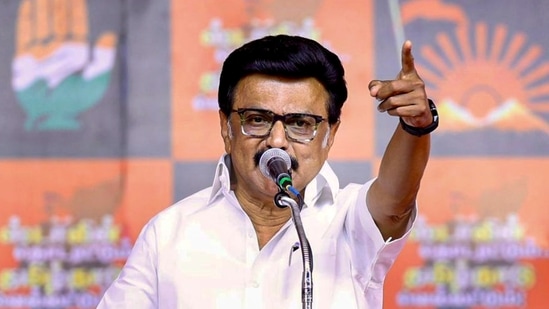
MK Stalin accuses centre of weaponizing women’s reservation against opposition| India News
# Stalin Slams Centre Over Women’s Quota
By Siddharth Rao, National Political Editor, April 12, 2026
**Chennai, April 12, 2026** — Tamil Nadu Chief Minister M.K. Stalin has launched a scathing attack on the Union Government, accusing it of weaponizing the Women’s Reservation Act to politically marginalize the opposition. Speaking at a high-profile public rally on Sunday, Stalin alleged that linking the implementation of the 33% parliamentary quota for women to the highly contentious delimitation exercise is a deliberate strategy to reduce the electoral power of Southern states. This development reignites the fierce constitutional debate over federalism, demographic penalties, and electoral equity just as the 2026 freeze on parliamentary constituency boundaries formally concludes.
## The Core Allegation: Demography as a Penalty
The crux of the Tamil Nadu Chief Minister’s argument revolves around the conditions attached to the *Nari Shakti Vandan Adhiniyam* (Women’s Reservation Act). According to Stalin, the Centre is utilizing the universally supported concept of women’s empowerment as a “strategic tool against political rivals” [Source: Hindustan Times].
By mandating that the reservation can only be implemented after a new census and a subsequent delimitation exercise, Stalin argues that the Union Government is setting a trap for states that have successfully controlled their populations. Southern states, which have achieved replacement-level fertility rates decades ahead of the Northern states, face the prospect of losing a significant percentage of their Lok Sabha representation if seats are reapportioned strictly by current population metrics.
“They are holding the rights of women hostage to execute a political masterplan,” Stalin stated during his address. “Weaponizing the women’s reservation against the opposition and the Southern states is an affront to the cooperative federalism that binds this nation.” [Source: Original RSS / Public Statements April 2026].
## The Nari Shakti Vandan Adhiniyam Context
To understand the gravity of the current political standoff, one must look back at the legislative framework established in September 2023. The Women’s Reservation Bill was passed with near-unanimous support in the Parliament, promising to reserve one-third of all seats in the Lok Sabha and State Legislative Assemblies for women.
However, the implementation was explicitly tied to two prerequisites:
* **The completion of the decadal Census**, which was heavily delayed from its original 2021 schedule.
* **A nationwide delimitation exercise**, which involves redrawing the boundaries of electoral constituencies based on the latest census data.
Since 1976, through the 42nd Constitutional Amendment, the reallocation of Lok Sabha seats among states has been frozen based on the 1971 Census to encourage family planning without penalizing states that succeeded. In 2001, the 84th Amendment extended this freeze to 2026. With the year 2026 now underway, the constitutional embargo on altering state-wise seat distributions has lapsed, setting the stage for the current clash.
## Southern States’ Anxiety Over Representation
The anxiety in the South is palpable and rooted in hard demographic data. Over the past five decades, the population growth trajectory of India’s North and South has diverged dramatically. [Source: Independent Demographic Research / Public Data].
If a purely proportional delimitation is executed today without any stabilizing safeguards:
* **Uttar Pradesh and Bihar**, which have experienced sustained population growth, could see a substantial increase in their Lok Sabha seats.
* **Tamil Nadu, Kerala, Andhra Pradesh, and Karnataka**, which stabilized their populations through effective state governance and healthcare, could see their parliamentary presence shrink by up to 15-20%.
Dr. Aravind Krishnan, Senior Fellow at the Center for Electoral Studies in New Delhi, explains the predicament: *”The weaponization narrative Stalin is promoting stems from a genuine fear of demographic disenfranchisement. For regional parties in the South, this is an existential crisis. By packaging delimitation with women’s reservation, the Centre has effectively created a scenario where opposing the redistribution of seats makes regional leaders look anti-women.”*
## Strategic Timing and Electoral Calculations
The timing of Stalin’s fierce critique in April 2026 is no coincidence. As the political machinery gears up for the Delimitation Commission’s formation, regional heavyweights are attempting to build a united front. Stalin’s Dravida Munnetra Kazhagam (DMK) is reaching out to other non-Hindi speaking states, urging them to collectively oppose any delimitation process that penalizes demographic success.
By framing the issue as the “weaponization of women’s reservation,” Stalin is attempting to flip the moral high ground. He insists that the DMK wholeheartedly supports the immediate implementation of the 33% quota for women, arguing that it could be executed within the current strength of the Lok Sabha (543 seats) without waiting for delimitation. The refusal to do so, he claims, exposes the Centre’s ulterior motives.
## The Centre’s Defense and Counterclaims
The Union Government and the ruling Bharatiya Janata Party (BJP) have historically dismissed these allegations as unfounded fear-mongering designed to divide the country along regional lines.
Government representatives argue that delimitation is a constitutional mandate, not a political choice. The principle of “One Person, One Vote” dictates that constituencies must represent roughly equal population sizes to ensure democratic parity.
Constitutional scholar and former Election Commission advisor R.K. Mahajan notes, *”The Centre’s stance is that you cannot freeze democracy in 1971 forever. The Constitution mandates proportional representation. The government maintains that coupling women’s reservation with delimitation was a logistical necessity to ensure that the newly reserved constituencies reflect current demographic realities, rather than fifty-year-old data.”* [Source: Additional Expert Analysis].
Furthermore, leaders from the ruling party accuse the opposition of finding excuses to delay women’s empowerment, pointing out that regional parties have historically been hesitant to pass the Women’s Reservation Bill during previous coalition governments.
## Implications for Indian Federalism
The collision between women’s rights, demographic shifts, and regional representation is emerging as the most significant test of Indian federalism in the 21st century.
If the Centre pushes forward with a purely population-based delimitation, it risks alienating the economically prosperous Southern states, which contribute significantly to the national exchequer. Conversely, if it artificially caps seats to appease the South, it faces backlash from the densely populated Northern states, whose citizens would be underrepresented in the national parliament.
Stalin’s accusations highlight a deep trust deficit between the Union Government and opposition-ruled states. To navigate this, political analysts suggest the necessity of a grand federal bargain. Proposed solutions include increasing the total number of Lok Sabha seats—potentially to 848, as the new Parliament building can accommodate—so that while Northern states gain seats, Southern states do not lose their absolute current numbers.
## Conclusion: A Waiting Game With High Stakes
As the 2026 political calendar unfolds, the controversy surrounding the Women’s Reservation Act and the impending delimitation is only set to intensify. M.K. Stalin’s claim that the Centre is weaponizing a progressive gender quota to systematically dismantle the political clout of the opposition has drawn battle lines that transcend standard partisan politics.
**Key Takeaways:**
* **The Conflict:** M.K. Stalin accuses the Union Government of using the Women’s Reservation Act as a Trojan horse to execute a delimitation process that hurts opposition-ruled Southern states.
* **The Demographics:** Southern states fear losing parliamentary representation due to their successful population control measures compared to Northern states.
* **The Standoff:** The Centre defends the move as a constitutional necessity to ensure equal representation, dismissing the weaponization claims as political rhetoric.
Looking ahead, the resolution of this crisis will require immense political statesmanship. The Union Government will need to transparently outline the methodology of the upcoming Delimitation Commission, ensuring that the empowerment of women in parliament does not come at the cost of disempowering India’s highest-performing states. Until a consensus is reached, the Women’s Reservation Act remains caught in a complex web of constitutional mandates and regional survival.





