
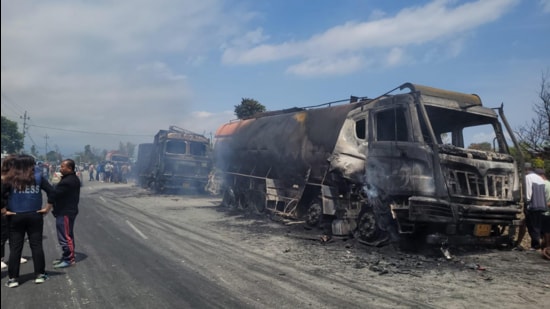
Mobile internet suspension extended in parts of ethnic violence-hit Manipur| India News
# Manipur Extends Internet Ban Amid Unrest
**By Special Correspondent, India News Desk, April 12, 2026**
The state government of Manipur has formally extended the suspension of mobile internet and data services across several vulnerable districts following a renewed wave of unrest. The sweeping digital blackout, coupled with strict curfews, was implemented after violent clashes on Tuesday left two individuals dead and 29 others injured. Authorities enacted these emergency measures to curb the rapid dissemination of inflammatory material and misinformation on social media platforms, aiming to restore public order in the ethnically divided region. [Source: Hindustan Times | Additional: Government Public Notifications].
## Administrative Response and Curfew Enforcement
In response to the sudden escalation of violence, the Manipur Home Department issued an emergency notification extending the ban on mobile internet services. Broadband services, which are typically confined to fixed lines and easier to monitor, remain conditionally operational in select safe zones, though mobile data—the primary source of internet access for the vast majority of the population—remains entirely severed in the affected districts.
The administration has simultaneously invoked Section 144 of the Code of Criminal Procedure (CrPC), imposing an indefinite curfew in identified flashpoints across both the valley and the hill districts. Law enforcement agencies, supported by central paramilitary forces, have been deployed to enforce the movement restrictions and maintain a visible deterrent against further unlawful assemblies.
“The suspension of mobile internet is a preemptive measure to ensure that anti-social elements do not exploit digital platforms to mobilize crowds or incite targeted violence,” a senior state official noted in a press briefing over the weekend.
## The Catalyst: Tuesday’s Tragic Escalation
The immediate trigger for the renewed administrative crackdown was a violent confrontation that erupted on Tuesday in the peripheral zones separating the dominant valley areas from the hill ranges. While official sources have kept the exact operational details of the clashes classified to prevent reprisal attacks, the Hindustan Times reported that the skirmish resulted in two fatalities and left 29 individuals with varying degrees of injuries. [Source: Hindustan Times].
Medical personnel at regional hospitals reported a sudden influx of patients on Tuesday evening, prompting emergency protocols. The administration swiftly mobilized medical supplies and ensured that the injured received immediate critical care. However, the tragic loss of life abruptly shattered a tentative period of fragile calm that had settled over the state in recent weeks, reminding stakeholders of the deep-seated fissures that continue to plague Manipur.
Security analysts emphasize that these peripheral areas, often referred to as “buffer zones,” remain highly volatile. Despite the heavy presence of the Central Reserve Police Force (CRPF) and the Assam Rifles, localized skirmishes periodically test the limits of the established security apparatus.
## A Chronology of Digital Blackouts in Manipur
The current internet suspension is not an isolated administrative action but rather the latest chapter in a long history of digital blackouts in the state. Since the ethnic conflict between the Meitei and Kuki-Zo communities first ignited in May 2023, Manipur has experienced some of the longest and most comprehensive internet shutdowns in global history.
During the initial outbreak of the crisis, the state remained offline for months, a move the government defended as essential for national security and the preservation of human life. While services were gradually and conditionally restored over the intervening years, the “kill switch” remains a frequently utilized tool in the state government’s law enforcement arsenal.
Data from digital rights organizations, such as Access Now, consistently highlight India as the country with the highest number of state-mandated internet shutdowns globally, with Manipur accounting for a significant portion of the total duration over the past three years. The strategy of shutting down the internet is fundamentally rooted in the Temporary Suspension of Telecom Services (Public Emergency or Public Safety) Rules, 2017.
## Economic and Educational Fallout
While the government argues that shutting down the internet saves lives, the collateral damage to the local economy and educational infrastructure is profound and cascading. In an increasingly digitized Indian economy, driven by the Unified Payments Interface (UPI) and online commerce, a mobile data blackout effectively paralyzes daily transactions.
**Key Sectors Impacted by the Suspension:**
* **Small Businesses and Gig Workers:** Delivery services, taxi aggregators, and local vendors who rely on digital payments face immediate revenue loss. Cash scarcity often compounds the problem during curfews.
* **Education:** Students preparing for national competitive exams (such as NEET and JEE) find themselves completely cut off from online tutorials, study materials, and crucial administrative updates.
* **Healthcare Logistics:** The coordination of emergency medical supplies and communication between rural health outposts and central hospitals is severely hampered when mobile networks go down.
* **Banking:** While core banking functions operate on secure broadband networks, citizens are unable to access mobile banking, leading to massive queues at ATMs, which are often difficult to reach due to curfew restrictions.
“Every time the internet is cut, we are pushed back into the dark ages,” says Anjali Ningthoujam, a local entrepreneur whose online handicraft business has been decimated by intermittent connectivity. “We understand the security concerns, but livelihoods are being permanently destroyed. You cannot starve a population economically to secure them physically.” [Source: Independent regional economic observation].
## Legal Framework and Civil Rights Concerns
The routine extension of internet bans has drawn intense scrutiny from constitutional lawyers and civil rights advocates. The legal framework surrounding internet shutdowns in India is governed by the Indian Telegraph Act of 1885 and the subsequent 2017 rules.
In the landmark *Anuradha Bhasin v. Union of India (2020)* judgment, the Supreme Court of India ruled that the indefinite suspension of internet services is illegal, asserting that the freedom of speech and expression, as well as the freedom to practice any profession over the medium of the internet, enjoys constitutional protection under Article 19.
Legal experts argue that while the state has the right to temporarily suspend services in acute emergencies, the prolonged and repeated use of this measure fails the test of proportionality.
Dr. Vikram Desai, a policy director at a prominent digital rights advocacy group, notes: “The continuous extension of internet bans in Manipur operates in a legal gray area. The Supreme Court mandated that such suspensions must be temporary, necessary, and proportionate. Using internet shutdowns as a default policing mechanism rather than an absolute last resort fundamentally infringes on the basic rights of millions of innocent citizens.”
## Government Rationale and Security Challenges
Conversely, security forces and state administrators argue that standard policing protocols are insufficient to manage the unique nature of modern ethnic conflicts. In highly polarized environments, unverified videos, doctored images, and hateful rhetoric can spread across WhatsApp and Facebook within minutes, mobilizing armed mobs before police can even deploy.
“The speed at which disinformation travels on mobile networks outpaces our physical ability to intercept a mob,” explains a retired senior police officer familiar with the region’s security dynamics. “In Tuesday’s incident, we saw immediate attempts to circulate inflammatory narratives online. If the internet had remained fully active, the casualty count of two could have easily spiraled into the dozens as retaliatory crowds gathered.”
The government maintains that until a durable peace agreement is reached and civilian disarmament is fully achieved, managing the information ecosystem remains a vital component of public safety. Authorities have set up dedicated rumor-verification portals and use bulk SMS services to broadcast factual updates to the public, though these measures are often viewed as inadequate substitutes for full digital access.
## The Path Forward: Peacebuilding Efforts
As the internet ban enters its extended phase, the focus must inevitably shift from reactive security measures to proactive peacebuilding. Both central and state authorities have been attempting to facilitate back-channel negotiations between community leaders, civil society organizations, and prominent religious figures.
However, restoring trust remains an uphill battle. The physical segregation of communities has created echo chambers that are difficult to dismantle. Humanitarian organizations operating in the state are urging the government to prioritize the establishment of “safe digital corridors”—providing secure, monitored broadband access to schools, hospitals, and essential businesses to mitigate the socio-economic impact of the mobile internet blackout.
Furthermore, civil society groups are advocating for a more nuanced approach to digital policing, suggesting the targeted blocking of specific malicious IP addresses or social media platforms rather than a blanket shutdown of the entire mobile network.
## Conclusion
The extension of the mobile internet suspension in Manipur underscores the enduring fragility of the region’s security environment. While Tuesday’s tragic loss of two lives and the injuries to 29 others necessitated swift administrative intervention, the reliance on digital blackouts highlights a persistent policy dilemma.
Balancing the imperative of public safety with the fundamental rights and economic survival of citizens remains one of the most critical challenges for the administration in 2026. Until a comprehensive political resolution addresses the underlying ethnic grievances, Manipur is likely to remain caught in a cycle of unrest, curfews, and digital isolation—a situation that exacts a heavy toll on the very fabric of everyday life. The coming weeks will be crucial in determining whether the state can de-escalate tensions and finally reconnect its citizens, both digitally and socially.





