
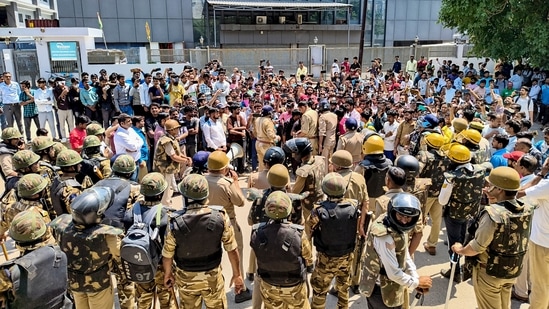
Noida workers protest low wages: ‘We work 12 hours a day, earn just ₹13,000’
# Noida Workers Protest Low Wages & Long Hours
**By Arun Desai, The Metro Chronicle | April 14, 2026**
NOIDA, UTTAR PRADESH — Thousands of factory workers have taken to the streets in Noida this week, halting production across major industrial clusters to protest severe wage stagnation and grueling working conditions. Sparked by mounting inflation and a rapidly rising cost of living in the National Capital Region (NCR), the demonstrations highlight a deepening crisis among the urban working class. Laborers report being forced into mandatory 12-hour shifts for a meager monthly income of just ₹13,000, leaving their families unable to afford basic necessities. As tensions escalate between workers, factory management, and local authorities, the unrest threatens to disrupt regional supply chains and manufacturing output.
## The Breaking Point for Noida’s Labor Force
The ongoing demonstrations in Noida—a premier industrial and technological hub bordering New Delhi—have brought the realities of India’s blue-collar workforce into sharp focus. Workers from various sectors, including garment manufacturing, electronics assembly, and auto parts, have temporarily downed their tools, gathering in large numbers outside factory gates in Sectors 58, 63, and 81.
At the heart of the outrage is the stark disparity between the grueling hours demanded by employers and the financial compensation provided.
“Our salary is very low. I earn ₹13,000 a month. And I work 12 hours a day,” one factory worker said during the ongoing protests [Source: Hindustan Times].
This sentiment echoes across the thousands of workers who have joined the demonstrations. Many claim that the 12-hour shift has become an unwritten industry standard, effectively bypassing standard labor regulations that mandate an eight-hour workday. The extra four hours, workers allege, are rarely compensated at the legally required overtime rates, leaving laborers exhausted and trapped in a cycle of poverty.
## The Economics of Survival: ₹13,000 in a Metro City
To understand the gravity of the workers’ grievances, it is essential to contextualize a ₹13,000 salary within the current economic realities of the National Capital Region in 2026. Over the past few years, the cost of living has surged, driven by inflation in food, fuel, and housing markets [Source: Reserve Bank of India Inflation Reports, 2025-2026].
For a migrant worker supporting a family of four in Noida, survival on this wage is mathematically impossible without resorting to high-interest debt or drastically compromising on health and nutrition.
**Estimated Monthly Living Costs in Noida Working-Class Neighborhoods (2026):**
* **One-room tenement rent:** ₹4,500 – ₹5,500
* **Basic groceries and food:** ₹6,000 – ₹7,500
* **Electricity and utilities:** ₹1,200 – ₹1,800
* **Transportation (shared autos/buses):** ₹1,000 – ₹1,500
* **Medical and unforeseen expenses:** ₹1,500 – ₹2,000
* **Total Minimum Requirement:** **₹14,200 – ₹18,300**
As the data illustrates, a fixed income of ₹13,000 leaves families in a persistent deficit before factoring in children’s education or savings.
“The narrative of a growing Indian economy rings hollow for the people building it,” notes Dr. Meera Sanyal, a labor rights economist at the Center for Equity Studies. “When real wages decline against inflation, we aren’t just seeing economic hardship; we are witnessing the systematic depletion of the working class’s physical and mental health. A 72-hour workweek for starvation wages is a human rights issue.”
## Labor Laws and the Exploitation of Overtime
The protests have reignited a fierce debate over the enforcement of labor laws in Uttar Pradesh. Under the Factories Act of 1948, adult workers are restricted to a maximum of 48 hours a week, and not more than 9 hours in a single day. Any work beyond this threshold mandates overtime pay at twice the ordinary rate of wages.
However, workers in Noida allege that factory owners routinely exploit loopholes or simply ignore compliance. Protesters state that basic employment contracts are either manipulated or withheld, making it difficult for laborers to prove their overtime hours to labor inspectors.
“We are forced to punch out after eight hours, but the gates are locked until we finish the 12-hour production quota,” explained a garment worker during the sit-in. “If we refuse, we are fired the next day. There is no job security, so we suffer in silence.”
The implementation of the new Occupational Safety, Health and Working Conditions Code, which consolidated several labor laws, theoretically allows for 12-hour shifts *only* if the weekly working hours do not exceed 48 (translating to a four-day work week). However, unions argue that industries are adopting the 12-hour shift while maintaining a six-day workweek, resulting in 72 hours of grueling labor without adequate financial compensation.
## Industry Perspective: MSMEs and Supply Chain Pressures
While the workers’ plight has garnered widespread sympathy, industry representatives point to structural challenges that make wage increases difficult. Noida is home to thousands of Micro, Small, and Medium Enterprises (MSMEs) that serve as sub-contractors for larger multinational corporations.
These smaller factories operate on razor-thin margins. Post-pandemic recovery has been uneven, and global supply chain disruptions, coupled with high raw material costs and volatile energy prices, have severely constrained MSME profitability.
Rajiv Kapoor, a spokesperson for an MSME industry association in Noida, offered a counter-perspective on the protests. “We understand the difficulties faced by our workforce, but the manufacturers are also fighting for survival. Large buyers dictate incredibly low procurement prices. If we raise wages to the ₹21,000 minimum that unions are demanding, 40% of the smaller units in Noida will go bankrupt overnight, leading to massive job losses. We need government subsidies or tax relief to facilitate better wages.”
This squeeze from the top down highlights a systemic flaw in modern manufacturing. The pressure to keep production costs artificially low to remain globally competitive is ultimately passed down to the most vulnerable link in the chain: the factory floor worker.
## Demands of the Protesters and Union Involvement
As the protests entered their third day on April 13, 2026, labor unions, including factions affiliated with the Centre of Indian Trade Unions (CITU) and the All India Trade Union Congress (AITUC), stepped in to organize the scattered demonstrations into a cohesive movement.
**The primary demands presented to the local administration include:**
1. **Strict Enforcement of the 8-Hour Workday:** Immediate penalization of factories illegally enforcing 12-hour shifts.
2. **Overtime Compensation:** Backpay for unpaid overtime at the legal double-rate for all workers.
3. **Minimum Wage Revision:** An increase in the mandated minimum wage to a living wage of ₹21,000 per month, adjusted for NCR’s inflation.
4. **Job Security:** An end to arbitrary dismissals and the regularization of contract workers who have served for more than a year.
Union leaders have threatened a complete ‘chakka jam’ (roadblock) of the vital Noida-Greater Noida Expressway if the District Magistrate and the local labor department fail to broker a fair negotiation between the workers and the factory owners’ association within the week.
## Local Administration Response and Legal Implications
The Gautam Buddha Nagar district administration has deployed a heavy police presence in the affected sectors to prevent any escalation of violence. Thus far, the protests have remained largely peaceful, though the disruption to daily industrial operations is costing the local economy millions of rupees a day.
The Deputy Labor Commissioner’s office has reportedly issued notices to over 50 factories flagged by workers for violating standard working hours. A special investigative committee has been formed to audit the payroll and attendance registries of these units. However, workers remain skeptical of the bureaucratic process, noting that previous audits have often resulted in minor fines for corporations while failing to deliver tangible wage improvements for the laborers.
“The labor department is acting as a mediator, and we are holding tripartite talks involving the administration, factory owners, and worker representatives,” stated a senior official from the local administration. “Our priority is to restore law and order while ensuring that no worker is denied their legal right to fair compensation under the Minimum Wages Act.”
## Implications for the “Make in India” Initiative
The unrest in Noida carries significant implications for India’s broader economic ambitions. The central government has aggressively promoted the ‘Make in India’ initiative, offering Production Linked Incentives (PLIs) to attract global manufacturing giants away from China.
However, global investors are increasingly sensitive to Environmental, Social, and Governance (ESG) compliance. International brands cannot afford the reputational risk associated with sweatshop-like conditions and labor exploitation within their supply chains. If regional hubs like Noida become synonymous with labor unrest and human rights violations, it could severely dent foreign direct investment (FDI) in the manufacturing sector.
Industrial economists warn that a model built on suppressed wages is unsustainable. For India to truly emerge as a high-quality global manufacturing hub, it must transition from competing purely on cheap labor to competing on productivity, innovation, and a skilled, well-compensated workforce.
## Conclusion: A Ticking Time Bomb
The protests by Noida’s factory workers are a symptom of a much larger socio-economic ailment. The desperate cry of a worker earning just ₹13,000 for 12 hours of backbreaking daily labor is a stark reminder of the widening inequality in urban centers.
While factory owners grapple with tight margins and global competition, the human cost of this economic pressure can no longer be ignored. Without meaningful intervention—such as stringent enforcement of existing labor laws, realistic minimum wage revisions, and support mechanisms for struggling MSMEs—the industrial harmony required for India’s economic growth will remain fragile.
As April 2026 unfolds, the resolution of the Noida labor protests will set a critical precedent. It will determine whether the region’s industrial machinery will evolve to offer a life of dignity to its foundational workforce, or whether it will continue to risk recurring paralysis by ignoring the very hands that build it.





