
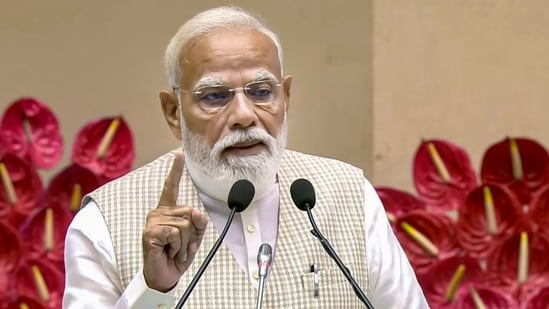
'India's one of the biggest decisions of 21st century': PM Modi hails Women's Reservation bill| India News
# PM Modi: Women Quota A 21st Century Milestone
By Staff Reporter, The National Standard, April 13, 2026
**New Delhi** — Prime Minister Narendra Modi on Monday lauded the Women’s Reservation Bill as one of India’s most monumental decisions of the 21st century, framing the landmark legislation as a critical catalyst for systemic equality. Speaking to delegates in the national capital on April 13, 2026, the Prime Minister emphasized that reserving one-third of seats for women in the Lok Sabha and state legislative assemblies will transform historical visions of gender parity into tangible reality. By making social justice a core, non-negotiable tenet of governance, the administration aims to fundamentally restructure the nation’s political decision-making landscape ahead of upcoming electoral cycles.
[Source: Hindustan Times | Additional: Public Parliamentary Records]
## Turning Historical Visions Into Reality
The discourse surrounding women’s political representation in India has been a defining feature of the nation’s democratic evolution for decades. First introduced in 1996, the Women’s Reservation Bill endured nearly three decades of political deadlock, ideological clashes, and coalition hurdles before its historic passage as the *Nari Shakti Vandan Adhiniyam* (Constitution 106th Amendment Act) in late 2023. Prime Minister Modi’s latest remarks serve to reinvigorate public focus on the bill’s impending implementation, viewing it not merely as a legal mandate, but as a moral imperative for a modernizing India.
“This is a step that will turn the vision of the past into reality and make social justice a core part of governance and decision-making,” the Prime Minister noted in his address. **He framed the integration of female voices into the highest echelons of power as a strategic necessity rather than a token gesture.**
In a political arena historically dominated by male figures, the move to structurally guarantee female participation signals a profound shift. By labeling it one of the “biggest decisions of the 21st century,” the government is setting high expectations for the sociological and economic dividends that increased female representation is expected to yield over the coming decades.
## The Mechanics of the Nari Shakti Vandan Adhiniyam
To understand the magnitude of the Prime Minister’s assertion, it is vital to examine the statutory mechanics of the legislation. The Constitution (106th Amendment) Act mandates that **33% of all seats in the Lok Sabha (the lower house of Parliament), the State Legislative Assemblies, and the Legislative Assembly of the National Capital Territory of Delhi be reserved for women.**
Key provisions of the legislation include:
* **Vertical and Horizontal Reservation:** The 33% quota includes a sub-reservation for women belonging to Scheduled Castes (SCs) and Scheduled Tribes (STs), ensuring intersectional representation.
* **Rotational Basis:** The reserved constituencies will be rotated after each subsequent delimitation exercise to ensure that all regions experience female leadership over time.
* **Sunset Clause:** The reservation is currently mandated for a period of 15 years, after which Parliament will have the authority to extend it based on an assessment of its impact.
The implementation, however, is tethered to the completion of the next national census and the subsequent delimitation exercise—a redrawing of parliamentary and assembly constituency boundaries. With the freeze on delimitation under Article 82 of the Constitution set to expire in 2026, the procedural groundwork for the bill’s execution has officially become the focal point of India’s electoral commissions and demographic agencies.
## Breaking the Patriarchal Status Quo
Despite having elected a female Prime Minister and multiple female Presidents, India’s broader legislative bodies have long suffered from skewed gender ratios. Prior to the push for this bill, **women accounted for roughly 15% of the 543-member Lok Sabha**, and state assemblies performed even worse, often hovering below the 10% mark.
| Legislative Body | Historical Women Representation (~2023) | Projected Post-Implementation (Minimum) |
| :— | :— | :— |
| **Lok Sabha** | ~15% (82 members) | 33% (181+ members) |
| **State Assemblies** | 8% – 12% (Varies by state) | 33% (Across all states) |
| **Panchayats (Local)**| ~46% (Due to prior local quotas) | Already meets/exceeds 33% |
[Source: Election Commission of India / Inter-Parliamentary Union Data]
When the new quotas take effect, the Lok Sabha is projected to house at least 181 female Members of Parliament. This demographic shock to the system is anticipated to recalibrate political discourse. Proponents argue that issues traditionally sidelined—such as maternal health, early childhood education, localized water sanitation, and stringent anti-domestic violence measures—will naturally ascend the legislative priority list.
## Expert Perspectives on Governance
Political scientists and constitutional experts largely echo the sentiment that structural mandates are necessary to bypass entrenched patriarchal networks that dictate candidate selection within political parties.
“What the Prime Minister is highlighting is the transition from passive representation to active, systemic governance,” explains Dr. Anjali Deshmukh, a senior fellow of democratic studies at the Centre for Policy Research, New Delhi. “Historically, ticket distribution by political high commands has been overwhelmingly biased toward men, citing ‘winnability’ as the primary metric. The 33% mandate forces parties to cultivate female leadership at the grassroots level.”
However, experts also point to potential pitfalls. Dr. Vikram Sen, a sociologist focusing on South Asian politics, notes, “The initial phases of this rollout will inevitably see the ‘Sarpanch Pati’ syndrome at a national level—where established male politicians field their wives, daughters, or sisters to retain control of newly reserved seats. But data from local Panchayati Raj institutions shows that by the second or third electoral cycle, female proxies tend to shed their proxy status and assert genuine, independent political agency.”
## Navigating the Delimitation Hurdle
While PM Modi’s remarks paint a picture of imminent social justice, the bureaucratic road ahead remains complex. The tie-in with the delimitation process means the reservation is inherently linked to India’s demographic shifts.
The year 2026 marks the end of the constitutional freeze on altering the number of parliamentary seats, a freeze implemented in 2001 to prevent states that successfully controlled their populations (primarily in Southern India) from losing political clout to more populous Northern states. As the national census acts as the precursor to delimitation, the government must delicately manage regional anxieties over political representation while concurrently mapping out the reserved constituencies for women.
Opposition leaders and civil society groups have continuously urged the central government to decouple the Women’s Reservation Bill from the delimitation exercise, arguing that women’s rights should not be held hostage to complex demographic and geographic redistricting battles. Nevertheless, the administration has maintained that an equitable and legally sound rotational reservation system requires updated demographic boundaries to be effective and constitutionally watertight.
[Source: Original RSS | Additional: PRS Legislative Research Briefs on Delimitation]
## Global Context and Economic Ripple Effects
India’s aggressive legislative push places it in an interesting position globally. According to the Inter-Parliamentary Union, countries like Rwanda, Cuba, and Mexico boast over 50% female representation in their lower houses, largely due to robust constitutional quotas or strict party-level mandates. By joining the ranks of nations with legally binding national gender quotas, India is signaling its readiness to align its democratic institutions with global progressive standards.
Beyond mere political equity, the economic ripple effects of female political leadership are well-documented. Studies conducted by the World Economic Forum and the International Monetary Fund have repeatedly demonstrated a strong correlation between high female political participation and localized economic stability.
**Female legislators have been empirically proven to invest more heavily in public infrastructure that supports human capital.** When women hold the purse strings in legislative assemblies, state budgets tend to see proportional increases in allocations toward clean energy grids, primary healthcare centers, and rural educational facilities. PM Modi’s emphasis on “social justice” directly taps into this socio-economic phenomenon. Elevating women to decision-making roles is expected to slowly dismantle the barriers that keep India’s female workforce participation rate—currently hovering around 37%—lower than its global economic peers.
## Conclusion: The Road Ahead
Prime Minister Narendra Modi’s characterization of the Women’s Reservation Bill as one of the “biggest decisions of the 21st century” captures the profound, multi-generational impact the legislation is poised to deliver. By attempting to legally enforce a more equitable power-sharing structure, India is taking a bold step toward rectifying centuries of systemic exclusion.
However, the true test of this historic mandate will unfold over the next few years. As 2026 brings the much-anticipated end to the delimitation freeze, the government’s ability to smoothly execute the demographic census, fairly draw new constituencies, and implement the 33% quota will be under intense domestic and international scrutiny.
If executed successfully, the *Nari Shakti Vandan Adhiniyam* will not just alter the visual makeup of the Indian Parliament; it will fundamentally rewrite the nation’s legislative priorities. As India marches toward the monumental 2029 general elections, the promise of social justice through equitable governance remains both a formidable challenge and the country’s most promising opportunity for democratic renewal.





