
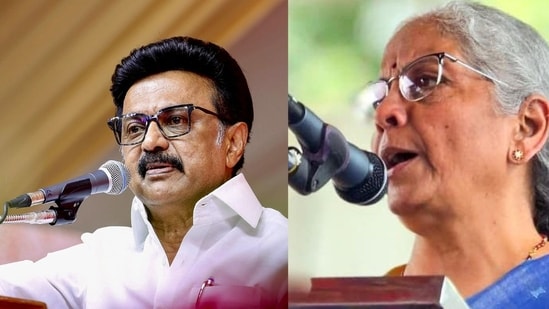
Sitharaman accuses Stalin of creating false narrative to ‘score political points’ over advisory on wheat and paddy bonus| India News
# Sitharaman Slams Stalin Over Crop Bonus Row
**By National Correspondent, India News Desk, April 14, 2026**
Union Finance Minister Nirmala Sitharaman launched a scathing attack on Tamil Nadu Chief Minister M.K. Stalin on Monday, April 13, 2026, accusing the state leadership of manufacturing a “false narrative” regarding a central advisory on wheat and paddy procurement bonuses. Speaking to reporters in New Delhi, Sitharaman alleged that the Dravida Munnetra Kazhagam (DMK) government is actively weaponizing agricultural policies to score political points ahead of the impending state assembly elections. Furthermore, she challenged Stalin to pivot away from “anti-Centre rhetoric” and explain alleged concessions being made to foreign industrial interests at the expense of domestic growth.
[Source: Hindustan Times | Additional: Public records on India’s agricultural procurement policies]
## The Core Dispute: Advisories and Agricultural Bonuses
The current political firestorm originates from a recent advisory issued by the Union Ministry of Consumer Affairs, Food and Public Distribution. The central directive cautioned state governments against declaring exorbitant financial bonuses over and above the federally mandated Minimum Support Price (MSP) for wheat and paddy. The Centre’s rationale is rooted in macroeconomic stability: excessive state-level bonuses can distort open market prices, trigger inflation, and disrupt the Food Corporation of India’s (FCI) national procurement strategies.
Tamil Nadu, a state with robust decentralized procurement systems and a history of heavily subsidizing its agricultural sector, viewed the advisory as an infringement on cooperative federalism and state rights. Chief Minister Stalin publicly criticized the advisory last week, framing it as an anti-farmer mandate dictated by New Delhi that strips states of their autonomy to support local agrarian economies.
In her sharp rebuttal on Monday, Sitharaman dismantled the DMK’s narrative, stating that the Centre’s advisory is a standard fiscal mechanism designed to ensure uniform market practices across the nation, not a targeted attack on Tamil Nadu’s farmers.
“The advisory is a nationwide fiscal prudence measure,” Sitharaman clarified. “To twist this into an ‘anti-Tamil Nadu’ or ‘anti-farmer’ narrative is a deliberate obfuscation of facts. The Chief Minister is creating a false narrative purely to score political points while ignoring the very real economic ramifications of market distortion.”
## Accusations of “Political Point-Scoring”
The friction over the paddy and wheat bonus is reflective of a deeper, ongoing ideological clash between the Bharatiya Janata Party (BJP)-led central government and the DMK-led state government. For years, the DMK has positioned itself as the vanguard of regional autonomy, frequently clashing with the Centre over issues ranging from Goods and Services Tax (GST) compensation to language policies and disaster relief funds.
According to Sitharaman, this latest agricultural dispute is merely a smokescreen. By focusing public outrage on the MSP bonus advisory, she argued, the state government is attempting to distract voters from its own administrative shortcomings. The Finance Minister pointed out that the central government has consistently increased the baseline MSP for both Kharif and Rabi crops year-over-year, ensuring that farmers receive a guaranteed 50% profit margin over their comprehensive cost of production.
**Key Facts on the Procurement System:**
* **Minimum Support Price (MSP):** The baseline price set by the Government of India to protect farmers against steep declines in agricultural prices.
* **State Advised Price (SAP) / Bonus:** Additional financial incentives offered by individual state governments on top of the MSP.
* **FCI Guidelines:** The central government occasionally restricts the Food Corporation of India from procuring surplus grain from states that offer high bonuses, as it forces the Centre to bear the inflated holding and distribution costs.
Sitharaman urged the Stalin administration to focus on building cold storage infrastructure, improving supply chain logistics, and expanding irrigation networks rather than engaging in a persistent victimhood narrative.
## The “Foreign Interests” Allegation Explored
Perhaps the most explosive element of Sitharaman’s Monday address was her pivot from agricultural policy to industrial foreign investment. Advising Stalin “not to waste time on anti-Centre rhetoric,” the Finance Minister demanded an explanation as to why the Tamil Nadu government is allegedly “giving away opportunities to foreign interests.”
While she did not name specific multinational corporations, political analysts suggest her comments were aimed at recent Memorandums of Understanding (MoUs) signed by the Tamil Nadu government following high-profile global investor summits. Over the past year, the state has aggressively courted foreign direct investment (FDI) in sectors such as electric vehicle (EV) manufacturing, semiconductor packaging, and renewable energy.
The central government’s implicit critique is that while Tamil Nadu offers massive land concessions, tax holidays, and subsidized utilities to foreign multinationals, it simultaneously complains about fiscal constraints and central funding deficits regarding domestic welfare and agriculture.
“There is a glaring hypocrisy in state governance when you lay out the red carpet and forfeit immense state revenue to foreign conglomerates, yet weaponize a standard agricultural advisory to claim the Centre is starving the state of funds,” Sitharaman noted.
## The Economics of MSP and State Bonuses
To understand the gravity of the agricultural bonus advisory, it is essential to examine the underlying economics. When a state announces a heavy bonus on wheat or paddy, local farmers inevitably pivot toward cultivating these water-intensive crops, leading to severe ecological imbalances, groundwater depletion, and overproduction of cereals.
Furthermore, the central government is left to manage the surplus. If the Centre procures this surplus at the state-inflated prices, it balloons the national food subsidy bill, which already accounts for a massive portion of the Union Budget.
| Factor | Central MSP Policy Focus | State Bonus Policy Focus |
| :— | :— | :— |
| **Primary Goal** | National food security, inflation control | Local farmer income support, political goodwill |
| **Market Impact** | Stabilizes baseline commodity prices | Can distort local market prices, discouraging private buyers |
| **Crop Diversification**| Encourages pulses/oilseeds via balanced MSP | Often skews heavily towards paddy and wheat |
| **Fiscal Burden** | Borne by the Union Budget | Borne by State Exchequer (often leading to debt) |
By issuing the advisory, the central government is attempting to enforce fiscal discipline and promote crop diversification—encouraging farmers to grow millets, oilseeds, and pulses, which are in high demand and ecologically sustainable. Sitharaman’s defense of the advisory is grounded in this long-term macroeconomic perspective, contrasting it with what she views as the DMK’s short-term electoral populism.
## Expert Perspectives on Federal Tensions
Independent economists and agricultural policy experts view the ongoing spat as a classic example of India’s complex federal architecture being tested by regional politics.
Dr. Rajesh Venkat, a Senior Fellow at the Institute for Agricultural Policy Studies in New Delhi, notes that both sides have valid technical arguments, but the dialogue has been entirely overshadowed by political posturing.
“The Finance Minister is economically correct; unchecked state bonuses on paddy and wheat severely distort procurement markets and derail national efforts toward crop diversification,” Dr. Venkat explained. “However, Chief Minister Stalin is politically and constitutionally justified in asserting that agriculture is heavily a state subject, and states should have the leeway to support their farmers, especially given the rising input costs of fertilizers and diesel. The tragedy here is that technical advisories are being debated in the arena of partisan politics rather than policy councils.”
Other political commentators highlight that the rhetoric regarding “foreign interests” is a strategic move by the BJP to challenge the DMK’s governance model. By framing the DMK as overly accommodating to external corporate entities while playing the victim card on domestic agrarian issues, the BJP is attempting to chip away at the DMK’s pro-poor, pro-farmer image.
## Political Road to the 2026 Assembly Elections
Timing is everything in Indian politics. The escalating war of words between Nirmala Sitharaman and M.K. Stalin must be viewed through the lens of the upcoming 2026 Tamil Nadu Legislative Assembly elections.
The BJP has been working aggressively to expand its political footprint in the southern state, a region historically dominated by Dravidian majors—the DMK and the All India Anna Dravida Munnetra Kazhagam (AIADMK). With the AIADMK experiencing internal factionalism, the BJP sees a window to position itself as the primary ideological opposition to the ruling DMK.
Agriculture remains a highly sensitive and electorally potent issue in Tamil Nadu, particularly in the Cauvery Delta region, which is considered the rice bowl of the state. By proactively addressing the DMK’s narrative on the paddy bonus, Sitharaman is attempting to prevent Stalin from consolidating rural vote banks under the guise of an “anti-farmer Centre.”
Simultaneously, the DMK relies heavily on an anti-Centre narrative to unify its cadre and allied parties. Highlighting perceived slights from New Delhi—whether regarding disaster relief funds, language imposition, or agricultural advisories—has been a consistently successful electoral strategy for the regional powerhouse.
## Conclusion and Future Outlook
The clash between Union Finance Minister Nirmala Sitharaman and Tamil Nadu Chief Minister M.K. Stalin over the agricultural bonus advisory highlights the increasingly fragile nature of Centre-State relations in India. What began as a technocratic directive regarding wheat and paddy procurement has rapidly metamorphosed into a high-stakes political battle involving accusations of false narratives, fiscal mismanagement, and favoritism toward foreign industrial interests.
As the 2026 Tamil Nadu state elections draw closer, voters can expect these administrative disagreements to become even more polarized. For the agricultural sector, the continued politicization of Minimum Support Prices and state bonuses risks delaying much-needed structural reforms in crop diversification and supply chain infrastructure. Ultimately, both the central and state governments will need to find a middle ground that respects regional autonomy without compromising national macroeconomic stability.





