
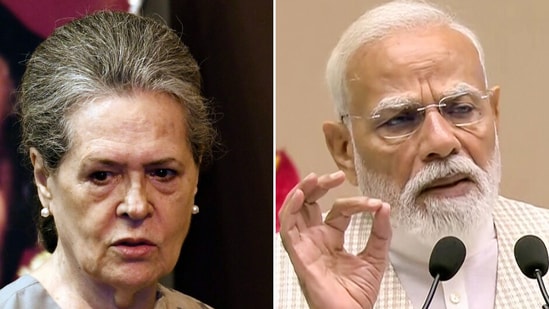
'Delimitation is the issue': Sonia Gandhi vs PM Modi on women's quota bill
# Quota Row: Modi-Sonia Clash on Delimitation
By Senior Political Desk, New Delhi, April 13, 2026
On April 13, 2026, the implementation of India’s historic Women’s Reservation Bill emerged as the central flashpoint between Prime Minister Narendra Modi’s government and the Opposition led by Sonia Gandhi. The core dispute revolves around the upcoming delimitation exercise—the constitutional mandate to redraw Lok Sabha constituencies based on the latest population data. While the ruling party insists the 33% quota must systematically follow a national census and subsequent delimitation, opposition leaders, prominently including Tamil Nadu Chief Minister M.K. Stalin, are demanding immediate implementation within the current electoral maps, fearing the redrawing process will marginalize southern states.
[Source: Hindustan Times RSS | Additional: Parliamentary Records 2023-2026]
## The Constitutional Catch: Tracing the Timeline
To understand the current political gridlock, one must look back to September 2023, when the Parliament passed the **Nari Shakti Vandan Adhiniyam** (Women’s Reservation Bill). The legislation guarantees 33% reservation for women in the Lok Sabha and state legislative assemblies. However, the fine print of the law contained a crucial caveat: the reservation would only come into effect after the publication of the first census conducted post-passage, followed by a nationwide delimitation exercise.
Because the decadal 2021 Census was delayed due to the COVID-19 pandemic and subsequent administrative hurdles, the timeline for women’s reservation was effectively pushed into the late 2020s. Now, in 2026—the year the **84th Constitutional Amendment** freeze on delimitation is officially set to expire—the theoretical debate has transformed into an immediate political crisis.
## Sonia Gandhi’s Stance: Justice Delayed is Justice Denied
For the Congress party and its allies, the linkage between women’s reservation and delimitation is viewed as an unnecessary delay tactic. Former Congress President Sonia Gandhi has spearheaded the charge against the Modi government, arguing that the political empowerment of Indian women cannot be held hostage to bureaucratic census operations and deeply complex constituency boundary disputes.
Gandhi’s argument rests on a simple premise: the existing 543 Lok Sabha seats can be mathematically apportioned to accommodate the 33% quota immediately. The Opposition has repeatedly pointed out that when the Panchayat Raj institutions implemented women’s reservations in the 1990s—a milestone championed by the late Rajiv Gandhi—it did not require a sweeping national delimitation to be functional.
“The women of India have waited decades for equal representation in the highest law-making body of the land,” notes a senior Congress spokesperson echoing Gandhi’s sentiments. “Tying this fundamental democratic right to a deeply controversial delimitation exercise is a deliberate mechanism to delay women’s empowerment.”
[Source: Hindustan Times RSS | Additional: Public Statements, Indian National Congress 2026]
## PM Modi’s Defense: Adhering to Constitutional Propriety
Conversely, Prime Minister Narendra Modi and the ruling Bharatiya Janata Party (BJP) have steadfastly defended the structured approach. The government argues that altering the demographic composition and reservation status of constituencies without updated population figures would be legally unsound and prone to massive judicial challenges.
The government’s stance is rooted in **Article 82** of the Constitution, which mandates the readjustment of seats after every census. By executing the quota post-delimitation, the Election Commission of India can transparently and scientifically identify which specific constituencies should be reserved for women, ideally rotating these seats in subsequent election cycles.
The ruling administration maintains that immediate implementation on outdated 1971 or 2001 census maps (the baselines currently used for seat counts and boundaries, respectively) would create vast representational disparities.
## The Southern Anxiety: Demography as a Penalty
The sharpest critique of the government’s plan has emerged not from the Hindi heartland, but from India’s southern states. Tamil Nadu Chief Minister M.K. Stalin’s recent intervention highlights the most explosive aspect of the 2026 delimitation: the shifting balance of regional power.
Southern states like Tamil Nadu, Kerala, Karnataka, and Andhra Pradesh have effectively implemented family planning policies over the last four decades, successfully stabilizing their populations. In contrast, northern states like Uttar Pradesh and Bihar have seen sustained population growth. If the Lok Sabha seats are increased and redistributed strictly based on current population metrics, southern states face a severe reduction in their proportional representation and political clout in New Delhi.
Stalin has categorically demanded that the women’s quota be granted “without tinkering with the number of seats and their maps.”
This introduces a deeply federal dispute into the gender justice narrative. Southern leaders argue that they are being penalized for successfully executing national population control mandates. Tying the Women’s Reservation Bill to this volatile demographic shift means that the consensus required for the quota is constantly undermined by regional anxieties.
[Source: Hindustan Times RSS | Additional: Demographic Data Analysis 2026]
## Expert Analysis: The Legal and Political Quagmire
Legal and political experts view the clash between Sonia Gandhi and PM Modi as a symptom of a much larger constitutional bottleneck that India must untangle in 2026.
Dr. Meenakshi Ramanathan, a senior constitutional scholar at the Centre for Legislative Studies in New Delhi, explains the complexity of the government’s position. “The linkage of the quota to delimitation is legally sound but politically perilous,” Dr. Ramanathan notes. “If you randomly reserve 33% of existing seats without a Delimitation Commission hearing public grievances, it violates the principles of natural justice for candidates. However, the Opposition is equally correct that the overarching delay frustrates the very spirit of the 2023 Act.”
Political analyst Sanjay Verma highlights the electoral calculus. “The BJP wants to enter the next general elections championing the finalization of the Women’s Reservation Act alongside a newly delimited Parliament that accurately reflects the population density of their political strongholds in the North. For the Congress and regional parties, stalling delimitation while forcing the quota through is essential for their political survival in the South.”
## Projected Impact of Delimitation on Seat Share
To understand why delimitation is such a “sticking point,” one must look at demographic projections. If the Lok Sabha is expanded from 543 to, for example, over 800 seats to reflect the current population ratio (roughly one MP per 1.5 to 2 million citizens), the distribution shift is stark:
* **Uttar Pradesh & Bihar:** Expected to see a dramatic surge in seat share, potentially dominating parliamentary majorities.
* **Tamil Nadu & Kerala:** Expected to see their proportional weight shrink significantly, despite contributing heavily to national GDP.
* **Women Representatives:** Even if the overall seats increase, maintaining the 33% quota guarantees that the absolute number of female MPs will rise to unprecedented levels—potentially over 260 women in the lower house.
## Conclusion: Key Takeaways and Future Outlook
The clash over the Women’s Reservation Bill in 2026 is no longer just about gender equality; it has become a proxy battle for India’s federal structure.
**Key Takeaways:**
1. **Stalled Empowerment:** Despite being passed into law, the 33% quota for women remains in limbo due to structural prerequisites.
2. **Federal Tensions:** The debate highlights the stark demographic divergence between North and South India, with southern CMs like M.K. Stalin opposing any map redrawing that dilutes their states’ political power.
3. **Constitutional Standoff:** While Sonia Gandhi advocates for immediate inclusion based on existing constituencies, PM Modi’s administration maintains that bypassing the census and delimitation process is unconstitutional.
**Future Outlook:**
As the 2026 unfreezing of the delimitation clause looms, the Modi government faces immense pressure to devise a consensus formula. Proposals circulating among policymakers suggest a potential compromise: capping the total number of Lok Sabha seats to protect southern representation while only redrawing internal state boundaries to implement the women’s quota.
Until a middle path is negotiated, the historic legislation meant to shatter India’s political glass ceiling remains ensnared in the complex web of demographic arithmetic and constitutional mandates.





