
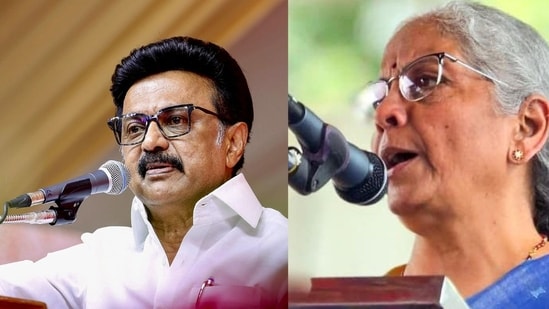
Sitharaman accuses Stalin of creating false narrative to ‘score political points’ over advisory on wheat and paddy bonus| India News
# Sitharaman Slams Stalin Over Paddy Bonus Claims
**By Editorial Staff, The India Chronicle** | **April 14, 2026**
On Monday, April 13, 2026, Union Finance Minister Nirmala Sitharaman launched a scathing attack on Tamil Nadu Chief Minister M.K. Stalin, accusing his government of fabricating a “false narrative” regarding a central advisory on wheat and paddy bonuses. Speaking to the press in New Delhi, Sitharaman alleged that Stalin is deliberately misinterpreting federal agricultural directives to score political points ahead of the upcoming Tamil Nadu assembly elections. Furthermore, she issued a sharp rebuke against the state administration, advising Stalin to halt his “anti-Centre rhetoric” and demanding an explanation as to why his government is allegedly ceding critical domestic agricultural and industrial opportunities to foreign interests. [Source: Hindustan Times].
## Decoding the Wheat and Paddy Bonus Advisory
At the heart of this escalating political confrontation is a recently issued advisory from the central government’s Department of Food and Public Distribution. The directive pertains to the financial bonuses that state governments offer to farmers over and above the Minimum Support Price (MSP) set by the central government for staple crops like wheat and paddy.
Historically, under India’s decentralized procurement framework, if a state government declares a bonus on top of the central MSP, the Food Corporation of India (FCI) restricts its procurement from that state to the exact quantity required for the state’s Targeted Public Distribution System (TPDS). Any surplus must be disposed of by the state government at its own risk and cost. The recent advisory sought to strictly enforce this rule, cautioning states that excessive, unbudgeted state-level bonuses distort local market dynamics and place an unsustainable fiscal burden on the national exchequer.
However, the Tamil Nadu government, led by the Dravida Munnetra Kazhagam (DMK), interpreted this advisory as an encroachment on state autonomy and a direct assault on the livelihood of local farmers. Chief Minister M.K. Stalin argued that the Centre was actively trying to prevent states from properly rewarding their agricultural workers. In response, **Nirmala Sitharaman** clarified that the central government has never banned states from providing bonuses, provided they bear the financial responsibility for the surplus procurement. She accused the Tamil Nadu Chief Minister of twisting standard bureaucratic procedure into a sensationalized political grievance. [Source: Hindustan Times | Additional: Ministry of Consumer Affairs, Food and Public Distribution Policy Guidelines].
## The Politics of ‘False Narratives’ and Election Strategy
The timing of this dispute is highly critical. With the Tamil Nadu State Legislative Assembly elections slated for mid-2026, the political atmosphere in the state is highly charged. The DMK is seeking to consolidate its rural voter base, heavily relying on its image as the protector of Tamil Nadu’s farmers against what it portrays as a hostile, Hindi-centric federal government.
Sitharaman’s statements directly attacked this strategy. She asserted that the DMK’s narrative is a calculated diversionary tactic meant to obscure the state government’s own fiscal mismanagement and unfulfilled electoral promises. “Instead of addressing the genuine infrastructural needs of the farmers in the Cauvery Delta region, the Chief Minister is wasting valuable time on anti-Centre rhetoric,” Sitharaman remarked during her press briefing. She emphasized that the central government has continuously increased the MSP for paddy year-on-year, and the false claim that the Centre is anti-farmer is merely a tool for Stalin to “score political points.” [Source: Hindustan Times].
Political analysts note that the BJP-led central government is aggressively trying to dismantle the DMK’s regional stronghold by exposing logical inconsistencies in their governance model. By framing Stalin’s protests as a “false narrative,” the Centre is attempting to bypass state leadership and appeal directly to the agricultural community, highlighting the central funds directly transferred to farmers under schemes like PM-KISAN.
## The Controversy Over ‘Foreign Interests’
Perhaps the most explosive element of Sitharaman’s critique was her sudden pivot to Tamil Nadu’s foreign investment policies. The Union Finance Minister challenged Stalin to explain why, while ostensibly championing local farmers, his administration is “giving away opportunities to foreign interests.” [Source: Hindustan Times].
While Sitharaman did not explicitly name specific corporations in her initial address, political commentators widely understand this as a reference to a series of recent Memorandums of Understanding (MoUs) signed by the Tamil Nadu government with multinational agro-logistics and foreign food-processing conglomerates. Over the past year, the state has actively courted global investors to modernize its supply chain infrastructure.
However, opposition parties in the state, including the BJP and the AIADMK, have raised red flags. They allege that these foreign contracts offer massive land subsidies and tax holidays to international firms, while local cooperative societies and domestic agro-startups are sidelined. The central government’s implied argument is that if the Tamil Nadu government genuinely cared for local agricultural prosperity, it would empower domestic agrarian entrepreneurs rather than outsourcing the most profitable sectors of the agricultural supply chain to foreign entities.
This accusation places the DMK in a delicate position, forcing them to balance their aggressive industrialization and foreign direct investment (FDI) goals with their traditional, grassroots socialist messaging.
## Tamil Nadu’s Stance and the Defense of Fiscal Federalism
The Tamil Nadu government has fiercely defended its position, framing the Centre’s advisory and subsequent comments by Sitharaman as a classic example of federal overreach. Members of Stalin’s cabinet have argued that agriculture is intrinsically a state subject, and the ability of a state to provide additional financial incentives to its farmers should not be micro-managed by New Delhi.
State officials argue that the central MSP often fails to account for the unique, region-specific costs of cultivation. In Tamil Nadu, issues such as fluctuating monsoon patterns, the cost of groundwater extraction, and higher agricultural wage rates necessitate the state bonus. By threatening to cap FCI procurement if bonuses are paid, the DMK argues that the Centre is effectively holding the state’s food security apparatus hostage.
Furthermore, regarding the accusations of favoring foreign interests, DMK spokespersons have swiftly rebuffed the Finance Minister’s claims. They argue that foreign investment in agro-processing brings vital technology, reduces post-harvest losses, and ultimately creates a more robust market for the farmers’ produce. They view Sitharaman’s comments as an attempt to sabotage Tamil Nadu’s economic growth and tarnish its reputation as one of India’s most investor-friendly states. [Source: Additional context on Tamil Nadu Industrial Policy].
## Economic Implications for the Agricultural Sector
Beyond the political theater, the dispute over the paddy bonus has tangible economic implications for millions of farmers. To understand the gravity of the issue, one must look at the financial breakdown of crop procurement.
Below is a projected look at the current procurement pricing structure for Paddy (Common) in the 2025-2026 Kharif Marketing Season:
| Pricing Component | Amount (per Quintal) | Financial Bearer |
| :— | :— | :— |
| **Central Minimum Support Price (MSP)** | ₹2,350 | Central Government (via FCI) |
| **Proposed State Incentive/Bonus** | ₹150 – ₹200 | State Government |
| **Effective Price to Farmer** | ₹2,500 – ₹2,550 | Shared |
**Key Facts on Procurement Mechanics:**
* If Tamil Nadu implements the ₹200 bonus, the total realization for the farmer increases significantly.
* However, under the central advisory guidelines, if this triggers excessive local procurement that exceeds the state’s internal welfare needs, the FCI will refuse to purchase the surplus.
* This leaves the state government with the financial burden of storing, managing, and auctioning the surplus grain, an exercise that often results in heavy fiscal losses for the state exchequer.
The uncertainty surrounding whether the state will actually disburse the promised bonuses in light of the Centre’s strict advisory has left farmers in the Cauvery Delta anxious. Agricultural unions are demanding clarity from both governments, urging them not to make farmers collateral damage in a pre-election political tug-of-war.
## Expert Analysis on Cooperative Federalism
The clash between Sitharaman and Stalin highlights a deeper, systemic issue within India’s economic governance: the strained concept of cooperative federalism.
Dr. Rajesh Venkataraman, a senior political analyst at the Centre for Policy Studies, explains the dynamic: *”What we are witnessing is the collision of central fiscal prudence with regional electoral compulsions. The Centre is correct in stating that unchecked state bonuses distort the national macroeconomic framework and create inequality among states—poorer states cannot afford bonuses, putting their farmers at a disadvantage. However, Stalin’s government is also reacting to the very real agrarian distress at the grassroots level. The rhetoric about ‘foreign interests’ is simply the BJP finding a pressure point to counter the DMK’s regional chauvinism.”*
From an economic perspective, Dr. Meera Sanyal, an agricultural economist, notes the dangers of policy uncertainty. *”When the Centre and State engage in public sparring over procurement guidelines, the primary victim is the supply chain. If the state backs down on the bonus due to FCI threats, farmers lose out. If the state proceeds, it risks a fiscal deficit blowout. The introduction of foreign agro-tech firms, which Sitharaman criticized, is actually necessary for modernization, but it must be integrated in a way that includes, rather than alienates, the local agricultural workforce.”*
These expert viewpoints underscore that while the immediate trigger is the wheat and paddy advisory, the underlying battle is ideological—a fight over who truly represents and protects the Indian farmer.
## Conclusion and Future Outlook
The escalating war of words between Finance Minister Nirmala Sitharaman and Chief Minister M.K. Stalin over the wheat and paddy bonus advisory signifies a turbulent political season ahead for Tamil Nadu. By accusing Stalin of crafting a “false narrative” to score political points and challenging his administration’s deals with foreign interests, the central government has drawn clear battle lines ahead of the 2026 state assembly elections.
**Key Takeaways:**
1. **Policy vs. Politics:** The central advisory is a standard fiscal mechanism to prevent market distortion, but its strict enforcement has been weaponized by both sides for political messaging.
2. **The FDI Debate:** Sitharaman’s attack brings Tamil Nadu’s foreign direct investment policies into the agricultural spotlight, forcing the DMK to defend its economic modernization strategy.
3. **Farmer Uncertainty:** Until a functional consensus is reached regarding procurement limits and state incentives, the financial security of farmers in Tamil Nadu remains in limbo.
As April progresses, it remains to be seen whether the Tamil Nadu government will officially contest the central advisory in legal forums or if the dispute will remain confined to press conferences and campaign rallies. What is undeniably clear is that agricultural policy and fiscal federalism will be the central battlegrounds in the fight for Tamil Nadu’s political future.





