
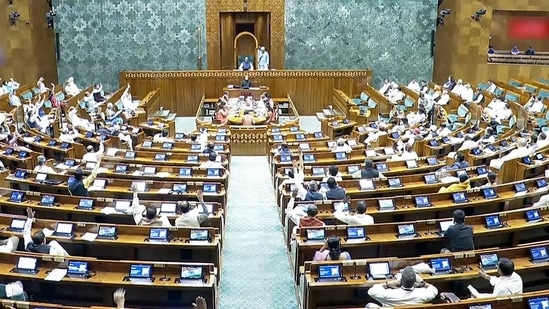
Parliament special session LIVE: Stalin sets delimitation bill copy on fire; Cong calls proposal 'destructive'| India News
# Parliament 2026: Quota & Delimitation Bills
New Delhi, April 16, 2026 — The Indian Parliament convened a historic special session today to introduce three landmark bills that will fundamentally reshape the nation’s electoral landscape. At the center of the legislative agenda are the Delimitation Bill, 2026, and the Constitution (131st Amendment) Bill, 2026, which collectively pave the way for redrawing parliamentary constituencies and finally implementing the much-anticipated 33% Women’s Reservation quota. Prime Minister Narendra Modi championed the push as a monumental milestone for women’s empowerment, even as political battle lines are drawn over the impending and highly controversial redistribution of Lok Sabha seats between India’s northern and southern states. [Source: Hindustan Times | Additional: Parliamentary Bulletins].
## The Legislative Triad: Redefining Representation
As the special session commenced, the Union Government tabled three vital pieces of legislation, signaling a tectonic shift in India’s democratic framework. According to the parliamentary schedule, the bills introduced are:
1. **The Constitution (One Hundred and Thirty-First Amendment) Bill, 2026:** A sweeping constitutional amendment designed to establish the legal framework for the post-2026 electoral matrix, modifying provisions related to the allocation of seats in the House of the People (Lok Sabha) and State Legislative Assemblies.
2. **The Delimitation Bill, 2026:** Legislation establishing an independent Delimitation Commission tasked with updating constituency boundaries and determining the total number of parliamentary seats based on recent demographic data.
3. **The Union Territories Laws (Amendment) Bill, 2026:** A corollary bill addressing the proportional representation and electoral boundaries within India’s Union Territories, ensuring that regions like Delhi, Puducherry, and Jammu & Kashmir are integrated into the broader delimitation framework.
The introduction of these bills initiates a complex process that will ultimately dictate how power is distributed in the world’s largest democracy ahead of the 2029 General Elections. [Source: Hindustan Times | Additional: Constitutional Archives].
## Modi Hails ‘Nari Shakti’ and Women’s Empowerment
Addressing the Lok Sabha before the introduction of the bills, Prime Minister Narendra Modi framed the special session as a victory for “Nari Shakti” (Women’s Power). The foundation for this moment was laid in September 2023 with the passage of the Nari Shakti Vandan Adhiniyam (128th Constitutional Amendment Bill), which mandated a 33% reservation for women in the Lok Sabha and state assemblies.
However, the 2023 legislation contained a crucial caveat: the quota could only be implemented after a new census was published and a subsequent delimitation exercise was completed. By initiating the delimitation process in 2026, the government is officially setting the clock on the women’s reservation rollout.
“Today, we are not just amending laws; we are fulfilling a sacred promise made to the mothers, sisters, and daughters of this nation,” PM Modi stated during his opening remarks. “True women’s empowerment requires structural integration into our highest decision-making bodies. The bills introduced today ensure that the 33% reservation transitions from a legislative promise to a democratic reality.”
The impending quota will involve a complex system of rotational constituencies, ensuring that women’s representation is distributed equitably across the country while maintaining existing sub-quotas for Scheduled Castes (SC) and Scheduled Tribes (ST).
## The Great Delimitation Dilemma: The North-South Divide
While the consensus on women’s reservation remains largely bipartisan, the vehicle delivering it—the Delimitation Bill, 2026—has triggered intense anxiety, particularly among India’s southern states.
To understand the controversy, one must look at the constitutional history of India’s electoral boundaries. In 1976, during the Emergency, the 42nd Amendment froze the state-wise allocation of Lok Sabha seats based on the 1971 Census. The primary rationale was to ensure that states successfully implementing family planning and population control measures were not politically penalized in parliament. In 2001, the 84th Amendment extended this freeze until the publication of the first census taken after the year 2026.
With the freeze now expiring, the new Delimitation Commission will reapportion seats based on current population metrics. Over the last 50 years, northern states like Uttar Pradesh, Bihar, and Rajasthan have seen massive population growth, while southern states like Kerala, Tamil Nadu, Andhra Pradesh, and Karnataka have stabilized their demographics.
If seats are allocated strictly on a proportional population basis, the political center of gravity will shift drastically toward the Hindi-speaking belt. Regional leaders in the south have vehemently argued that they are being “punished for their progress” in human development and population control.
### Projected Demographic Shifts (Hypothetical Seat Allocations)
| Region / State | 1971 Population Share | 2026 Population Share (Est.) | Current Lok Sabha Seats | Projected Impact Without Safeguards |
| :— | :— | :— | :— | :— |
| **Uttar Pradesh** | 16.1% | 19.5% | 80 | **Significant Gain** |
| **Bihar** | 10.4% | 12.8% | 40 | **Significant Gain** |
| **Tamil Nadu** | 7.5% | 5.3% | 39 | **Substantial Loss** |
| **Kerala** | 3.9% | 2.4% | 20 | **Substantial Loss** |
*Note: Data represents demographic trends debated in parliamentary corridors. Actual allocations will depend on the final formulas utilized by the Delimitation Commission.*
## Decoding the Constitution (131st Amendment) Bill, 2026
The political volatility surrounding delimitation is precisely why the Constitution (131st Amendment) Bill, 2026, is the linchpin of the special session. [Source: Hindustan Times | Additional: Public Domain Legal Analysis].
Constitutional analysts suggest that the 131st Amendment is designed to strike a delicate federal balance. While the exact text of the bill is currently under parliamentary debate, it is widely expected to increase the total number of seats in the Lok Sabha. The new Parliament building, inaugurated in 2023, was purposefully constructed with a seating capacity of 888 in the Lok Sabha chamber, anticipating this very expansion.
By expanding the total size of the house rather than merely redistributing the existing 543 seats, the government aims to ensure an absolute “no-loss” scenario for the southern states. In this proposed model, states like Tamil Nadu and Kerala would retain their current number of MPs, while the newly created seats would be allocated to the high-population states in the north.
However, opposition figures argue that even in a “no-loss” scenario, the *relative* and *proportional* strength of the southern states in the lower house will be severely diluted, potentially altering the dynamics of fiscal federalism and resource allocation.
## Union Territories Representation: The Missing Puzzle Piece
Accompanying the major constitutional amendments is the Union Territories Laws (Amendment) Bill, 2026. While states dominate the delimitation discourse, the shifting demographics of India’s Union Territories require recalibration.
The National Capital Territory of Delhi, which currently holds seven Lok Sabha seats, has experienced exponential population growth since the 1971 freeze. Similarly, the political integration of Jammu & Kashmir, following its reorganization in 2019, requires alignment with the newly proposed national electoral quotas.
This specific bill ensures that the Delimitation Commission has the statutory authority to adjust legislative boundaries in UTs, applying the 33% women’s quota to the assemblies of Delhi, Puducherry, and Jammu & Kashmir.
## Expert Analysis: Federalism Under the Microscope
The special session has ignited a fierce debate among constitutional experts and political scientists. The core conflict lies between two democratic principles: the “one person, one vote” doctrine versus the sanctity of the federal compact.
“From a purely democratic standpoint, the current freeze is an anomaly. An MP in Uttar Pradesh currently represents nearly 3 million citizens, while an MP in Kerala represents roughly 1.5 million. This violates the principle of equal representation,” explains Dr. Meenakshi Ramanathan, a senior fellow of constitutional law at a prominent New Delhi think tank. “However, India is a ‘Union of States’. If the southern states, which contribute massively to the national GDP and have achieved demographic stability, feel politically marginalized by a northern super-majority, it could strain the federal fabric of the country.”
Political analysts also point out that tying the women’s reservation quota to this controversial delimitation process was a strategic masterstroke by the ruling government. “By intertwining the universally popular 33% women’s quota with the highly contentious delimitation exercise, the government has made it incredibly difficult for the opposition to block the bills without appearing anti-women,” noted one seasoned parliamentary observer.
## Conclusion: A Defining Epoch for Indian Democracy
The Parliament special session of April 2026 will undoubtedly be remembered as a watershed moment in Indian political history. The introduction of the Constitution (131st Amendment) Bill, the Delimitation Bill, and the Union Territories Laws (Amendment) Bill sets into motion a process that will rewrite the geographical and demographic boundaries of Indian power.
Key takeaways from the session include:
* **The Clock Starts on Women’s Quota:** The 33% reservation for women in legislative bodies moves one step closer to reality, transforming the demographic composition of future parliaments.
* **Expansion of the Lok Sabha:** The anticipated unfreezing of seats will likely result in a heavily expanded lower house, utilizing the full capacity of the new Parliament building.
* **Federal Friction:** The ensuing debates will heavily feature negotiations between the Center and southern states, demanding creative constitutional safeguards to prevent the dilution of regional political agency.
As the bills move toward debate and voting, the Delimitation Commission will face the monumental task of executing this transition impartially. The outcome of this legislative triad will not only redefine the boundaries of constituencies but will permanently alter the character, inclusivity, and regional balance of Indian democracy ahead of the critical 2029 electoral cycle.
***
**By Senior Parliamentary Correspondent, National Political Desk, April 16, 2026.**





