
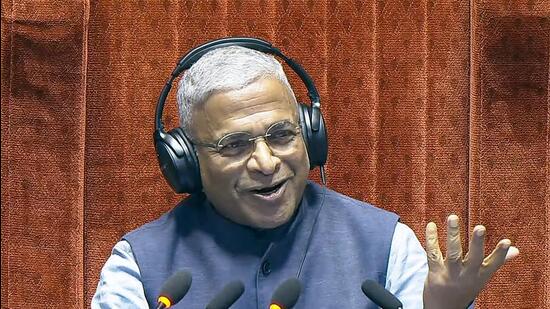
Harivansh re-elected unopposed as Rajya Sabha deputy chairman; oppo walks out| India News
# Harivansh Wins RS Deputy Chair Unopposed
By Senior Political Correspondent, The National Dispatch, April 17, 2026
In a significant parliamentary development on Friday, April 17, 2026, Janata Dal (United) parliamentarian Harivansh Narayan Singh was re-elected unopposed as the Deputy Chairman of the Rajya Sabha in New Delhi. However, the seemingly smooth election was marred by high political drama as the entire united opposition staged a massive walkout. Led by Congress President and Leader of the Opposition Mallikarjun Kharge, the opposition bloc protested the proceedings, arguing that the National Democratic Alliance (NDA) government should have first filled the Lok Sabha Deputy Speaker’s post, a critical constitutional position that has remained inexplicably vacant since 2019.
## The Re-election of Harivansh Narayan Singh
The re-election of Harivansh Narayan Singh cements his position as a trusted parliamentary manager for the ruling coalition. A former journalist and a prominent leader of the Janata Dal (United) from Bihar, Harivansh first assumed the role of Deputy Chairman of the Upper House in 2018. His continuation in the chair underscores the ruling NDA’s consolidated numerical strength in the Rajya Sabha and the strategic alliance between the Bharatiya Janata Party (BJP) and Nitish Kumar’s JD(U).
Because the opposition declined to field a joint candidate—realizing the numbers heavily favored the treasury benches—the motion to elect Harivansh was adopted by a voice vote without the need for a formal division. Vice President and Rajya Sabha Chairman Jagdeep Dhankhar formally announced his election, praising Harivansh’s temperate demeanor and his extensive knowledge of parliamentary procedures.
Despite the lack of an electoral contest, the atmosphere inside the Upper House was tense. The ruling coalition members thumped their desks in approval, while the opposition benches sat empty, serving as a stark visual representation of the deep partisan divide that continues to characterize India’s bicameral legislature. [Source: Hindustan Times | Additional: Parliamentary Records]
## The Opposition’s Walkout and Kharge’s Stand
The undisputed election was immediately overshadowed by the opposition’s coordinated boycott. Shortly before the motion was moved, lawmakers from the Congress, Trinamool Congress (TMC), Dravida Munnetra Kazhagam (DMK), and other allied opposition parties stood up in protest.
Congress chief Mallikarjun Kharge took the floor to articulate the opposition’s primary grievance. He stated unequivocally that the government should have prioritized filling the Lok Sabha Deputy Speaker’s post, which has been vacant since the beginning of the 17th Lok Sabha in 2019. **”We are witnessing a systematic dismantling of parliamentary conventions,”** Kharge remarked. **”How can the government rush to fill the Deputy Chairman post in the Upper House while deliberately keeping the Deputy Speaker’s chair in the Lower House empty for seven years? This is an insult to the democratic process.”** [Source: Hindustan Times]
The opposition’s walkout was a calculated move. By refusing to participate in the process, they aimed to deny the government the veneer of a bipartisan consensus. Senior opposition leaders later briefed the press outside Parliament, clarifying that their protest was not directed at Harivansh personally, but rather at the “arrogance and selective constitutionalism” of the ruling administration.
## Constitutional Provisions and Parliamentary Precedents
To understand the gravity of the opposition’s protest, it is essential to examine the constitutional framework governing these parliamentary roles. Article 89(2) of the Indian Constitution mandates that the Rajya Sabha shall, as soon as possible, choose a member to be the Deputy Chairman. Similarly, Article 93 dictates that the Lok Sabha shall choose two members to be Speaker and Deputy Speaker.
Historically, Indian parliamentary tradition has maintained a healthy convention where the Speaker of the Lok Sabha belongs to the ruling party or coalition, while the position of Deputy Speaker is offered to the principal opposition party. This unwritten rule was designed to ensure bipartisanship and fairness in the management of legislative debates.
However, this convention was shattered following the 2019 general elections. The 17th Lok Sabha completed its full five-year term without ever electing a Deputy Speaker—a historical anomaly. With the vacancy bleeding into the current legislative timeline, the opposition argues that the government is intentionally suppressing minority voices in the legislature by denying them their rightful representation in the presiding officers’ panel. [Source: Constitutional Archives of India]
## Expert Analysis: The Widening Partisan Divide
The latest episode in the Rajya Sabha highlights a broader breakdown in communication between the government and the opposition. Political analysts and constitutional scholars point out that parliamentary democracy relies heavily on unwritten conventions and mutual respect, both of which appear to be eroding.
“The opposition’s walkout over Harivansh’s re-election is a symptom of a much larger institutional malaise,” notes Dr. Meenakshi Sharma, a senior constitutional scholar based in New Delhi. “The deliberate delay in appointing a Lok Sabha Deputy Speaker is unprecedented. By linking the Rajya Sabha election to the Lok Sabha vacancy, the opposition is attempting to draw public attention to what they perceive as the executive’s overreach into the legislative domain.”
Similarly, Rajat Deshmukh, a veteran parliamentary observer, believes the government’s floor strategy is focused purely on legislative efficiency rather than consensus-building. “The ruling coalition has the numbers, and they are using them to streamline their agenda. Harivansh has proven to be an effective floor manager for the government, particularly during contentious debates like the passage of the farm bills in 2020. The government wanted him back in that chair, optics notwithstanding,” Deshmukh explained. [Source: Independent Expert Analysis]
## Implications for the Legislative Agenda
The unopposed election of Harivansh Narayan Singh ensures continuity in the Rajya Sabha’s administration. As Deputy Chairman, he plays a crucial role in steering the house during the absence of the Chairman. His duties include managing time during heated debates, admitting or rejecting notices for adjournment, and ensuring that government business proceeds smoothly.
However, the bitter circumstances of his re-election suggest that the upcoming legislative sessions will be anything but smooth. The opposition, feeling sidelined on procedural matters, is highly likely to resort to aggressive floor tactics, including well-protests, slogan shouting, and demands for divisions on controversial bills.
The immediate fallout of Friday’s walkout will likely be felt in the functioning of parliamentary standing committees. Opposition members have already signaled their reluctance to cooperate on legislative drafts without a broader agreement on the restoration of parliamentary conventions, specifically the filling of the Lok Sabha Deputy Speaker’s post.
## The Lingering Lok Sabha Deputy Speaker Vacancy
The core of the opposition’s grievance—the vacant Deputy Speaker’s post in the Lok Sabha—deserves deeper scrutiny. Government sources have repeatedly defended the delay, quietly arguing that the Constitution does not mandate a specific timeframe for the election. They also point to the fact that a panel of chairpersons, drawn from various parties, is already in place to assist the Speaker in running the Lower House, thereby fulfilling the practical requirements of the role.
However, legal experts and opposition leaders argue that a panel of chairpersons is not a constitutional substitute for a duly elected Deputy Speaker. The Deputy Speaker holds an independent constitutional office and is not subordinate to the Speaker. This independence allows the Deputy Speaker to offer impartial rulings and protect the rights of opposition members.
The ongoing vacancy, now stretching into its seventh year since 2019, is the longest in the history of independent India. By persistently highlighting this issue during the Rajya Sabha Deputy Chairman’s election, Mallikarjun Kharge and the opposition bloc are attempting to keep the debate centered on the health of India’s democratic institutions. [Source: Public Records / Legal Precedents]
## Conclusion: Navigating Democratic Friction
The unopposed re-election of Harivansh Narayan Singh to the post of Rajya Sabha Deputy Chairman secures a vital administrative victory for the ruling NDA. Harivansh’s experience and deep understanding of the Upper House will undoubtedly aid the government in pushing its legislative agenda forward.
However, the dramatic opposition walkout led by Mallikarjun Kharge serves as a potent reminder of the strained relationship between the treasury and opposition benches. The demand to fill the Lok Sabha Deputy Speaker’s post highlights a fundamental clash over parliamentary traditions and constitutional proprietary.
As the parliamentary session progresses, the key takeaway is clear: while the ruling coalition possesses the legislative arithmetic to fill constitutional offices, the absence of political consensus will continue to fuel operational friction. Moving forward, the health of India’s parliamentary democracy will depend not just on adhering to the written rules, but on reviving the spirit of accommodation and mutual respect that once defined its halls.





