
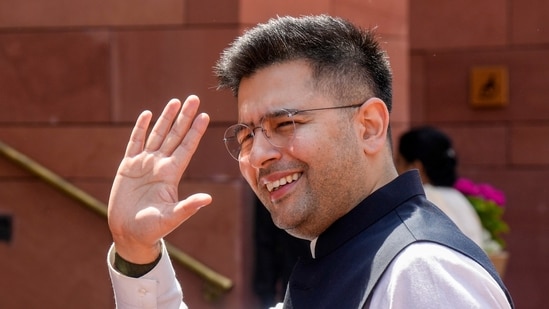
‘I am the recently removed deputy leader’: Chadha's jibe at AAP in Rajya Sabha| India News
# Chadha Mocks AAP Over Rajya Sabha Deputy Post
By Senior Political Correspondent, The National Brief, April 17, 2026
**New Delhi:** In a rare display of intra-party friction spilling onto the parliamentary floor, Aam Aadmi Party (AAP) Member of Parliament Raghav Chadha took a veiled jibe at his own party’s leadership during a Rajya Sabha session on Friday, April 17, 2026. Speaking during a critical debate in the Upper House, Chadha wryly introduced himself as the “recently removed deputy leader” of AAP. He further drew attention to the absence of his successor, Ashok Kumar Mittal, utilizing his allotted parliamentary time to underscore shifting internal dynamics within AAP’s national leadership structure. This public expression of discontent highlights the ongoing organizational reshuffles within India’s prominent opposition party as it navigates complex political terrain ahead of upcoming state elections. [Source: Hindustan Times].
## The Incident in the Upper House
The Rajya Sabha, often characterized by its stringent adherence to decorum and procedural gravity, witnessed an unusual moment of self-deprecating political irony on Friday afternoon. Raghav Chadha, widely recognized as one of AAP’s most articulate and visible young faces, was granted the floor to articulate the party’s stance on pending legislative business. However, before delving into the substance of his address, Chadha chose to contextualize his standing within his own political outfit.
“I am the recently removed deputy leader,” Chadha remarked to the Chair, a statement that immediately elicited murmurs across the aisles. He did not stop at his own demotion but proceeded to highlight the empty seat of the man who replaced him. “The newly appointed deputy leader of the party I belong to is also not present in the House,” Chadha added, explicitly referring to AAP MP Ashok Kumar Mittal. [Source: Hindustan Times].
The comment, delivered with Chadha’s signature blend of rhetorical sharpness and feigned innocence, was undeniably aimed at the AAP high command. Parliamentary observers noted that while intra-party reshuffles are routine in democratic institutions, it is exceptionally rare for an active parliamentarian to utilize floor time to broadcast personal grievances regarding internal party appointments. The incident immediately went viral on digital platforms, prompting widespread speculation regarding Chadha’s current equation with AAP’s top leadership.
## The Context of the Leadership Reshuffle
To understand the weight of Chadha’s Friday jibe, one must examine the recent organizational changes within the AAP’s parliamentary committee. Until recently, Raghav Chadha served as the party’s Deputy Leader in the Rajya Sabha. In this role, he was responsible for floor coordination, strategizing with other opposition blocs, and serving as the primary attack dog against the ruling Bharatiya Janata Party (BJP) during high-stakes debates. His aggressive debating style and deep understanding of legal and constitutional matters made him a natural fit for the role.
However, in a sudden move earlier this month, the AAP Political Affairs Committee (PAC) restructured its parliamentary leadership. While veteran leader Sanjay Singh retained his position as the Leader of the Party in the Rajya Sabha, Chadha was quietly replaced by Ashok Kumar Mittal as the Deputy Leader.
The party officially characterized this change as a routine rotation designed to give diverse voices within the party an opportunity to take on leadership roles. Privately, however, political corridors in New Delhi buzzed with rumors that the reshuffle was a strategic move to pacify different regional factions, particularly within the Punjab unit from which both Chadha and Mittal draw their Rajya Sabha mandates.
## Profile of the Parliamentarians: Chadha vs. Mittal
The contrast between the “recently removed” deputy leader and his successor is stark, reflecting a potential shift in AAP’s parliamentary strategy.
**Raghav Chadha:** A chartered accountant by profession, Chadha is a foundational member of AAP. He has been a loyalist to the party’s core leadership and played pivotal roles in AAP’s electoral victories in Delhi and Punjab. His approach in Parliament is highly visible, media-friendly, and combative.
**Ashok Kumar Mittal:** Mittal brings a very different pedigree to the Upper House. He is the founder and Chancellor of Lovely Professional University (LPU), one of India’s largest private educational institutions. Nominated to the Rajya Sabha from Punjab by AAP, Mittal represents the intellectual and entrepreneurial capital the party sought to align with in the state. His parliamentary style is generally perceived as more subdued, academic, and behind-the-scenes compared to Chadha’s frontline aggression.
| Trait/Background | Raghav Chadha | Ashok Kumar Mittal |
| :— | :— | :— |
| **Professional Background** | Chartered Accountant | Academic Administrator / Chancellor (LPU) |
| **Party Affiliation Timeline** | Founding member / Long-term loyalist | Later entrant via Punjab RS nomination |
| **Parliamentary Style** | Aggressive, media-forward, vocal | Subdued, policy-focused, low-profile |
| **Previous Role** | Deputy Leader of AAP in RS | Member of various standing committees |
| **Current Role** | Rajya Sabha MP | Deputy Leader of AAP in RS |
By drawing attention to Mittal’s absence during a crucial session, Chadha subtly questioned the effectiveness of the leadership transition. The implication was clear: the party had replaced an ever-present, hyper-active deputy with one who was not even on the floor when required.
## Expert Perspectives on AAP’s Internal Dynamics
Political analysts view this development as symptomatic of the growing pains AAP continues to face as it matures from an anti-corruption movement into a formalized national party.
Dr. Sunita Varma, a New Delhi-based political scientist and author of several works on contemporary Indian political structures, notes that Chadha’s public grievance is a calculated risk. “Raghav Chadha is too astute a politician to make an off-the-cuff remark in the Rajya Sabha without understanding its implications,” Dr. Varma explains. “This jibe was a message to the AAP high command that his demotion has not been accepted gracefully. Furthermore, by pointing out Mittal’s absence, Chadha is attempting to prove to the party leadership that operational efficiency in Parliament is suffering due to political appeasement.” [Source: Independent Political Analysis].
Similarly, veteran parliamentary correspondent Rajesh Kumar suggests that the incident points to potential friction within the Punjab cohort of AAP MPs. “AAP’s massive victory in Punjab brought an influx of diverse leaders into the Rajya Sabha—from grassroots workers to billionaire educators. Balancing the egos and ambitions of this diverse group is proving to be a headache for the central leadership. Chadha, who was considered the ‘super CM’ by his detractors during the early days of the Punjab government, might be feeling sidelined by the elevation of figures like Mittal.”
## Broader Implications for the Opposition Strategy
The timing of this internal friction is less than ideal for the broader opposition strategy in the Rajya Sabha. In the current parliamentary configuration of 2026, every seat and every leadership role matters in the opposition’s attempt to counter the ruling NDA coalition.
The Deputy Leader of a party acts as the crucial whip-hand, ensuring members are present for voting, coordinating walkouts, and negotiating time allocations with the Chairman. If the newly appointed Deputy Leader, Ashok Kumar Mittal, is absent during key debates—as Chadha pointed out—it compromises AAP’s ability to punch above its weight in the Upper House.
Furthermore, Chadha’s public airing of grievances provides political ammunition to the BJP. Ruling party members were seen smiling and thumping their desks in mock sympathy when Chadha made his statement. For a party like AAP, which prides itself on tight discipline and a unified public front, such displays of discord are highly uncharacteristic and damaging to its institutional credibility.
## Conclusion and Future Outlook
Raghav Chadha’s wry admission of being the “recently removed deputy leader” is more than just a fleeting parliamentary soundbite. It is a window into the evolving, and sometimes turbulent, internal mechanics of the Aam Aadmi Party in 2026.
**Key Takeaways:**
* **Public Discontent:** Chadha’s willingness to vocalize his demotion on the Rajya Sabha floor indicates a significant level of frustration with the party’s recent organizational decisions.
* **Question of Merit vs. Representation:** The transition from Chadha to Ashok Kumar Mittal highlights AAP’s ongoing struggle to balance aggressive parliamentary representation with the need to accommodate influential regional figures from Punjab.
* **Operational Void:** Mittal’s absence, highlighted by Chadha, raises legitimate questions about AAP’s floor management and tactical readiness in the Upper House under its new leadership structure.
Looking ahead, the AAP leadership will need to engage in swift damage control to prevent this solitary jibe from escalating into a deeper factional rift. Raghav Chadha remains one of the party’s most recognizable and popular figures among the youth demographic. Marginalizing him entirely in Parliament could lead to further alienation. Conversely, Ashok Kumar Mittal will now be under intense scrutiny; he must step visibly into his role as Deputy Leader to silence critics who view his appointment as merely ceremonial.
As the 2026 parliamentary sessions progress, all eyes will be on the AAP benches in the Rajya Sabha—not just to see how they debate the government, but to watch how they navigate the increasingly complex dynamics among themselves.





