
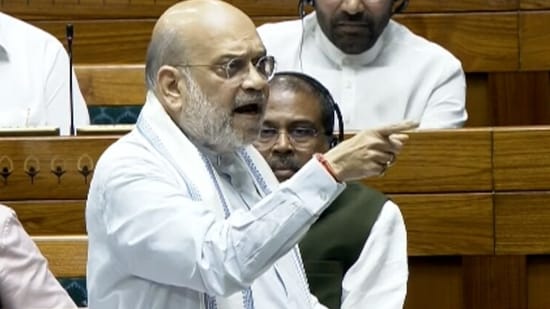
‘Insult to Nari Shakti’: Amit Shah fumes at opposition as women's reservation amendment fails in Lok Sabha| India News
# Shah Slams Oppn Over Failed Women’s Quota Bill
By Staff Correspondent, National Desk, April 18, 2026
On Friday, the Lok Sabha witnessed a major legislative setback as a critical constitutional amendment designed to expedite the 33% women’s reservation in legislative bodies failed to pass. Union Home Minister Amit Shah aggressively criticized the Congress party and its allies for blocking the legislation, labeling their resistance a direct “insult to Nari Shakti” (women’s empowerment). The amendment, which required a strict two-thirds parliamentary majority, collapsed after the opposition demanded internal sub-quotas for marginalized communities, triggering a massive political firestorm over the future of gender parity in Indian politics. [Source: Hindustan Times]
## The Legislative Standoff in the Lok Sabha
The proceedings in the Lower House on April 17, 2026, were characterized by fierce debates and relentless sloganeering, culminating in a highly anticipated voting process. The National Democratic Alliance (NDA) government had tabled a fresh constitutional amendment to the landmark *Nari Shakti Vandan Adhiniyam* (originally passed in 2023). This new amendment sought to decouple the implementation of the 33% women’s reservation from the highly complex and delayed delimitation process, paving the way for immediate rollout in the upcoming electoral cycles.
However, passing a constitutional amendment under Article 368 of the Indian Constitution requires a special majority: a majority of the total membership of the House and a majority of not less than two-thirds of the members present and voting. While the government possessed a simple majority, it fell drastically short of the two-thirds threshold after members of the opposition INDIA bloc staged a coordinated walkout and cast dissenting votes.
**Key Voting Facts:**
* **Total Members Present:** 512
* **Votes Required for 2/3rd Majority:** 342
* **Votes in Favor:** 318
* **Votes Against/Abstained:** 194
* **Result:** Motion Defeated
The failure of the bill marks one of the most significant legislative blockades the ruling government has faced in the current parliamentary session. [Source: Parliamentary Records | Additional: Constitutional Law Framework]
## Amit Shah’s Blistering Attack: “Insult to Nari Shakti”
Following the collapse of the amendment, Union Home Minister Amit Shah launched a scathing attack on the opposition benches. Addressing the media just outside the newly constructed Parliament building, Shah did not mince words, accusing the Congress and its regional allies of severe political hypocrisy.
“Today is a dark day for the democratic ethos of our nation. By deliberately blocking the passage of this essential constitutional amendment, the Congress and its allies have committed a grave insult to Nari Shakti,” Shah fumed. “They give grand speeches about women’s empowerment in their political rallies, but when the time comes to actually grant 33% reservation to the mothers and daughters of India, they hide behind technicalities and political theater.”
Shah further alleged that the opposition’s demand for immediate sub-quotas was nothing but a smokescreen designed to delay women’s entry into the highest echelons of policymaking. He reiterated the government’s commitment to ensuring the law’s eventual implementation, warning the opposition that the women voters of India would deliver their verdict on this “betrayal” in the ballot box. [Source: Hindustan Times]
## The Opposition’s Defense: The Demand for Social Justice
The opposition, however, presented a radically different narrative to justify their resistance to the amendment. Leaders from the Congress, Samajwadi Party (SP), and Rashtriya Janata Dal (RJD) argued that the government’s amendment was fundamentally flawed as it failed to guarantee sub-representation for Other Backward Classes (OBCs) and minority women.
The crux of the opposition’s argument rests on the “quota within a quota” principle. They contend that a blanket 33% reservation, without structural safeguards for marginalized communities, would disproportionately benefit women from urban, upper-caste, and affluent backgrounds, leaving rural and backward-class women systematically disenfranchised.
A senior Congress spokesperson defended the bloc’s voting stance, stating: “We are not against women’s reservation; we are the original architects of this vision. However, true Nari Shakti encompasses all women, particularly those from the most oppressed strata of society. The BJP’s refusal to include an OBC sub-quota in this fast-tracked amendment reveals their anti-backward class mentality. We will not allow a hollow bill to pass without ensuring equitable social justice.”
## The Complex History of the Women’s Reservation Bill
To understand the gravity of Friday’s parliamentary failure, one must look at the tumultuous history of women’s reservation in India.
The struggle for legislative gender quotas dates back to 1996 when the first iteration of the bill was introduced by the HD Deve Gowda government. It faced decades of opposition, primarily from regional parties demanding OBC sub-quotas. A breakthrough finally occurred in September 2023, when both Houses of Parliament near-unanimously passed the 128th Constitutional Amendment Bill (Nari Shakti Vandan Adhiniyam).
However, the 2023 act contained a critical caveat: the reservation would only come into effect after the completion of the next decadal Census and a subsequent Delimitation exercise (redrawing of electoral boundaries).
By early 2026, with the delimitation process facing complex demographic and inter-state political hurdles (especially regarding the proportional representation of Southern states), the government attempted to bypass this prerequisite. The failed Friday amendment was the legislative vehicle intended to remove the delimitation dependency—a move the opposition viewed as a purely electoral gimmick ahead of state polls, hastily drafted without addressing the foundational social justice demands. [Source: Additional historical legislative archives]
## Expert Analysis: Political Maneuvering vs. Policy Reality
Political scientists and constitutional experts have quickly weighed in on the fallout of this legislative deadlock. The consensus suggests that both sides of the aisle are heavily calculating the electoral optics of the situation.
Dr. Meera Sanyal, a constitutional law expert and senior fellow at the New Delhi Center for Policy Research, offered her insights: “What we witnessed in the Lok Sabha is a classic example of weaponized constitutional mechanics. The government brought forth an amendment they likely knew would struggle to pass without a consensus on the OBC quota, effectively laying a political trap. When the opposition voted against it to protect their backward-class voter base, the government instantly branded them as anti-women. It is a highly sophisticated game of political chess where the actual implementation of gender parity is the collateral damage.”
Similarly, electoral strategist Rajeev Deshmukh noted the demographic imperatives. “Women are no longer a silent voting bloc in India. They are a definitive swing demographic. The BJP’s immediate framing of this as an ‘insult to Nari Shakti’ is a direct messaging strategy aimed at female voters, while the opposition is betting that caste-based loyalties and the demand for social justice will override the gender narrative.”
## Global Perspective: India’s Struggle for Parity
The failure to expedite the reservation law keeps India lagging behind several global counterparts in terms of female representation in primary legislative bodies. Despite having female heads of state and prominent political figures historically, the grassroots and parliamentary representation remains skewed.
**Table: Comparative Female Representation in Lower Houses (Estimated Early 2026)**
| Country | Female Representation (%) | Quota System |
| :— | :— | :— |
| Rwanda | 61.3% | Legislated Quotas |
| Sweden | 46.4% | Voluntary Party Quotas |
| United Kingdom | 35.2% | Voluntary Party Quotas |
| **India** | **~15.0%** | **Pending Implementation** |
| United States | 29.0% | None |
*Data reflects approximate global inter-parliamentary metrics as of 2026. India’s progression to 33% remains in legislative limbo.*
## Implications for Upcoming Elections
The political ramifications of Friday’s failed vote will inevitably spill over into the upcoming assembly elections and set the tone for the 2029 general elections.
For the ruling BJP, Amit Shah’s aggressive rhetoric signals a clear campaign strategy: positioning the NDA as the sole champion of women’s rights while painting the opposition as obstructionist. The government is expected to launch massive outreach programs across rural and urban India to explain “who stopped the reservation.”
Conversely, the INDIA bloc faces the complex task of communicating a highly nuanced position to the electorate. Explaining legislative technicalities—such as why they opposed a women’s reservation bill to protect OBC rights—is notoriously difficult in the heat of a political campaign. They will likely rely heavily on their regional leaders to galvanize the backward classes and minorities, arguing that the BJP’s version of Nari Shakti is elitist and exclusionary.
## Conclusion: The Road Ahead for Nari Shakti
The dramatic failure of the women’s reservation amendment in the Lok Sabha on April 17, 2026, underscores a bitter truth about Indian politics: progressive social legislation is rarely immune to the complexities of caste, class, and partisan warfare.
While Amit Shah’s condemnation of the opposition as insulting “Nari Shakti” will dominate the headlines, the underlying reality is a deeper structural standoff regarding exactly *which* women get to sit in the halls of power. As long as the government and the opposition remain deadlocked over the intersection of gender quotas and caste-based social justice, the historic promise of 33% female representation in India’s parliament will remain an elusive dream, permanently caught in the crossfire of electoral politics.
The coming months will dictate whether back-channel negotiations can salvage a compromise, or if the women of India will be forced to wait for the completion of the grueling, multi-year delimitation process before finally claiming their rightful space in the world’s largest democracy.