
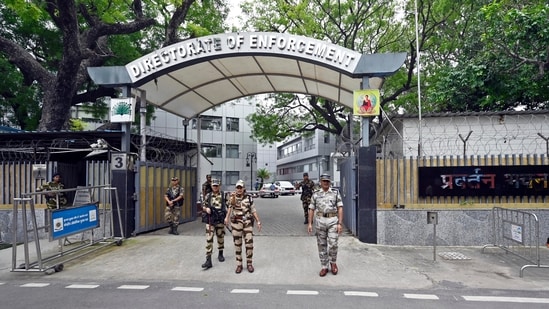
ED raids nine places in Bengal in Public Distribution System 'scam' case| India News
# ED Raids 9 Bengal Sites in PDS Scam Probe
**By Siddharth Narayan, National Desk | April 25, 2026**
The Enforcement Directorate (ED) launched a series of sweeping, coordinated raids across nine locations in West Bengal early Saturday morning, intensifying its ongoing probe into the multi-crore Public Distribution System (PDS) scam. The operations, which commenced at dawn on April 25, 2026, are specifically targeting the commercial and residential premises of prominent food grain suppliers and exporters situated in **Kolkata**, **Burdwan**, and **Habra**. Armed with fresh intelligence regarding the cross-border diversion of subsidized rations, central investigative officers are scrutinizing financial records, digital devices, and shell company networks that allegedly facilitated the massive embezzlement of state resources meant for impoverished citizens. [Source: Hindustan Times].
## Sweeping Crackdown Across Key Districts
The Saturday morning crackdown marks a significant escalation in the ED’s multi-year investigation under the **Prevention of Money Laundering Act (PMLA)**. Escorted by heavily armed personnel from the Central Armed Police Forces (CAPF) to prevent a repeat of the violent mob attacks witnessed during similar raids in early 2024, ED officials simultaneously entered nine distinct properties.
In **Kolkata**, the focus remained tightly concentrated on corporate offices located in the central business district of Dalhousie and upscale residential apartments in Ballygunge. These locations are reportedly linked to high-profile agro-commodity exporters suspected of laundering the proceeds of the diverted PDS grains.
Meanwhile, in **Burdwan**—often referred to as the “rice bowl” of West Bengal—the agency targeted massive rice milling complexes and the homes of influential mill owners. Intelligence suggests these mills acted as the primary hubs where subsidized government paddy was milled and illicitly redirected into the open market. In **Habra**, a strategic town in the North 24 Parganas district near the international border, raids focused on local suppliers and transport syndicate operators who managed the logistical movement of the stolen grains. [Source: Hindustan Times | Additional: Public records on ED operational protocols].
“The geographic spread of these raids is not coincidental. Burdwan provides the grain, Habra provides the border proximity for illicit movement, and Kolkata provides the corporate veneer to launder the money,” explains Dr. Arijit Sen, a Kolkata-based independent economic offenses analyst. “The agency is now striking at the logistical and financial nervous system of this syndicate.”
## The Anatomy of the PDS Syndicate
To understand the gravity of the April 2026 raids, one must dissect the complex *modus operandi* of the West Bengal PDS scam, which authorities estimate to be worth upwards of **₹10,000 crore**. The Public Distribution System is designed to provide heavily subsidized food grains to citizens below the poverty line under the National Food Security Act (NFSA).
However, investigators allege that a deeply entrenched nexus of politicians, bureaucrats, mill owners, and ration distributors systematically hijacked this supply chain.
The mechanism operated in three distinct phases:
1. **Procurement Fraud:** Fake farmer entities were created to sell non-existent paddy to the government at Minimum Support Price (MSP), siphoning off direct benefit transfers.
2. **Milling Diversion:** Subsidized grains meant for ration shops were deliberately diverted to private flour and rice mills. Here, the stock was illegally mixed with lower-grade commercial grains or repackaged entirely.
3. **Open Market Sales:** The repackaged, high-quality PDS grain was then sold in the open market at premium rates, completely bypassing the intended impoverished beneficiaries.
The cash generated from these open-market sales was then layered through a labyrinth of shell companies to purchase real estate, fund political campaigns, and invest in legitimate corporate enterprises. [Source: Publicly filed ED charge sheets 2023-2025].
## Following the Money: Exporters Under Scanner
The most alarming revelation prompting this weekend’s raids is the “export angle.” The RSS snippet from Hindustan Times explicitly highlights that the premises linked to **”exporters”** are currently under the scanner.
According to sources close to the Directorate, the syndicate did not merely sell the diverted grains in domestic open markets. Taking advantage of global wheat and rice shortages over the past few years, these operators allegedly utilized front companies to export the stolen Indian PDS grains to neighboring countries, including Bangladesh, Nepal, and parts of Southeast Asia.
By invoicing these exports through legitimate corporate entities in Kolkata, the syndicate successfully converted illicit domestic goods into clean foreign exchange. The ED is currently seizing export ledgers, shipping bills, and bank statements at the Kolkata and Habra locations to trace the hawala networks that brought this money back into the Indian economy.
“When you move from domestic diversion to international export, you are not just defrauding the state exchequer; you are violating the Foreign Exchange Management Act (FEMA) and manipulating national export quotas,” notes Meera Sanyal, a senior advocate specializing in financial law at the Supreme Court of India. “This elevates the PDS scam from a regional corruption case to a matter of national economic security.”
## Political Fallout and State Response
The PDS scam has been a political powder keg in West Bengal since the explosive arrests of former state food minister Jyotipriya Mallick and businessman Bakibur Rahaman in late 2023. As the investigation stretched through 2024 and 2025, ensnaring multiple grassroots leaders and municipal figures, the ruling Trinamool Congress (TMC) has consistently accused the Bharatiya Janata Party (BJP)-led central government of weaponizing federal agencies.
Following the news of the Saturday raids in Burdwan, Kolkata, and Habra, political battle lines were swiftly drawn once again. Opposition parties, including the BJP and the CPI(M), held impromptu press conferences demanding broader accountability, suggesting that the “exporters” currently being raided are merely frontmen for higher-ranking political figures.
Conversely, state government representatives have reiterated their stance that the ED’s actions are timed to disrupt local political ecosystems. They maintain that the state had already initiated internal audits of the ration distribution network and digitized ration cards to weed out ghost beneficiaries long before the central agencies intervened.
Despite the political rhetoric, the undeniable trail of cash, properties, and digital evidence recovered in previous raids has kept the judicial pressure mounting. The Calcutta High Court has repeatedly observed the severity of the allegations, urging central agencies to bring the matter to a logical, legal conclusion without unnecessary delays.
## Timeline of the Bengal Ration Scam
To contextualize the ongoing operations, it is crucial to review the trajectory of this massive investigation:
| Date/Period | Key Event | Significance |
| :— | :— | :— |
| **Oct 2023** | Arrest of Bakibur Rahaman & Jyotipriya Mallick | ED exposes the initial nexus between mill owners and the state food ministry. |
| **Jan 2024** | Sandeshkhali ED Attack | Mob attacks ED officers raiding TMC leader Shahjahan Sheikh, highlighting the violent defense of the syndicate. |
| **Mid-2024** | Expansion of PMLA Probe | Thousands of ghost ration cards cancelled; ED traces ₹2,000 crore invested in real estate and film production. |
| **2025** | Supplementary Charge Sheets Filed | Lower-rung distributors and transport syndicate heads formally charged; court attaches properties worth hundreds of crores. |
| **April 25, 2026** | Raids on Exporters (Current) | Investigation pivots to the international laundering of grains via Kolkata, Burdwan, and Habra-based shell exporters. |
*[Data compiled from accumulated public records and official ED press releases spanning 2023-2026]*
## Legal and Economic Implications
The systemic theft from the Public Distribution System represents a dual tragedy. Economically, it represents a massive hemorrhage of taxpayer funds. The central and state governments spend thousands of crores annually to procure grains at MSP to support farmers and distribute them at highly subsidized rates to support the poor. When these grains are diverted, both the taxpayer and the impoverished citizen are defrauded.
Legally, the ED’s focus on the PMLA means the burden of proof heavily disadvantages the accused. Under Section 45 of the PMLA, securing bail is notoriously difficult, as the court must be satisfied that the accused is *prima facie* not guilty. This stringency explains why key figures arrested in 2023 and 2024 remain incarcerated as of April 2026.
If the digital evidence seized from the nine locations in Saturday’s raids confirms the export-laundering hypothesis, the ED will likely file a fresh supplementary charge sheet. This could potentially implicate customs clearance agents, banking officials who approved the Letters of Credit, and international trading partners, vastly expanding the scope of the trial.
## Conclusion: What Lies Ahead?
The Enforcement Directorate’s coordinated raids across Kolkata, Burdwan, and Habra on April 25, 2026, signal a critical maturation of the Bengal PDS scam investigation. By shifting focus from the local politicians and millers to the corporate exporters and financial facilitators, the agency is attempting to dismantle the very architecture that allowed regional corruption to plug into global financial networks.
As the raids continue into the weekend, the immediate outcomes will likely involve the freezing of corporate bank accounts, the seizure of digital hard drives, and the issuance of summons to the directors of the targeted export firms.
For the citizens of West Bengal, the unfolding saga serves as a stark reminder of the vulnerabilities within state welfare programs. The ultimate success of this investigation will not just be measured in arrests or attached properties, but in whether it forces sweeping, foolproof technological reforms in how subsidized food is procured and distributed to the millions who genuinely depend on it.





