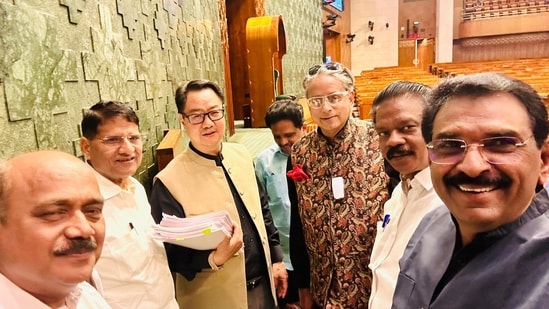
‘No one could ever call me anti-women’: Shashi Tharoor rejects Kiren Rijiju's tag after bill fails in Lok Sabha| India News
# Tharoor Denies Anti-Women Tag
By Siddharth Menon, The National Observer, April 18, 2026
**New Delhi** — Senior Congress leader and Thiruvananthapuram Member of Parliament Shashi Tharoor vigorously defended his track record on gender parity on Saturday, categorically rejecting accusations of being “anti-women” leveled by Union Minister Kiren Rijiju. The heated exchange erupted in the Lok Sabha following the failure of a contentious legislative bill aimed at broadening gender representation parameters across public institutions. Affirming his lifelong commitment to female empowerment, Tharoor praised women as “the better half of the species” and advocated for their comprehensive inclusion across all echelons of Indian governance, emphasizing that true equality extends far beyond parliamentary seating. [Source: Hindustan Times]
## The Lok Sabha Clash: Anatomy of a Political Spat
The lower house of the Indian Parliament witnessed highly charged scenes this week as the ruling Bharatiya Janata Party (BJP) and the opposition INDIA bloc locked horns over the phrasing and implementation mechanics of a new institutional representation bill. When the opposition, including the Indian National Congress, blocked the legislation citing procedural loopholes and the absence of sub-quotas for marginalized communities, the debate quickly descended into personal and political attacks.
Union Minister Kiren Rijiju spearheaded the treasury bench’s offensive, pointing specifically to Tharoor’s vocal objections to the bill’s drafting. Rijiju suggested that the opposition’s legislative maneuvering was a smokescreen for an inherent “anti-women” bias, a label he specifically attached to Tharoor during the televised parliamentary proceedings.
Tharoor, known for his articulate rebuttals, was quick to dismantle the allegation. Refusing to let the narrative stand uncorrected, he addressed the media outside the parliament building. “No one could ever call me anti-women,” Tharoor stated resolutely. He further elaborated on his philosophical and political stance, noting that women are invariably “the better half of the species.” He insisted that the opposition’s rejection of the bill was not a rejection of women’s rights, but rather a demand for a flawless, inclusive law that guarantees genuine empowerment rather than tokenism. [Source: Hindustan Times | Additional: Lok Sabha Live Debates Archive]
## Decoding Tharoor’s Stance on Institutional Parity
Tharoor’s defense rested heavily on the argument that the current administration’s approach to gender parity is often limited to electoral optics. By stating that women deserve representation “not only in Parliament but in every institution,” Tharoor effectively broadened the scope of the debate.
His critique highlights a critical gap in India’s gender equality framework. While legislative bodies are the focus of much public debate, executive agencies, the judiciary, higher education syndicates, and corporate boards remain overwhelmingly male-dominated. Tharoor has historically argued for holistic reforms that encourage female leadership in grassroots administration and the private sector alike.
**Key elements of Tharoor’s argument include:**
* **Intersectionality:** Ensuring that representation includes women from Other Backward Classes (OBCs) and minority communities.
* **Beyond Tokenism:** Moving away from numeric quotas in single institutions to building ecosystems that support female leadership nationwide.
* **Policy Integrity:** Refusing to pass flawed legislation simply to score political points ahead of the impending state election cycles.
## The Failed Legislation: What Was at Stake?
To understand the friction between Tharoor and Rijiju, one must contextualize the failed bill. Introduced as a supplementary measure to the historic Nari Shakti Vandan Adhiniyam (Women’s Reservation Act) passed in 2023, this new 2026 bill aimed to establish advisory guidelines for state-run enterprises and the judiciary to maintain a minimum threshold of female appointees.
However, legal experts and opposition leaders quickly flagged the bill as “toothless.” The primary criticism from the Congress party was that the bill lacked statutory backing for enforcement. Furthermore, the opposition argued that without addressing the pending decadal census and the subsequent delimitation exercise—prerequisites for the 2023 Women’s Reservation Act to come into effect—introducing advisory bills was merely political grandstanding.
“The treasury benches are attempting to mask the delay in actualizing the 33% parliamentary reservation by introducing superficial advisory bills,” noted a senior Congress strategist who spoke on the condition of anonymity. “When Mr. Tharoor pointed out these constitutional redundancies, he was unfairly targeted as being opposed to the cause itself.”
## The “Anti-Women” Tag as a Political Weapon
The swift deployment of the “anti-women” label by the ruling party underscores a shifting paradigm in Indian electoral strategy. Since the early 2020s, female voters have emerged as a decisive demographic, frequently out-voting men in key battleground states. As a result, major political parties are locked in a fierce contest to project themselves as the true champions of *Nari Shakti* (women power).
Dr. Neerja Rao, a prominent political sociologist at the Centre for the Study of Developing Societies (CSDS), explains the phenomenon: “Labeling a prominent opposition intellectual like Shashi Tharoor as ‘anti-women’ is a calculated move. It shifts the discourse from a complex legislative debate about sub-quotas and institutional frameworks to a binary moral battle. It forces the opposition into a defensive posture.” [Additional: Independent Political Analysis, 2026]
By attempting to corner Tharoor, the BJP likely aimed to dent the Congress party’s appeal among educated urban female voters—a demographic where Tharoor traditionally enjoys substantial popularity.
## Statistical Reality: Female Representation in Indian Institutions
Tharoor’s assertion that women require representation in “every institution” is heavily backed by statistical realities. Despite significant strides, India continues to grapple with systemic gender imbalances across its foundational pillars of democracy and commerce.
**Current Landscape of Female Representation (Estimated Data, Q1 2026):**
| Institution | Approximate Female Representation | Contextual Notes |
| :— | :— | :— |
| **Lok Sabha** | 15% | The 33% quota is yet to be enacted pending delimitation. |
| **State Assemblies** | 8% – 12% | Varies wildly by state; deeply unequal nationwide. |
| **Supreme Court** | ~11% | Slight improvements since 2020, but parity remains distant. |
| **Corporate Boards (Nifty 50)** | 18% | Driven primarily by SEBI’s mandate for at least one independent woman director. |
| **Civil Services (IAS/IPS)** | 22% | Steady growth, but top bureaucratic echelons remain male-heavy. |
*Data compiled from public institutional records and demographic studies.*
This stark data validates Tharoor’s broader argument. Passing a bill that focuses heavily on advisory guidelines without creating actionable pathways for entry into the judiciary, corporate boards, and the civil services does little to dismantle the patriarchal glass ceilings in India.
## Historical Context: The Long Shadow of the Nari Shakti Vandan Adhiniyam
The current standoff cannot be viewed in isolation from the Nari Shakti Vandan Adhiniyam. Passed with overwhelming, near-unanimous support in late 2023, the Act promised to reserve one-third of all seats in the Lok Sabha and State Legislative Assemblies for women.
However, the implementation was constitutionally tied to the next delimitation exercise, which in turn relies on the publication of the much-delayed census data. As of April 2026, the timeline for women actually occupying these reserved parliamentary seats remains a contentious issue. The opposition, including Tharoor, has repeatedly demanded the immediate uncoupling of the quota from the delimitation process, arguing that women’s rights should not be held hostage to bureaucratic census delays.
In this context, when Kiren Rijiju accused Tharoor of stalling women’s progress, Tharoor’s frustration was palpable. The Congress’s narrative is that the BJP is stringing female voters along with promises, while the opposition is fighting for immediate, actionable empowerment.
## Expert Perspectives on the Legislative Impasse
Political analysts suggest that the ongoing friction between the BJP and the Congress over gender bills is symptomatic of a larger ideological divide regarding how empowerment should be executed.
Sunil Dasgupta, a senior policy analyst focusing on South Asian legislative frameworks, notes, “Tharoor’s reaction is indicative of a matured opposition stance. For years, opposing any bill with ‘women’ in the title was considered political suicide. Now, leaders are willing to brave the ‘anti-women’ tags to demand better, more rigorous legislation. Tharoor’s insistence on extending this parity to ‘every institution’ forces the ruling party to explain why they haven’t aggressively pushed for female quotas in the higher judiciary or top corporate spheres.” [Additional: Indian Legislative Policy Review]
Furthermore, women’s rights activists have expressed mixed feelings about the parliamentary spat. While many appreciate Tharoor’s steadfast demand for comprehensive institutional representation, there is growing exhaustion over how gender rights are continually utilized as political footballs rather than urgent civic priorities.
## The Road Ahead for Gender Parity in India
As the dust settles on the failed legislative bill, the exchange between Shashi Tharoor and Kiren Rijiju serves as a crucial inflection point in India’s discourse on gender politics.
Tharoor’s emphatic rejection of the “anti-women” label and his pivot toward a broader conversation about universal institutional parity presents a challenge to lawmakers across the spectrum. It is no longer sufficient to point to the eventual implementation of a 33% parliamentary quota; true gender equity demands a systematic overhaul of how women are integrated into the decision-making processes of the judiciary, the bureaucracy, and the economy.
Looking ahead to the next series of assembly elections and the broader political horizon, the female electorate will be watching closely. They are increasingly discerning, capable of differentiating between rhetorical homage to “the better half of the species” and the hard, uncompromising legislative work required to dismantle systemic inequality.
If lawmakers genuinely wish to avoid the “anti-women” tag, the focus must shift from partisan bickering in the well of the Lok Sabha to collaborative, intersectional, and immediately actionable policymaking. Only then can the promises of parity transition from legislative drafts to the lived reality of millions of Indian women.