
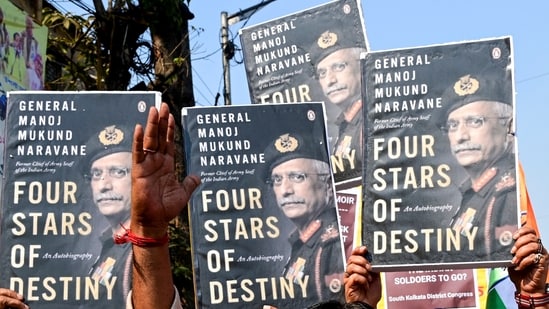
‘Not warranted’ to quote and drag me to limelight over unpublished book: Ex-army chief Naravane| India News
# Naravane Rebukes Quotes from Unreleased Book
**By Special Correspondent, The India Desk, April 25, 2026**
Former Indian Army Chief General Manoj Mukund Naravane has strongly objected to political leaders citing his unpublished memoir for partisan debates. Speaking on Saturday, April 25, 2026, in New Delhi, the former army chief expressed deep reservations after Lok Sabha Leader of Opposition Rahul Gandhi was blocked from reading alleged excerpts of the manuscript in Parliament earlier this year. Calling the attempt to drag him into the political limelight “not warranted,” Naravane underscored the necessity of keeping the armed forces insulated from electoral slugfests, particularly regarding a personal manuscript that is still undergoing mandatory government clearance.
## The Parliamentary Flashpoint
The controversy first ignited during the turbulent parliamentary sessions earlier this year. Lok Sabha Leader of Opposition Rahul Gandhi attempted to reference specific, purportedly leaked passages from General Naravane’s upcoming memoir, *Four Stars of Destiny*. The opposition leader aimed to utilize the former military commander’s written reflections to corner the ruling government on sensitive national security issues, most notably the implementation of the Agnipath short-term military recruitment scheme and the handling of the 2020 border standoff with China.
However, Gandhi was swiftly prevented from citing the manuscript by the Speaker of the Lok Sabha. The Speaker cited parliamentary rules that prohibit members from quoting unverified, unpublished, or classified documents on the floor of the House without prior authentication. The interruption sparked a massive row, leading to adjournments and heated exchanges between the treasury and opposition benches. [Source: Hindustan Times | Additional: Lok Sabha Rules of Procedure and Conduct of Business].
While the political theater played out in the capital, the man at the center of the storm remained notably silent—until now. General Naravane’s recent remarks highlight a growing frustration among retired military officials whose personal writings are weaponized by political factions before the authors even have a chance to present their full context to the public.
## ‘Not Warranted’: Naravane’s Pushback Against Politicization
Breaking his silence on the parliamentary commotion, General Naravane made his position unequivocally clear. He stated that it was “not warranted” to quote him and drag his name into the political limelight over a book that has yet to be published. [Source: Hindustan Times].
For a former Chief of Army Staff (COAS) who led the 1.3 million-strong Indian Army through some of its most challenging peacetime crises—including the deadly Galwan Valley clashes of June 2020 and the subsequent COVID-19 pandemic—the desire to remain apolitical is deeply ingrained. General Naravane’s pushback is less about defending the government and more about protecting the sanctity of the military institution.
Dr. Arindam Sen, a senior fellow specializing in civil-military relations at a prominent New Delhi think tank, explains the gravity of the situation. “When a sitting politician quotes an unpublished memoir of a former service chief to score points, it inadvertently frames the veteran as an active political participant. General Naravane is rightly pushing back against this. A military memoir is a historical record, not an opposition manifesto.” [Source: Additional Expert Insight].
By publicly disavowing the political usage of his drafts, Naravane is sending a stern message to leaders across the political spectrum: the armed forces, and the veterans who once led them, must not be used as pawns in legislative maneuvering.
## The Mystery of ‘Four Stars of Destiny’
To understand the crux of the current controversy, one must examine the turbulent journey of the book itself. General Naravane’s memoir, *Four Stars of Destiny*, was initially slated for release in early 2024 by Penguin Random House India. Pre-release promotional materials and early media reviews indicated that the book would offer unprecedented insights into the highest echelons of Indian military decision-making.
However, the book abruptly hit a roadblock. Under the Central Civil Services (Pension) Rules, specifically amended in 2021, retired officials who have served in intelligence or security-related organizations are mandated to seek prior clearance from the competent authority before publishing any material related to the domain of the establishment. The Ministry of Defence (MoD) flagged several passages in the manuscript, prompting a thorough, albeit prolonged, review process.
The delay created an information vacuum. In late 2023, select excerpts found their way into the public domain through media leaks. These fragments allegedly contained General Naravane’s candid observations on two highly sensitive subjects:
* **The Agnipath Scheme:** Early leaks suggested that the sweeping recruitment reform, which transitioned the armed forces to a four-year short-service model, came as a “surprise” to the defense establishment.
* **The Chinese Incursions:** The drafts reportedly detailed the fraught operational decisions made during the peak of the Ladakh standoff, including interactions with the political leadership.
Because the book is trapped in an indefinite pre-publication purgatory, these leaked, out-of-context snippets have become highly prized ammunition for the opposition. The irony is palpable: a book held back by the government to protect sensitive information has become a more potent political weapon in its unpublished state than it likely would have been upon release. [Source: Public Domain Defence Reporting 2024-2026].
## Civil-Military Relations and the Precedent of Silence
The Naravane episode brings to the forefront a longstanding debate regarding civil-military relations in India. Unlike the United States or the United Kingdom, where retired four-star generals routinely publish tell-all memoirs shortly after hanging up their boots, India possesses a deeply conservative tradition regarding the post-retirement utterances of its military commanders.
The military is historically viewed as an instrument of the state, subservient to civilian authority, and strictly neutral. When former commanders write books, they tread a delicate line between contributing to the country’s strategic history and violating the Official Secrets Act.
“The Indian system is traditionally uncomfortable with high-ranking military officers documenting their tenure while the political leadership of that era is still in power,” notes Shalini Prasad, an independent defense analyst. “General Naravane’s predicament highlights a broken review mechanism. By stalling the book indefinitely, the authorities created a mystery. The opposition capitalized on that mystery, and the author is the one left to manage the resulting fallout.” [Source: Additional Expert Insight].
General Naravane’s assertion that it is “not warranted” to drag him into the limelight is a defense of the traditional civil-military boundary. It emphasizes that a soldier’s operational reflections, even when critical of systemic processes, are intended for institutional learning, not for aiding an opposition leader’s parliamentary speech.
## Implications for Future Military Authors
The controversy surrounding *Four Stars of Destiny* and the subsequent parliamentary clash will undoubtedly cast a long shadow over future military authors in India. The episode establishes several critical implications for the defense community:
1. **Chilling Effect on Documentation:** Potential military authors might self-censor or altogether abandon plans to write memoirs, fearing their legacies will be trapped in MoD reviews or weaponized by politicians. This deprives the nation of valuable strategic literature and historical documentation.
2. **Stricter Vetting Mechanisms:** The Ministry of Defence may enforce even more stringent non-disclosure agreements and pre-publication reviews for top brass.
3. **The Perils of Leaks:** Publishers and authors will need to implement draconian security measures over their manuscripts to prevent the kind of selective leaking that fueled Rahul Gandhi’s parliamentary attack.
General Naravane’s dignified objection to the unfolding drama serves as a vital reminder of the ethics of citation. Quoting an unverified, incomplete draft violates the fundamental principles of historical and political debate. As the former Army Chief rightfully pointed out, judging an author—and a government—based on a book that has not officially seen the light of day is inherently flawed.
## Looking Ahead: Will the Memoir Ever Be Published?
As of April 2026, the status of *Four Stars of Destiny* remains uncertain. Sources within the defense establishment suggest that the manuscript has undergone multiple revisions, with the author working cooperatively with the Ministry of Defence to ensure no operational secrets or sensitive geopolitical narratives are compromised.
However, until the book is officially released and the full context of General Naravane’s words is available to the public, the political skirmishing is likely to continue. The opposition sees the delayed memoir as proof of a government cover-up regarding the Agnipath scheme’s origins and the handling of the Chinese border crisis. Conversely, the ruling coalition views the opposition’s reliance on unpublished drafts as desperate political opportunism.
Ultimately, General Manoj Mukund Naravane’s public rebuke serves as a necessary ethical boundary. By telling lawmakers it is “not warranted” to use his unpublished life’s work as a political football, he has reaffirmed the dignity of his office. His stance demands that political leaders fight their electoral battles based on their own policies and merits, rather than piggybacking on the unauthorized, unvetted drafts of a decorated military veteran.
The nation now waits to see if the Ministry of Defence will expedite the clearance process, allowing the General to finally share his true, contextualized story with the Indian public on his own terms.





