DUSU chief Aryan Maan, ABVP workers forcibly enter DU's Gargi College; AAP questions ‘sanskaar’| India News
# DUSU Chief Storms Gargi; AAP Slams ABVP Actions
By Staff Reporter, Delhi News Desk, April 19, 2026
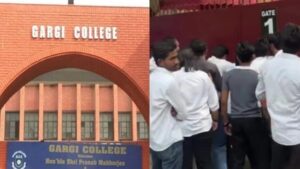
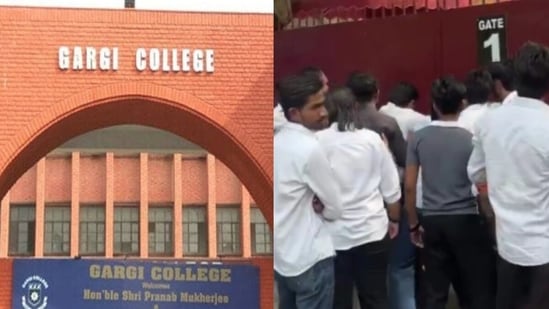
Delhi University Students’ Union (DUSU) President Aryan Maan and several Akhil Bharatiya Vidyarthi Parishad (ABVP) workers forcibly entered Gargi College, a premier women’s institution in New Delhi, after security personnel denied them access at the main gates. The confrontation occurred because Gargi College enforces strict entry protocols, explicitly stating that male visitors are permitted only on specific occasions and following thorough verification. The breach of protocol by the student leaders has ignited a fierce political controversy, prompting the Aam Aadmi Party (AAP) to sharply question the “sanskaar” (cultural values) of the ABVP. The incident has renewed heated debates over campus security, student politics, and the sanctity of women’s educational spaces.
## The Confrontation at the Gates
The incident unfolded on a busy weekday morning when DUSU chief Aryan Maan, accompanied by a sizeable entourage of ABVP supporters, arrived at Gargi College. According to eyewitnesses and preliminary reports, the group intended to enter the campus for student outreach and to address administrative grievances. However, the college’s private security guards and administrative staff intercepted the delegation at the entrance, citing institutional regulations.
Gargi College, like many women’s colleges under the University of Delhi (DU) umbrella, operates under strict entry guidelines. Male visitors are generally barred from freely roaming the campus. Entry is typically restricted to faculty, authorized staff, or specific invited guests during heavily monitored events, such as inter-college festivals, and only after rigorous identity verification.
When informed of these rules, the student leaders reportedly argued that the DUSU President holds a mandate to represent all students, regardless of the college’s gender-specific status. The verbal altercation quickly escalated, resulting in Maan and his supporters pushing past the security barricades and forcibly entering the college premises.
[Source: Hindustan Times | Additional: General knowledge on DU college entry regulations]
## Institutional Protocols and Historical Context
To understand the gravity of the unauthorized entry, it is essential to look at the historical context of campus security at Delhi University’s women’s colleges. Institutions like Gargi College, Miranda House, and Lady Shri Ram College (LSR) have historically served as safe academic havens for female students.
The strict enforcement of entry rules at Gargi College is not a mere bureaucratic hurdle but a heavily fortified security measure born out of past traumas. In February 2020, Gargi College witnessed a harrowing incident during its annual cultural festival, *Reverie*, when hundreds of unauthorized men broke through the gates, leading to widespread reports of harassment and molestation. Since then, the college administration, backed by the Delhi Police and the University Grants Commission (UGC), has implemented zero-tolerance policies regarding unauthorized male entry.
**Key Security Protocols at Gargi College:**
* **Mandatory ID Verification:** All visitors must present valid, government-issued identification or university credentials.
* **Prior Authorization:** Male guests must have prior written approval from the college administration or faculty.
* **Restricted Event Access:** During college festivals, male entry is either completely banned or restricted to students from other DU colleges who possess specific entry passes.
When DUSU representatives bypassed these protocols, it triggered immediate alarm among the student body and faculty, who viewed the breach not just as a violation of rules, but as a direct threat to the safe space the college strives to maintain.
## AAP’s Political Backlash: Questioning “Sanskaar”
The forceful entry rapidly transcended campus politics, drawing the attention of major political parties in the national capital. The Aam Aadmi Party (AAP), which operates its own student wing, the Chhatra Yuva Sangharsh Samiti (CYSS), seized upon the incident to launch a scathing attack on the ABVP and its ideological parent, the Bharatiya Janata Party (BJP).
In a sharply worded statement, AAP spokespersons condemned the actions of Aryan Maan and his supporters. The party specifically used the term “sanskaar”—a culturally loaded Hindi word denoting upbringing, values, and moral character—to criticize the ABVP.
“Is this the ‘sanskaar’ that the ABVP teaches its leaders? To forcefully storm into a women’s college, blatantly ignoring the rules meant to protect female students?” an AAP representative questioned during a press briefing. The party further alleged that the ABVP has a history of utilizing intimidation tactics and “hooliganism” to exert dominance over the university’s academic spaces.
AAP’s strategic use of the word “sanskaar” is a direct rhetorical challenge to the ABVP’s frequent emphasis on traditional Indian values and discipline. By highlighting the aggressive nature of the entry into a women’s college, AAP aims to paint the ruling student union as reckless and disrespectful toward women’s safety.
## ABVP’s Defense and Counterclaims
In response to the mounting criticism, the ABVP has defended the actions of the DUSU President, framing the narrative around student rights and union representation. ABVP leaders argue that as the democratically elected head of the university’s central student union, Aryan Maan has a constitutional responsibility to address the concerns of all students, including those enrolled in women’s colleges.
According to statements released by ABVP sympathizers, the delegation visited Gargi College to discuss pressing student issues, potentially relating to infrastructure, fee structures, or academic grievances. They claim that the college administration was using security protocols as a “shield” to prevent the student union from engaging with the student body and fulfilling its electoral mandate.
Furthermore, ABVP representatives accused AAP of politicizing a campus administrative dispute to score cheap political points ahead of upcoming local elections. They maintained that the entry, while assertive, was not intended to cause harm or intimidate students, but was a necessary step to overcome “bureaucratic red tape” that isolates constituent colleges from the central union leadership.
[Source: Hindustan Times | Additional: Routine political discourse in Delhi student elections]
## Campus Safety and Gender Dynamics: Expert Perspectives
The incident has reignited a broader conversation among sociologists and education experts regarding the delicate balance between robust student union representation and the necessity of protected spaces for women.
Dr. Pallavi Desai, an independent researcher specializing in gender dynamics in Indian higher education, provided insight into the structural tensions at play. “Women’s colleges in India occupy a unique sociological space. They are designed to offer young women an environment free from the patriarchal pressures and male gaze that often dominate co-educational spaces,” Dr. Desai explained. “When political groups forcefully breach these spaces, it is not merely an administrative violation; it is a psychological disruption. It sends a message that male-dominated political authority supersedes institutional boundaries meant to protect women.”
Experts argue that while student unions play a vital role in democratic engagement on campuses, their authority cannot override the specific security needs of specialized institutions. The DUSU constitution grants the union the right to represent students, but individual college principals retain absolute jurisdiction over their respective campus security protocols.
## Legal and Disciplinary Implications
The forceful entry has prompted immediate calls for disciplinary action from various student collectives, faculty associations, and political bodies. The Gargi College administration is reportedly compiling a detailed report of the incident, including CCTV footage and testimonies from the security personnel stationed at the gates.
**Potential Actions Under University Rules:**
1. **Proctorial Inquiry:** The Delhi University Proctor’s office holds the authority to summon Aryan Maan and other involved students for a disciplinary hearing.
2. **Show Cause Notices:** The students involved may be issued notices asking them to explain their conduct, failing which they could face suspension or rustication.
3. **Police Intervention:** If the college administration determines that the forcible entry involved trespassing or the threat of violence, they have the legal right to file a First Information Report (FIR) with the Delhi Police.
Student organizations opposed to the ABVP, including the National Students’ Union of India (NSUI) and the All India Students’ Association (AISA), have demanded strict action against Maan, warning of campus-wide protests if the university administration fails to hold the DUSU leadership accountable.
## The Broader Political Landscape in DU
Delhi University has long been viewed as a microcosm of national politics. The student union elections and subsequent campus activities often serve as proxy battlegrounds for India’s major political parties. The current friction between the ABVP (backed by the BJP) and the AAP highlights the ongoing struggle for ideological dominance among the youth demographic in the capital.
For AAP, challenging the ABVP on issues of women’s safety and discipline is a calculated move to appeal to young, progressive voters and female students who prioritize campus security. For the ABVP, asserting the authority of the DUSU President across all constituent colleges is essential to maintaining its image as a powerful, pan-university force that cannot be sidelined by college-level administrations.
This incident also exposes the ambiguities within the operational framework of DUSU. While the union represents all students, the decentralized nature of Delhi University—where individual colleges are managed by distinct governing bodies—frequently leads to jurisdictional clashes.
## Conclusion and Future Outlook
The forced entry of DUSU chief Aryan Maan and ABVP workers into Gargi College is more than a fleeting campus skirmish; it is an intersection of political entitlement, institutional security, and gender dynamics. By bypassing rules specifically designed to protect a women-only educational environment, the student leaders have sparked a necessary debate on the limits of student union authority.
As the AAP questions the ethical “sanskaar” of the ABVP and the latter defends its right to student representation, the ultimate responsibility falls on the Delhi University administration. The university must navigate this highly polarized environment carefully, ensuring that the democratic rights of student unions do not compromise the foundational safety and security protocols of its constituent colleges.
Looking ahead, this incident is likely to prompt a comprehensive review of visitor policies across all DU women’s colleges. It may also force the university’s Proctorial board to establish clearer, non-negotiable guidelines detailing exactly how and when central student union representatives can interact with specialized institutions. Until such boundaries are unequivocally defined and respected, the tension between political outreach and campus security will continue to simmer.