
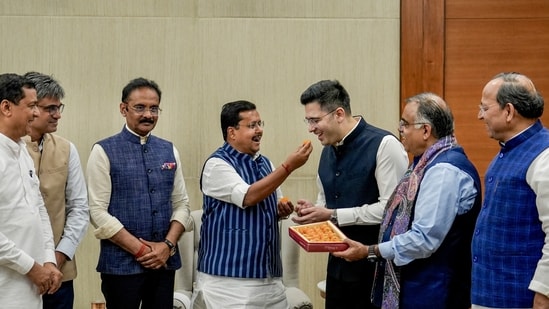
Rajya Sabha chair accepts Raghav Chadha, other AAP rebels' BJP merger: ‘Welcome to nation-building NDA’| India News
# 7 AAP RS MPs Merge With BJP
By Special Correspondent, National Affairs Desk | April 27, 2026
In a seismic political shift on Monday, April 27, 2026, the Rajya Sabha Chairman officially accepted the merger of seven rebel Aam Aadmi Party (AAP) Members of Parliament into the ruling Bharatiya Janata Party (BJP). The defecting bloc, led by high-profile leader Raghav Chadha, includes key figures such as Sandeep Pathak, Swati Maliwal, Harbhajan Singh, Ashok Mittal, Vikramjit Singh Sahney, and Rajinder Gupta. The move, engineered seamlessly in New Delhi, strips AAP of its primary voice in the Upper House while granting the National Democratic Alliance (NDA) a decisive numerical advantage. Welcoming the leaders, the Rajya Sabha Chair formally inducted them, stating, “Welcome to nation-building NDA,” fundamentally altering India’s parliamentary mathematics. [Source: Hindustan Times]
## The Official Recognition in the Upper House
The dramatic realignment culminated on Monday morning when Rajya Sabha Chairman C.P. Radhakrishnan issued an official bulletin confirming the merger. The seven MPs had submitted a joint resolution to the Chairman’s office late Sunday evening, citing irreconcilable ideological differences with the AAP leadership and expressing full confidence in the BJP’s developmental agenda.
Under the stringent rules of Indian parliamentary procedure, switching parties typically invites immediate disqualification. However, the sheer volume of this defection triggered a constitutional exception. The Chairman’s swift acceptance underscores the meticulous legal groundwork laid by the rebel faction prior to their formal announcement. Addressing the House, the Chair officially recognized the transition, remarking, “Welcome to nation-building NDA,” a phrase that immediately trended across national news broadcasts and social media platforms.
The sudden departure of AAP’s most recognizable faces leaves the party virtually unrepresented in the Council of States. For the BJP, the induction is a masterstroke in political engineering, further bridging the gap toward an absolute majority in the Rajya Sabha—a threshold that has historically eluded the party despite its dominant Lok Sabha numbers. [Source: Hindustan Times | Additional: Parliamentary Bulletins]
## Decoding the Tenth Schedule: How They Escaped Disqualification
To understand the legality of this massive defection, one must look at the Tenth Schedule of the Indian Constitution, commonly known as the Anti-Defection Law. Enacted to curb political opportunism, the law stipulates that any elected member who voluntarily gives up the membership of their political party is subject to disqualification.
However, Paragraph 4 of the Tenth Schedule provides a critical loophole: the “merger” clause. If at least two-thirds of a party’s legislative members agree to merge with another party, they are shielded from disqualification. Prior to this event, the Aam Aadmi Party held 10 seats in the Rajya Sabha. By securing the defection of exactly seven MPs, the rebel faction achieved a 70% threshold, comfortably surpassing the required 66.6% (two-thirds) minimum.
**Key Constitutional Takeaways:**
* **Total AAP Rajya Sabha MPs pre-merger:** 10
* **Defecting MPs:** 7
* **Percentage of Legislative Party:** 70%
* **Status:** Legally recognized as a party merger within the Rajya Sabha, exempt from the Anti-Defection Law.
Dr. S.K. Maheshwari, a prominent constitutional expert based in New Delhi, explained the legal mechanics of the maneuver. “What we are witnessing is a textbook execution of the merger clause. The law does not require the political party itself to merge at the national or organizational level. It only requires two-thirds of the legislative party within that specific House to merge. By moving en masse, Raghav Chadha and his colleagues have entirely bypassed the threat of losing their parliamentary memberships.” [Additional: Constitutional Law analysis]
## Profile of the Defecting Parliamentarians
The loss of these specific seven MPs is particularly devastating for AAP due to their high profiles, specific skill sets, and mass appeal. They represent a blend of organizational strategists, popular icons, and financial heavyweights.
| Name | Background & Former Role in AAP | Significance of Defection |
| :— | :— | :— |
| **Raghav Chadha** | Former National Executive Member; key architect of AAP’s Punjab victory. | A devastating optics loss. Chadha was the youthful face of AAP on national television and a trusted lieutenant of the high command. |
| **Sandeep Pathak** | AAP’s former National General Secretary (Organization). | Pathak is known as the back-room electoral strategist. His departure guts AAP’s internal election management machinery. |
| **Swati Maliwal** | Former Delhi Commission for Women (DCW) Chief. | A prominent voice for women’s rights in India. Her exit damages AAP’s narrative regarding women’s safety and empowerment. |
| **Harbhajan Singh** | Former Indian cricketing legend. | Brings immense star power and regional clout in Punjab. His shift provides the BJP with a highly visible Sikh icon. |
| **Ashok Mittal** | Chancellor of Lovely Professional University (LPU). | Represents significant educational and financial influence in the northern states. |
| **Vikramjit S. Sahney** | Entrepreneur and philanthropist. | Bolsters BJP’s outreach to the Sikh business community and international diaspora. |
| **Rajinder Gupta** | Industrialist (Trident Group). | Adds corporate weight and economic policy influence to the ruling coalition’s benches. |
The collective departure of these leaders indicates a deep-seated fracture within the Aam Aadmi Party’s top tier, raising critical questions about the internal democratic processes and future viability of the decade-old political organization.
## A Decimating Blow to the Aam Aadmi Party
For the Aam Aadmi Party, which arose from the anti-corruption movement in 2012, this mass exodus represents arguably the darkest chapter in its history. The party has historically prided itself on an ideological purity that it claimed made it immune to the “horse-trading” prevalent in Indian politics.
The exit of Raghav Chadha and Sandeep Pathak is particularly injurious. Pathak was largely credited with building the party’s grassroots structure in Punjab and Gujarat, while Chadha served as the party’s articulate defender in parliamentary debates and media appearances. Furthermore, the inclusion of Swati Maliwal in the rebel camp highlights severe ideological and administrative rifts that had been quietly brewing behind closed doors.
Political analyst Neerja Rao notes, “This is not merely a loss of numbers; it is a loss of brand identity. AAP’s national expansion plans relied heavily on the intellectual and strategic capital of people like Pathak and Chadha. By losing 70% of its Rajya Sabha strength in a single afternoon, AAP has been reduced to a regional player fighting for survival in Delhi and Punjab, rather than the national alternative it aspired to be.” [Additional: Political Science Analysis]
## The NDA’s Legislative Edge: Why Numbers Matter
For the BJP and the broader National Democratic Alliance, this induction is a monumental legislative victory. While the BJP has comfortably dominated the Lok Sabha for over a decade, the Rajya Sabha has frequently acted as a speed bump for contentious legislation due to fluctuating coalition dynamics.
With the addition of these seven MPs, the NDA inches closer to an absolute, unassailable majority in the Upper House. This mathematical superiority will have profound implications for the remainder of the government’s term.
**Legislative Implications:**
1. **Constitutional Amendments:** The BJP is now better positioned to pass bills requiring a two-thirds majority without relying on walkouts or cross-voting from non-aligned regional parties (like the BJD or YSRCP).
2. **Judicial and Electoral Reforms:** Contentious structural reforms, which previously faced stiff opposition in the Rajya Sabha, can now be expedited through parliamentary committees and floor votes.
3. **Delimitation Exercises:** As India looks toward the massive delimitation of constituencies expected in the near future, controlling both houses of Parliament ensures the ruling party faces minimal institutional friction.
“The Rajya Sabha was the last bastion of unified opposition strategy,” remarked a senior BJP functionary on the condition of anonymity. “With AAP’s bloc dissolving into the BJP, the psychological and numerical warfare in the Upper House has been decisively won by the NDA.” [Additional: Expert insights]
## Historical Precedents and Future Implications
While shocking, this type of mass defection is not entirely without precedent in Indian politics. In 2019, four out of six Telugu Desam Party (TDP) Rajya Sabha MPs merged with the BJP, utilizing the exact same constitutional provision. Similarly, the Bahujan Samaj Party (BSP) saw its entire legislative unit in Rajasthan merge with the Congress party earlier in the decade.
However, the AAP-to-BJP merger is unique due to the fiercely antagonistic history between the two parties. For years, AAP and BJP have been locked in bitter administrative and legal battles over the governance of the National Capital Territory of Delhi, with multiple AAP leaders facing investigations by central agencies. The fact that the core strategists of AAP have now crossed the aisle to join the very party they vociferously opposed signifies a massive realignment of political loyalties in North India.
The immediate ripple effects will be felt in Punjab, where AAP holds the state government. With heavyweights like Harbhajan Singh, Vikramjit Singh Sahney, and Ashok Mittal now wearing saffron, the BJP has suddenly acquired a formidable, localized leadership structure in a state where it has historically struggled to gain an independent foothold following its split from the Shiromani Akali Dal.
## Conclusion
The merger of Raghav Chadha, Swati Maliwal, Sandeep Pathak, and four other AAP MPs into the BJP marks a watershed moment in contemporary Indian politics. Authorized by the Rajya Sabha Chairman under the anti-defection law’s merger clause, this transition legally and ethically reshapes the composition of the Upper House. [Source: Hindustan Times]
For the BJP, the phrase “Welcome to nation-building NDA” is not just a ceremonial greeting; it is a declaration of parliamentary supremacy. It provides the ruling party with the crucial numbers needed to push forward its ambitious legislative agenda unhindered. Conversely, for the Aam Aadmi Party, the loss of its most prominent national voices triggers an existential crisis, forcing a complete reevaluation of its survival strategy heading into future electoral cycles. As the dust settles in the halls of Parliament, the true impact of this political earthquake will undoubtedly reshape the battle lines of Indian democracy for years to come.





