
Jadavpur: Bengal's high-voltage seat where legacy, lawfare and ideologies collide
# Jadavpur 2026: Bengal’s High-Voltage Clash
By Senior Editorial Correspondent, The Daily Chronicle, April 28, 2026
On Monday, April 27, 2026, the Jadavpur constituency in South Kolkata officially entered the final, fever-pitched phase of the West Bengal legislative elections. Once the undisputed fortress of former Chief Minister Buddhadeb Bhattacharjee, Jadavpur has evolved into the state’s most symbolically charged electoral battleground. Here, a high-stakes triangular contest between the ruling Trinamool Congress (TMC), a deeply entrenched Left Front, and an aggressively expanding Bharatiya Janata Party (BJP) is unfolding. Driven by historical legacy, intense legal battles, and stark ideological divisions, the outcome in Jadavpur will serve as the definitive barometer for West Bengal’s political future. [Source: Hindustan Times]
## A Legacy of Giants and Giant-Slayers
To understand the political gravity of Jadavpur, one must look at its unparalleled history of making and breaking political titans. Jadavpur is not merely a constituency; it is the cradle of West Bengal’s modern political narrative. It was here in 1984 that a young, relatively unknown Congress leader named Mamata Banerjee earned the moniker of “giant-slayer” by defeating the Communist Party of India (Marxist) stalwart Somnath Chatterjee in the Lok Sabha elections.
Decades later, the assembly segment became the political home of **Buddhadeb Bhattacharjee**, the Marxist Chief Minister who attempted to aggressively industrialize Bengal. Bhattacharjee represented Jadavpur from 1987 until his shocking defeat in the historic 2011 “Parivartan” (change) wave, which ended 34 years of Left Front rule.
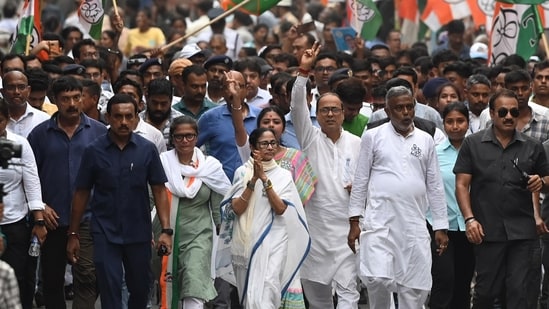
Today, the ghosts of these monumental electoral battles loom large. The streets of Jadavpur—lined with bustling markets, esteemed educational institutions, and decades-old refugee colonies—are plastered with flags representing competing visions for Bengal’s future. For the TMC, holding Jadavpur is a matter of defending its origin story. For the Left, it is a desperate bid to reclaim its lost intellectual and cultural heartland. For the BJP, breaching Jadavpur means finally cracking the code to Kolkata’s urban, educated electorate. [Source: Public Electoral Records]
## The 2026 Context: Where Politics Meets Lawfare
What sets the 2026 electoral contest in Jadavpur apart from previous cycles is the unprecedented weaponization of “lawfare”—the use of legal systems and institutions to damage or delegitimize a political opponent. Over the past four years, West Bengal’s political discourse has shifted significantly from the streets to the courtrooms of the Calcutta High Court.
The ruling TMC finds itself battling intense anti-incumbency fueled by a barrage of investigations spearheaded by central agencies like the Central Bureau of Investigation (CBI) and the Enforcement Directorate (ED). High-profile probes into alleged recruitment irregularities, municipal corruption, and ration distribution scams have deeply impacted public perception in highly educated, socially conscious constituencies like Jadavpur.
“Jadavpur is a politically hyper-literate constituency. The voters here read the fine print of court orders,” explains Dr. Amitava Sanyal, a professor of political science at a Kolkata-based university. “The continuous legal indictments and the unearthing of financial anomalies have created a distinct sense of unease among the urban middle class. The opposition, particularly the BJP and the Left, have effectively used this ‘lawfare’ to corner the ruling dispensation, forcing the TMC to run a purely defensive campaign focused on welfare delivery.” [Source: Independent Political Analysis]
The BJP asserts that the legal interventions are necessary to dismantle systemic corruption, positioning themselves as the party of law and order. Meanwhile, the TMC has vehemently countered this narrative, accusing the central government of orchestrating a political witch-hunt by misusing federal investigative agencies to subvert democratic mandates.
## The Intellectual and Refugee Heartland
The demographic makeup of Jadavpur is a microcosm of post-partition Bengal. Following the 1947 partition of India, and later the 1971 Bangladesh Liberation War, millions of refugees from East Bengal settled in the southern fringes of Kolkata. Neighborhoods like Baghajatin, Bijoygarh, and Ganguly Bagan were built through the sheer resilience of displaced populations who leaned heavily toward the communist ideology that championed their right to housing and dignity.
Simultaneously, the constituency houses **Jadavpur University**, consistently ranked among India’s premier academic institutions. The university’s campus is historically renowned as a bastion of left-wing student activism and fierce anti-establishment protests.
This unique blend of working-class refugee descendants and elite academia creates a highly volatile and discerning electorate. Promises of free rations or direct cash transfers—which yield massive dividends for the TMC in rural Bengal—often fall flat here. Instead, the Jadavpur voter demands answers on industrialization, white-collar job creation, freedom of speech, and urban infrastructure development.
## Trinamool’s Citadel Under Siege?
Despite the challenges, writing off the Trinamool Congress in Jadavpur would be a severe miscalculation. The ruling party has meticulously cultivated a formidable organizational machinery in South Kolkata over the last fifteen years.
To counter the urban disillusionment, the TMC has heavily emphasized its wildly popular social welfare schemes, particularly *Lakshmir Bhandar* (a direct cash transfer scheme for women) and *Swasthya Sathi* (health insurance). The party argues that while the opposition focuses on courtroom drama, the state government has steadily delivered socio-economic safety nets to millions.
Furthermore, the TMC has relied on extensive urban beautification projects, improved road connectivity, and the modernization of local markets in the Jadavpur area to showcase visible governance. However, local leaders privately admit that the continuous bombardment of corruption allegations has demoralized their grassroots workers, making the 2026 battle the toughest they have faced since coming to power.
## The Saffron Surge vs. The Red Revival
The opposition space in Jadavpur is witnessing an intense internal battle between the BJP and the CPI(M).
The **Bharatiya Janata Party**, which traditionally struggled to find a foothold in the cultural and intellectual hubs of Kolkata, is mounting an unprecedented offensive. Capitalizing on the corruption scandals engulfing the TMC, the BJP is appealing to the aspirational youth and the disillusioned middle class. They are promising sweeping economic reforms, a corruption-free administration, and aggressive integration with national development initiatives.
“The voter in Jadavpur is tired of the state’s isolationist politics,” stated a senior BJP strategist during a recent rally near the 8B Bus Stand. “Bengal’s youth are migrating to Bengaluru and Pune for jobs. We are promising to bring those industries back to Bengal by restoring the rule of law.”
Conversely, the **Left Front** is experiencing a palpable, albeit gradual, revival. Recognizing that they cannot outspend their rivals, the CPI(M) has fielded fresh, young faces—many of whom cut their teeth in student politics at Jadavpur University. The Left is attempting to frame the election as a battle of true ideologies, rejecting both the TMC’s alleged cronyism and the BJP’s right-wing nationalism. Their massive grassroots rallies, devoid of corporate funding but rich in youthful enthusiasm, have injected a surprising element of unpredictability into the race. [Source: Hindustan Times | Additional: Ground Reports]
## Electoral Dynamics at a Glance
To appreciate the volatility of Jadavpur, one must look at the voting patterns from the recent past, which show a sharp polarization and shifting loyalties:
**Recent Electoral Shifts in the Jadavpur Region**
* **2011 Assembly:** TMC secured a historic victory, defeating the sitting Left Front Chief Minister.
* **2016 Assembly:** TMC retained the seat, solidifying its grip on Kolkata’s southern fringes.
* **2019 Lok Sabha:** TMC won the parliamentary seat, though the BJP showed a massive surge in vote share in specific urban wards.
* **2021 Assembly:** TMC swept the assembly segment amidst a highly polarized state-wide battle against the BJP.
* **2026 Assembly (Current):** Analysts predict a tight three-way split in vote share, potentially leading to narrow margins of victory.
## The Path Forward: Implications for Bengal
As polling day looms, Jadavpur has transcended its geographical boundaries to become a symbol of West Bengal’s broader existential crisis. It is a constituency caught in the crossfire of its own illustrious past and an uncertain future.
The collision of legacy, lawfare, and ideology here is palpable. If the TMC manages to retain Jadavpur, it will prove that Mamata Banerjee’s welfare economics and formidable ground organization can withstand even the most severe anti-incumbency and legal scrutiny.
Should the BJP breach this citadel, it will signal a fundamental shift in Bengal’s urban political psyche, proving that their anti-corruption narrative has finally resonated with the state’s intellectual elite.
And if the Left stages an improbable comeback, it will mark the resurrection of a political ideology that many had written off as obsolete in the 21st century.
Whatever the outcome, when the electronic voting machines are finally unsealed, the mandate of Jadavpur will echo far beyond the university walls and refugee colonies. It will dictate the trajectory of West Bengal’s politics for the next decade, cementing either the resilience of the incumbent or the dawn of a radically new political era.





