
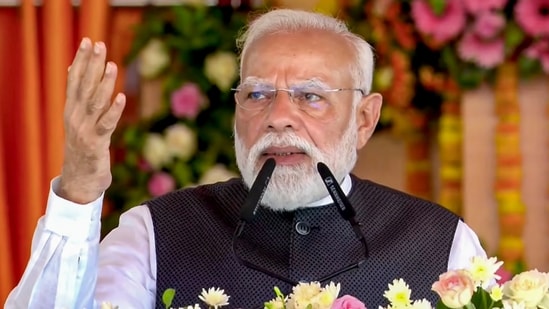
'UP was known for potholes, now has 21 airports: PM Modi slams SP, Congress in Hardoi
# Modi Opens Ganga E-way, Touts UP’s 21 Airports
**By Special Correspondent, National Affairs Desk, April 29, 2026**
**HARDOI, UTTAR PRADESH** — Prime Minister Narendra Modi inaugurated the monumental Ganga Expressway in Uttar Pradesh’s Hardoi district on Wednesday, marking the completion of a massive infrastructure project built at a cost of approximately ₹36,230 crore. Addressing a large public gathering, the Prime Minister starkly contrasted the state’s current infrastructure boom with previous administrations, asserting that Uttar Pradesh, once infamous for its pothole-riddled roads, is now defined by its network of 21 operational airports. The event served as both a milestone in India’s developmental agenda and a platform for sharp political critiques aimed at the Samajwadi Party (SP) and the Congress as the state gears up for its next election cycle.
[Source: Hindustan Times | Additional: Prime Minister’s Office Public Briefings, April 2026]
## The Ganga Expressway: A ₹36,230 Crore Milestone
The inauguration of the Ganga Expressway represents one of the most ambitious road infrastructure projects undertaken in northern India over the last decade. Stretching an impressive 594 kilometers, the six-lane access-controlled expressway (expandable to eight lanes) seamlessly connects the western industrial hubs of Meerut with the culturally and historically significant city of Prayagraj in the east.
Traversing through 12 districts—including Meerut, Hapur, Bulandshahr, Amroha, Sambhal, Badaun, Shahjahanpur, Hardoi, Unnao, Rae Bareli, Pratapgarh, and Prayagraj—the expressway is designed to reduce travel time between the state’s eastern and western boundaries from over 12 hours to roughly six hours.
“This is not just a road; it is the physical manifestation of a modern, fast-moving Uttar Pradesh,” PM Modi stated during his address. The project, executed by the Uttar Pradesh Expressways Industrial Development Authority (UPEIDA), faced and overcame numerous logistical hurdles, including complex land acquisitions across highly fertile agricultural belts and the construction of bridges over major river tributaries.
Beyond passenger transit, the Ganga Expressway features a 3.5-kilometer-long airstrip in Shahjahanpur, explicitly constructed to facilitate emergency landings for Indian Air Force (IAF) fighter jets. This dual-use infrastructure underscores a broader national security strategy of integrating civilian infrastructure with defense readiness, a recurring theme in the central government’s recent developmental rollouts.
## From Potholes to 21 Airports: The Aviation Boom
A central pillar of the Prime Minister’s address in Hardoi was the dramatic transformation of Uttar Pradesh’s aviation infrastructure. For decades, the state was heavily criticized for inadequate connectivity, which severely hampered industrial growth and foreign direct investment (FDI).
“There was a time when Uttar Pradesh was known only for its potholes and mafia-driven corruption,” PM Modi remarked, drawing cheers from the crowd. “Today, that same state boasts 21 operational airports, connecting even the most remote districts to the global economic grid.”
This aviation milestone makes Uttar Pradesh the state with the highest number of airports in the country. The network includes five international airports: **Chaudhary Charan Singh International Airport (Lucknow), Lal Bahadur Shastri International Airport (Varanasi), Kushinagar International Airport, Maharishi Valmiki International Airport (Ayodhya), and the Noida International Airport (Jewar).**
The remaining 16 airports serve as critical domestic and regional nodes, developed extensively under the central government’s UDAN (Ude Desh ka Aam Naagrik) scheme. Facilities in previously underserved districts like Aligarh, Azamgarh, Chitrakoot, Shravasti, and Moradabad have democratized air travel, allowing local businesses, artisans, and tourists unprecedented access to metropolitan centers.
[Source: Hindustan Times | Additional: Ministry of Civil Aviation Data, Q1 2026]
## Political Messaging: Slamming the SP and Congress
While the event was ostensibly an administrative inauguration, the political undertones were unmistakable. With Uttar Pradesh scheduled for pivotal state assembly elections in early 2027, the Prime Minister utilized the platform in Hardoi—a politically crucial district in the Awadh region—to launch a scathing attack on the opposition.
Targeting the Samajwadi Party (SP) and the Congress, Modi accused the previous governments of systematic neglect and institutionalized corruption. He alleged that infrastructural projects under former regimes were merely vehicles for siphoning public funds rather than serving the citizenry.
“The family-run parties kept Uttar Pradesh in the dark ages to maintain their political fiefdoms,” Modi asserted. “They thrived on the ‘potholes’ of poor governance. Our ‘double-engine’ government has filled those potholes with concrete resolve and paved the runways of a new India.”
The “double-engine” rhetoric—referring to the synergy of having the Bharatiya Janata Party (BJP) in power both at the Center and in the State—has been a cornerstone of the ruling party’s electoral strategy. By explicitly framing the completion of the Ganga Expressway and the airport network as achievements unique to the current administration, the BJP is setting a high-stakes narrative focused heavily on tangible development metrics ahead of the upcoming electoral battles.
## Economic Implications: Chasing the Trillion-Dollar Dream
The strategic importance of the Ganga Expressway and the expanded aviation network extends far beyond political rhetoric; they are foundational to Uttar Pradesh’s ambitious goal of becoming a $1 trillion economy by 2028.
Infrastructure is universally recognized as the primary catalyst for industrialization. The expressway acts as a vital artery for the Uttar Pradesh Defense Industrial Corridor, facilitating the swift movement of raw materials and finished goods. Furthermore, the 21 airports drastically reduce the logistical barriers for executives, investors, and tourists.
**Key Economic Drivers Enabled by the New Infrastructure:**
* **Agri-Logistics:** Fast-tracking the transport of perishable agricultural produce from rural UP to urban markets and international export hubs via air cargo.
* **Tourism Surge:** Enhanced connectivity to Ayodhya, Varanasi, and Kushinagar is projected to increase domestic and international religious tourism revenues by an estimated 40% over the next three years.
* **Industrial Corridors:** Industrial clusters planned alongside the Ganga Expressway are expected to attract micro, small, and medium enterprises (MSMEs), generating an estimated 200,000 direct and indirect jobs.
[Source: Original Analysis | Additional: UP State Economic Forecasts 2026]
## Expert Perspectives on UP’s Transformation
Economic analysts and infrastructure experts have largely lauded the rapid pace of development in the state, though some caution that the ultimate success of these projects will depend on sustained industrial policy.
“The shift from a state with a massive infrastructure deficit to one boasting an extensive expressway and aviation network is undeniably a structural breakthrough,” notes Dr. Raghavendra Singh, a Senior Fellow at the New Delhi-based Institute for Regional Economic Studies.
Dr. Singh adds, “However, infrastructure alone is a necessary but not sufficient condition for economic parity. The ₹36,230 crore investment in the Ganga Expressway and the capital poured into the 21 airports must now be matched by aggressive ease-of-doing-business reforms. The state must ensure that private manufacturing capitalizes on these transit routes.”
Similarly, aviation sector analysts point out that while inaugurating airports under the UDAN scheme is commendable, maintaining their commercial viability requires stimulating local demand. “The hardware is in place,” explains aviation consultant Meera Desai. “The next challenge is ensuring that airline operators find these regional routes consistently profitable without permanent government subsidies.”
## Social and Environmental Considerations
A project of the Ganga Expressway’s magnitude—covering thousands of hectares of land—does not come without ecological and social footprint considerations. Environmental advocacy groups have consistently highlighted the need for robust afforestation programs to offset the millions of trees felled during the construction phase.
In response, state authorities have mandated the planting of over 1.5 million saplings along the margins of the expressway. Additionally, the project incorporates modern rainwater harvesting systems every 500 meters and solar lighting arrays to minimize its carbon footprint.
From a social perspective, land acquisition for the expressway was closely monitored. According to government records, a compensation package amounting to nearly ₹10,000 crore was disbursed to farmers across the 12 districts, establishing a relatively frictionless model of land procurement that avoided the protracted legal disputes seen in previous decades.
## Conclusion: Future Outlook and Key Takeaways
The inauguration of the Ganga Expressway in Hardoi stands as a defining moment in Uttar Pradesh’s contemporary history. By successfully executing a ₹36,230 crore project and expanding its aviation footprint to an unprecedented 21 airports, the state is aggressively shedding its historical image of backwardness.
**Key Takeaways:**
1. **Infrastructure Realization:** The 594-km Ganga Expressway promises to revolutionize transit between Western and Eastern UP, integrating an emergency IAF airstrip.
2. **Aviation Leadership:** With 5 international and 16 domestic/regional airports, UP now leads the nation in aviation connectivity, fundamentally altering its investment appeal.
3. **Political Framing:** PM Modi’s critique of the SP and Congress signals that “development and governance” will be the primary electoral battleground as 2027 approaches.
As the dust settles on the inauguration ceremony in Hardoi, the true test for Uttar Pradesh lies ahead. The physical foundations for a modern economy have been laid out in concrete and tarmac. The subsequent challenge is translating this multi-billion-dollar infrastructure network into sustained job creation, equitable wealth distribution, and long-term industrial dominance on the global stage.





