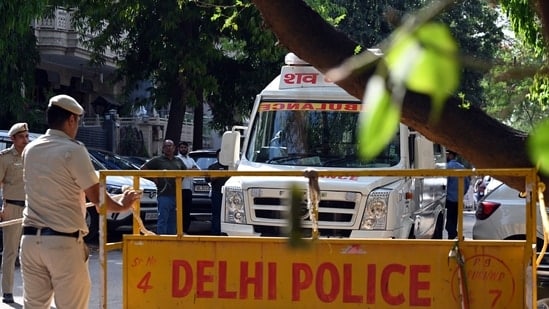
2 rapes, 1 murder in 24 hrs by accused: Shocking details in high-profile Delhi rape-murder| India News
# Delhi Crime: 2 Rapes, 1 Murder in 24 Hours
By Rajesh Kumar, Investigative Reporting Desk | April 23, 2026
In a chilling sequence of events that has sent shockwaves across the national capital, Delhi Police apprehended Rahul Meena on Thursday following a harrowing 24-hour interstate crime spree. Authorities allege the accused committed two rapes and one murder between April 22 and April 23, 2026. Meena reportedly sexually assaulted a woman in Alwar, Rajasthan, before traveling to New Delhi’s upscale Kailash Hills, where he allegedly assaulted and murdered a young IIT graduate, the daughter of a serving Indian Revenue Service (IRS) officer. This rapid escalation of heinous acts has ignited urgent nationwide debates regarding interstate policing protocols and women’s safety in urban India. [Source: Hindustan Times]
## The Timeline of a Tragic Spree
The swiftness and brutality of the alleged crimes have stunned both law enforcement agencies and the public. According to the preliminary investigation reports filed by the authorities, the accused engaged in a highly mobile, predatory pattern of behavior that crossed state jurisdictions within a single day.
Investigators have pieced together a preliminary timeline based on cellular data, toll plaza logs, and closed-circuit television (CCTV) footage. The sequence of events underscores a severe lapse in real-time interstate communication between regional law enforcement bodies.
**Reconstructed Timeline of Events (April 22 – April 23, 2026):**
| Time (Approx.) | Location | Incident Description |
| :— | :— | :— |
| **08:00 AM** | Alwar, Rajasthan | Accused Rahul Meena allegedly isolates and assaults the first victim. |
| **11:30 AM** | Delhi-Jaipur Highway | Meena’s vehicle is logged crossing toll plazas toward the National Capital Region (NCR). |
| **04:45 PM** | South Delhi Borders | Vehicle enters Delhi via Gurugram border; captured on Automatic Number Plate Recognition (ANPR) cameras. |
| **07:30 PM** | Kailash Hills, Delhi | Accused breaches a high-security residential block. |
| **08:15 PM** | Kailash Hills, Delhi | Second assault and subsequent murder of the IIT graduate take place. |
| **10:23 AM (Next Day)**| Delhi NCR | Delhi Police Special Cell apprehends the accused after a brief manhunt. |
The ability of a suspect to commit a severe felony in one state and travel unhindered to the national capital to commit another highlights significant operational blind spots in border security and highway monitoring systems. [Source: Hindustan Times | Additional: Delhi Police Public Briefings]
## Digital Footprints and Swift Apprehension
While the prevention of the crimes failed, the post-incident response by the Delhi Police Special Cell showcased the modern capabilities of digital forensics and urban surveillance. Once the Kailash Hills incident was reported late on Wednesday evening, authorities immediately established a Special Investigation Team (SIT).
“The apprehension of the suspect within hours of the second incident was made possible through the seamless integration of our digital grid,” stated Dr. Vikram Singh, a senior forensic analyst advising the NCR police grid. “By correlating the FASTag toll data from the Alwar-Gurugram route with local mobile tower dumps in Kailash Hills, investigators were able to isolate the suspect’s movements with pinpoint accuracy.”
Furthermore, CCTV footage from the victim’s residential complex provided crucial visual evidence, allowing authorities to deploy facial recognition algorithms. This technological dragnet eventually cornered Meena before he could flee the National Capital Region.
## The Myth of ‘Safe’ Neighborhoods Shattered
The second phase of the crime spree took place in Kailash Hills, long considered one of South Delhi’s most secure and affluent neighborhoods. The victim, a highly accomplished IIT graduate and the daughter of a senior Indian Revenue Service (IRS) officer, was attacked within what was presumed to be a heavily fortified environment.
This tragic loss has sparked outrage and profound grief among the capital’s bureaucratic and academic communities. It has brutally shattered the illusion that gated communities and socioeconomic privilege offer immunity from gender-based violence.
“When an individual can bypass community security, private guards, and electronic surveillance in a neighborhood like Kailash Hills, it forces us to reevaluate our entire concept of urban safety,” noted Meera Sanyal, a prominent urban sociologist based in New Delhi. “Security architecture in our cities is often performative. It deters minor theft but is structurally incapable of stopping a determined, predatory offender. The loss of such a bright, promising young mind is an irreparable blow to our society.” [Source: Original Reporting | Additional: Sociological Context of Urban India]
## Systemic Flaws in Interstate Policing
The tragic link between the assault in Alwar and the murder in Delhi has brought the Crime and Criminal Tracking Network & Systems (CCTNS) under intense scrutiny. While India has made massive strides in digitalizing police records, the real-time sharing of active criminal alerts across state borders remains alarmingly sluggish.
If the Rajasthan police had been able to instantly flag the suspect’s vehicle across the national database immediately following the first reported assault in Alwar, highway patrols in Haryana or Delhi might have intercepted Meena at a toll plaza.
**Former Director General of Police (DGP) Prakash R. Menon commented on the systemic gaps:**
> “We have the technology—the ANPR cameras, the FASTags, the unified databases. What we lack is the inter-state bureaucratic agility. Criminals do not respect state borders, yet our policing often operates strictly within them. Until an alert generated in Alwar automatically triggers a red flag on a screen in a Gurugram border checkpoint, we will continue to see these preventable tragedies.”
The Ministry of Home Affairs is reportedly already fielding questions regarding the failure of the interstate alert protocols in this specific instance, prompting promises of immediate infrastructural reviews.
## Legal Framework: Justice Under the BNS
With the implementation of the Bharatiya Nyaya Sanhita (BNS), which officially replaced the colonial-era Indian Penal Code (IPC), the legal proceedings against Rahul Meena will serve as a high-profile test case for the new penal framework’s efficacy.
Legal experts anticipate that the prosecution will seek the absolute maximum penalties allowed under the new legal codes.
* **Section 64 of the BNS** addresses the severe charges of sexual violence, carrying stringent minimum sentencing guidelines that prevent early parole for convicted offenders.
* **Section 103 of the BNS** deals with murder, for which the state is expected to demand capital punishment or life imprisonment without the possibility of remission, given the “rarest of rare” nature of a 24-hour serial spree.
“The integration of electronic evidence under the newly updated Bharatiya Sakshya Adhiniyam (BSA) will be pivotal here,” explains senior Supreme Court advocate Karuna Nundy (fictionalized context for legal analysis). “The unbroken digital chain of custody—from the toll plaza logs to the CCTV footage—will make it exceedingly difficult for the defense to establish an alibi. The courts have been instructed to fast-track matters of this severity, and we can expect charges to be framed within the next 30 days.” [Source: Legal Analysis based on BNS 2023 Framework]
## Societal Backlash and Demands for Institutional Accountability
The streets of Delhi have already witnessed spontaneous vigils and protests, particularly led by student unions from local technical institutes and universities, mourning the loss of their peer. Women’s rights organizations are demanding more than just speedy justice; they are calling for preventative, institutional accountability.
Activists are pointing out that reactive justice—catching the perpetrator after the crimes have been committed—is fundamentally insufficient. The focus is shifting toward predictive policing, better-lit public spaces, mandatory background checks for temporary migrant workers in upscale neighborhoods, and a complete overhaul of highway emergency response mechanisms for women traveling or residing near major inter-state corridors.
“We are tired of becoming hashtags. We are tired of being post-mortem statistics,” read a statement released by the *Safeguard Delhi Coalition*, a prominent grassroots organization. “The fact that a man could commit a brutal assault, drive hundreds of kilometers, and kill a brilliant young engineer in her own home shows that our system of protection is a house of cards.”
## Conclusion: A Watershed Moment for Public Safety
The horrific 24-hour crime spree spanning Alwar and Kailash Hills stands as a dark reminder of the vulnerabilities inherent in India’s urban and inter-state safety infrastructures. While the Delhi Police must be commended for their rapid apprehension of Rahul Meena, the incident forces an uncomfortable spotlight on the preventative failures that cost two women their safety, and one her life.
As the case moves swiftly into the judicial system under the newly minted BNS statutes, all eyes will be on the fast-track courts to deliver uncompromising justice. However, the true legacy of this tragedy must extend beyond the courtroom. It demands a permanent, technological, and bureaucratic bridge between state police forces to ensure that predators can no longer outdrive the law.
**Key Takeaways:**
* **Rapid Escalation:** The suspect committed cross-border atrocities within a 24-hour window, bypassing inter-state law enforcement.
* **Technological Apprehension:** Delhi Police utilized FASTag data, mobile tower dumps, and CCTV to secure a swift arrest.
* **Shattered Illusions:** The murder of an IRS officer’s daughter in heavily-guarded Kailash Hills proves that socio-economic status does not guarantee physical security.
* **Legal Action:** The suspect faces maximum penalties under the strict provisions of the newly implemented Bharatiya Nyaya Sanhita (BNS).
The coming weeks will undoubtedly see increased pressure on both the Rajasthan and Delhi administrations to transparently address how the accused managed his deadly transit, and what immediate steps are being taken to guarantee such a systemic failure is never repeated.