
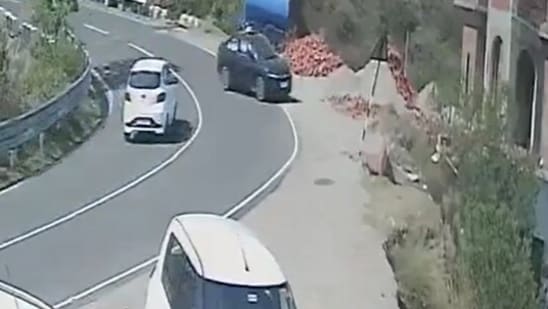
Car flies off road into deep gorge in Himachal Pradesh's Una, 2 killed
# 2 Dead as Car Plunges Into Gorge in Una
**By Staff Correspondent, The National Dispatch | April 30, 2026**
Two individuals lost their lives on Thursday afternoon when their vehicle careened off a treacherous mountain road and plunged into a deep gorge in Himachal Pradesh’s Una district. The fatal accident occurred at approximately 3:30 pm along the Chintpurni section of the Bharwain-Hoshiarpur Road. Local law enforcement authorities report that the driver seemingly lost control of the vehicle on a notoriously dangerous stretch characterized by sharp, blind turns and a severe downward gradient. Emergency response teams and local volunteers rushed to the rugged site, but both occupants suffered fatal injuries and were pronounced dead upon retrieval from the gorge. [Source: Hindustan Times].
## The Immediate Aftermath and Rescue Operations
The serenity of the Shivalik foothills was shattered on Thursday afternoon when the sound of screeching tires and a massive impact echoed through the Chintpurni valley. According to initial dispatches from the scene, the passenger vehicle was navigating the descent toward Punjab when it breached the roadside perimeter, tumbling down the precipitous slope.
Local shopkeepers and passing motorists were the first to alert the authorities. Teams from the local Chintpurni police station, aided by the State Disaster Response Force (SDRF) and courageous local volunteers, initiated a rigorous extraction operation. The steepness of the gorge and the dense foliage complicating the topography made the retrieval incredibly challenging. Rescuers had to rely on heavy-duty ropes, harnesses, and specialized extraction gear to reach the mangled wreckage of the vehicle resting at the bottom of the ravine.
Despite the rapid mobilization of emergency medical services, the severity of the crash left no room for survival. Medical personnel at the scene confirmed that both individuals succumbed to multiple traumatic injuries sustained during the violent descent. The bodies have since been transported to the regional government hospital for formal identification and post-mortem examinations.
## Investigating the Bharwain-Hoshiarpur Stretch
The Chintpurni section of the Bharwain-Hoshiarpur Road is a critical arterial route that connects the plains of Punjab to one of the most revered pilgrimage sites in northern India, the Chintpurni Mata Temple. Consequently, it witnesses an exceptionally high volume of vehicular traffic year-round. Pilgrims travelling from Punjab, Haryana, Delhi, and beyond frequently utilize this route.
However, the road’s geographical design makes it a high-risk zone, particularly for drivers unaccustomed to mountain navigation. The specific stretch where Thursday’s tragedy unfolded is infamous for its steep downward gradient paired with a sequence of blind hairpin bends.
“The descent from Bharwain towards Hoshiarpur drops significantly in elevation over a very short distance,” explained Dr. Anil Sharma, an independent civil engineer and road safety analyst based in Shimla. “When vehicles carry heavy loads or when drivers maintain the speeds they are used to on the plains, the physical forces at play on these sharp curves can easily overwhelm a vehicle’s braking system and tire traction.” [Additional Source: Public Road Safety Analysis].
## Eyewitness Accounts and Official Statements
While the exact sequence of events leading to the crash is still under active investigation, preliminary evidence points toward a catastrophic loss of vehicular control.
Eyewitnesses who were travelling uphill at the time of the incident reported seeing the descending car moving at a concerning speed before it failed to negotiate a sharp leftward curve. “It happened in the blink of an eye. The car didn’t seem to slow down enough for the turn, and before we could react, it crashed through the outer edge and disappeared into the gorge,” shared a motorist who pulled over to assist.
Local police officials have cordoned off the accident site to conduct a thorough forensic analysis. A senior investigating officer from the Una district police stated, “We are currently looking into all possible factors, including mechanical failure, brake fade, driver fatigue, or over-speeding. The regional transport office (RTO) has been called in to inspect the mechanical integrity of the wreckage. We urge all motorists to exercise extreme caution on this descent.”
## A Broader Look at Himalayan Road Safety
This tragic incident highlights a persistent and grim reality regarding road safety in India’s Himalayan states. Himachal Pradesh, with its breathtaking landscapes and vital religious tourism sector, relies heavily on its road networks. However, the state records thousands of vehicular accidents annually, many resulting in high fatality rates due to the unforgiving nature of the terrain.
According to data historically compiled by the Ministry of Road Transport and Highways (MoRTH), a significant percentage of fatal crashes in hill states involve vehicles originating from outside the state. The primary culprits remain human error, lack of hill-driving experience, and mechanical oversights.
**Common Factors Contributing to Accidents in Himachal Pradesh:**
* **Over-reliance on Brakes:** Drivers from the plains often ride their brakes continuously on long descents. This leads to “brake fade”—a phenomenon where brake fluid boils and brake pads overheat, causing a sudden and total loss of stopping power.
* **Unfamiliarity with Terrain:** Misjudging the severity of blind curves or failing to sound horns at unmarked corners.
* **Over-speeding:** Exceeding safe speed limits designed for mountainous topographies.
* **Poor Infrastructure:** Inadequate crash barriers, missing parapets, and crumbling road edges in remote sections.
## Infrastructure and Policy Interventions
In recent years, the Himachal Pradesh Public Works Department (PWD) and the National Highways Authority of India (NHAI) have undertaken extensive measures to identify and rectify “black spots”—specific locations with a high density of accidents.
Interventions have included widening critical bottlenecks, improving road signage, installing convex mirrors at blind turns, and deploying robust W-beam steel crash barriers. On certain highly dangerous hairpin bends, the state has experimented with modern rolling barriers designed to absorb impact energy and redirect errant vehicles back onto the roadway rather than allowing them to breach the edge.
However, the Chintpurni stretch remains a logistical challenge. The sheer volume of weekend and festival traffic often leads to congestion, prompting some drivers to take reckless overtaking maneuvers. While infrastructure upgrades are vital, experts argue that they must be paired with stringent enforcement of traffic laws and intensive public awareness campaigns aimed at incoming tourists.
## Expert Recommendations for Safe Hill Driving
The loss of two lives in Una serves as a stark reminder of the unforgiving nature of mountain roads. Automotive experts and road safety advocates emphasize that driving in the hills requires a fundamentally different skill set compared to highway cruising.
“The golden rule of descending a mountain is engine braking,” notes Vikram Singh, a driving instructor who specializes in high-altitude terrain orientation. “Drivers must shift to a lower gear—second or third, depending on the gradient—and let the engine’s natural resistance control the vehicle’s speed. Brakes should only be used intermittently to correct speed, never held down continuously.”
Other critical recommendations for tourists travelling to shrines like Chintpurni or hill stations in Himachal Pradesh include:
1. **Pre-Trip Vehicle Inspection:** Ensuring tire treads are deep and brake pads/fluids are in optimal condition before attempting mountain climbs.
2. **Respecting the Right of Way:** Vehicles travelling uphill inherently require more momentum and have the right of way. Downhill traffic must yield.
3. **Adhering to Speed Limits:** The posted speed limits in mountainous areas are not suggestions; they are calculated maximums for the physics of the curves.
4. **Avoiding Night Driving:** Visibility is severely compromised after dusk, and the risk of encountering wildlife or black ice (in colder months) increases exponentially.
## Conclusion and Future Outlook
The horrific crash on the Bharwain-Hoshiarpur Road on Thursday is a devastating event that has left two families grieving and a community in shock. As local authorities process the scene and conduct a post-mortem of the incident—both literally and figuratively—the focus must inevitably shift toward prevention.
While the exact cause of Thursday’s tragedy will be determined by forensic and mechanical reports in the coming days, the overarching narrative is clear: mountain roads demand absolute vigilance. For the government, this incident underscores the urgent need to accelerate the installation of heavy-duty crash barriers along the entirety of the Chintpurni descent. For the public, it is a sobering lesson on the critical importance of vehicle maintenance and adherence to safe hill-driving practices.
Until infrastructure perfectly aligns with stringent driver education, the steep slopes of the Himalayas will continue to test those who traverse them. Authorities urge all tourists and pilgrims planning to visit Himachal Pradesh this summer season to prioritize safety above all else, ensuring that a journey of faith or leisure does not end in irreversible tragedy.





