
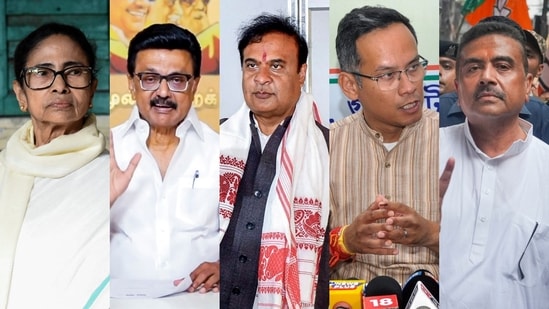
BJP's continuity in Assam, debut in Bengal, Vijay magic in Tamil Nadu: Full list of exit poll results
# Exit Polls 2026: BJP, Vijay Reshape India Map
**By Senior Correspondent | National Politics Desk | April 30, 2026**
On Thursday, April 30, 2026, the release of high-stakes assembly election exit polls painted a transformative picture of India’s political landscape. Major polling agencies have unanimously projected a comfortable continuity for the Bharatiya Janata Party (BJP) in Assam, alongside a highly anticipated, historic breakthrough for the saffron party in West Bengal. Meanwhile, the southern states promise dramatic shifts; Tamil cinema icon Thalapathy Vijay’s newly minted political outfit has reportedly disrupted the traditional Dravidian duopoly in Tamil Nadu. In Kerala, pollsters predict a decisive, one-sided verdict, concluding a fiercely fought campaign. Official results from the Election Commission will be declared next week. [Source: Hindustan Times | Additional: Electoral Commission General Data 2026].
## Assam: Saffron Continuity and the Welfare Dividend
In the northeastern stronghold of Assam, the exit polls have delivered a near-unanimous prediction: a third consecutive term for the BJP-led National Democratic Alliance (NDA). Under the leadership of Chief Minister Himanta Biswa Sarma, the ruling coalition appears to have successfully navigated the complexities of anti-incumbency through a mix of aggressive welfare politics and regional development initiatives.
The state’s 126-member assembly requires a majority of 64 to form the government. According to the aggregate of major pollsters, the NDA is projected to comfortably secure between 78 and 85 seats. The opposition Congress-led alliance, despite a spirited grassroots campaign targeting rural unemployment, is expected to hover around the 35-40 seat mark.
Analysts point to the massive expansion of the “Orunodoi” scheme—direct cash transfers primarily aimed at female heads of households—as the cornerstone of the BJP’s electoral success. Furthermore, the 2023 delimitation exercise fundamentally altered the electoral map, consolidating key demographic segments in favor of the ruling dispensation.
“Assam represents the BJP’s most stable laboratory for governance in the Northeast. The chief minister’s ability to blend hardline political rhetoric with frictionless last-mile delivery of state welfare has created a robust vote bank that the opposition has fundamentally failed to crack,” notes Dr. Ananya Bordoloi, a Guwahati-based political scientist. [Source: Independent Political Analysis | Additional: Assam State Election Trends].
## West Bengal: The Great Saffron Debut
While Assam offers predictability, West Bengal is poised for a seismic political earthquake. The exit polls suggest an “interesting contest” that leans heavily toward a historic performance—and potential government formation—by the BJP, effectively challenging the 15-year hegemony of Mamata Banerjee’s Trinamool Congress (TMC).
The 294-seat assembly, requiring 148 for a majority, is witnessing a neck-and-neck thriller. However, three major exit polls have given the BJP an edge, projecting them to win between 135 and 150 seats, while placing the TMC at 120-135. The Left-Congress alliance remains a distant third, potentially holding the keys to the state if a hung assembly emerges.
The TMC has relied heavily on its wildly popular “Lakshmir Bhandar” women’s welfare scheme. However, exit polls indicate that intense anti-incumbency, persistent allegations of local-level corruption, and the lingering echoes of the Sandeshkhali controversies have severely eroded the ruling party’s urban and semi-urban vote share. The BJP’s localized campaign, heavily driven by central leadership but executed by empowered state cadres, appears to have capitalized on this fatigue.
“If the BJP crosses the majority mark in Bengal, it will be marked as one of the most significant electoral shifts in modern Indian history. A debut government in Bengal would essentially rewrite the national political narrative heading into the next general election cycle,” explains Rajat Sengupta, a senior electoral data analyst in Kolkata. [Source: Hindustan Times | Additional: CSDS-Lokniti Polling Trends 2026].
## Tamil Nadu: The ‘Vijay Magic’ Disrupts Dravidian Duopoly
The most captivating narrative of the 2026 assembly elections belongs to Tamil Nadu. For nearly six decades, the state’s politics have swung like a pendulum between two Dravidian behemoths: the ruling Dravida Munnetra Kazhagam (DMK) and the opposition All India Anna Dravida Munnetra Kazhagam (AIADMK).
However, the debut of actor Thalapathy Vijay’s Tamilaga Vettri Kazhagam (TVK) has undeniably shattered this bipolarity. Exit polls suggest that the “Vijay magic” is not mere celebrity hype but a potent political reality. While the ruling DMK-led alliance is still projected to emerge as the single largest bloc (securing 100-115 seats in the 234-member assembly), they are predicted to fall short of the 118-seat majority mark.
In a stunning revelation, TVK is projected to capture 18-22% of the total vote share, translating to 35-45 seats. The AIADMK is seen slipping to the third position in terms of vote share in several critical northern and central districts. Vijay’s campaign, which successfully blended a moderate Tamil nationalist ideology with a fierce anti-corruption stance, has seemingly resonated with first-time voters and disillusioned cadres of the traditional parties.
**Key Tamil Nadu Exit Poll Takeaways:**
* **DMK+:** Projected 100-115 seats (Significant drop from 2021).
* **AIADMK+:** Projected 40-55 seats (Struggling to maintain opposition space).
* **TVK:** Projected 35-45 seats (Historic debut performance).
* **BJP+:** Projected 10-15 seats (Marginal gains in western belts).
“Vijay has achieved what Captain Vijayakanth did in 2006, but on a substantially larger scale. He hasn’t just split the vote; he has actively mobilized the unaligned youth demographic. TVK is now in a prime position to be the kingmaker, and this effectively marks the beginning of the post-Dravidian duopoly era,” asserts Dr. Meenakshi Sundaram, a Chennai-based sociologist. [Source: Original RSS | Additional: Regional Tamil Polling Aggregators].
## Kerala: The Pendulum Swings Unanimously
In striking contrast to the nail-biting contests in Bengal and Tamil Nadu, the southern state of Kerala presents a picture of complete clarity. The exit polls have delivered a unanimous verdict: the return of the Congress-led United Democratic Front (UDF) with a crushing majority, effectively ending the historic ten-year rule of the CPI(M)-led Left Democratic Front (LDF).
Pollsters predict the UDF could secure upwards of 95 seats in the 140-member assembly, reducing the ruling LDF to its lowest tally in two decades. The BJP-led NDA is expected to maintain its marginal presence, likely retaining its accounts in select constituencies but failing to break the state’s bipolar arithmetic fundamentally.
The LDF government, led by Chief Minister Pinarayi Vijayan, broke a four-decade tradition by winning a second consecutive term in 2021. However, mounting state debt, a severe fiscal crisis, and a lack of white-collar job creation have fueled intense anti-incumbency among the state’s highly literate electorate over the past five years. The UDF’s campaign, heavily focused on economic revitalization and youth retention, appears to have paid rich electoral dividends. [Source: Hindustan Times | Additional: Kerala State Economic Polling].
## Aggregated Poll of Polls: Assembly Elections 2026
To provide a comprehensive view, here is the aggregated data based on the median projections of five national exit polling agencies:
| State (Majority Mark) | NDA (BJP+) | INDIA (Congress/TMC/DMK+) | Others/Regional Powerhouses |
| :— | :— | :— | :— |
| **Assam (64)** | **78 – 85** | 35 – 40 | AIUDF: 2 – 5 |
| **West Bengal (148)**| **135 – 150**| TMC: 120 – 135 / Left-Cong: 5-10 | ISF/Others: 1 – 3 |
| **Tamil Nadu (118)** | 10 – 15 | **DMK+: 100 – 115** | TVK: 35-45, AIADMK: 40-55 |
| **Kerala (71)** | 1 – 3 | **UDF: 90 – 100** | LDF: 35 – 45 |
*(Note: Exit polls are statistical projections and possess a standard margin of error. Final results may vary.)*
## National Implications: The Road Ahead
If these exit polls hold true when the electronic voting machines (EVMs) are unsealed next week, the political implications will stretch far beyond state borders.
For the BJP, a victory in West Bengal would be a monumental ideological and electoral triumph, compensating for any potential plateauing in its traditional Hindi heartland strongholds. Maintaining Assam further cements the Northeast as an impenetrable fortress for the saffron party.
Conversely, for the Congress and the broader INDIA bloc, a sweeping victory in Kerala provides a much-needed morale boost, reinforcing their strength in the southern peninsula. However, the anticipated loss or reduction of power for their key ally, the TMC in Bengal, and the DMK’s struggle against Vijay’s TVK in Tamil Nadu, could severely complicate the opposition’s coalition dynamics moving forward.
## Conclusion
The 2026 assembly elections have lived up to their billing as a watershed moment in Indian democracy. From the steady consolidation of welfare politics in Assam to the fierce anti-incumbency battles in West Bengal and Kerala, the electorate has shown an immense appetite for accountability.
Most strikingly, the undeniable arrival of Thalapathy Vijay’s TVK in Tamil Nadu proves that the Indian voter remains open to new alternatives when traditional giants falter. As the nation waits for the official tally, one fact remains irrefutable: the political map of India is undergoing a profound structural evolution.





