
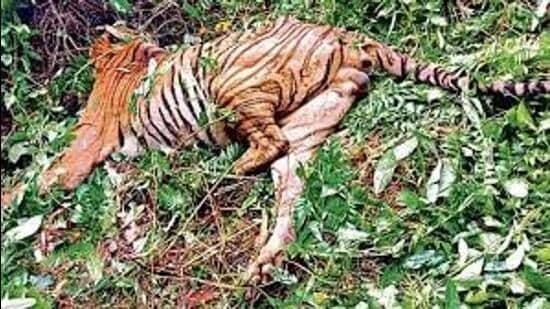
Tiger found dead in Goa’s forest with teeth, nails missing; poaching suspected
# Goa Tiger Poaching: Claws Missing, Sparking Ire
By Environment Correspondent, India Wildlife Monitor, May 02, 2026
The discovery of a mutilated tiger carcass in the dense forests of Goa’s Dharbandora region early this week has sent shockwaves through India’s conservation community. Forest officials found the apex predator with its teeth and nails extracted, a hallmark of organized poaching for the illegal wildlife trade. Discovered on May 2, 2026, the grim find has escalated long-standing demands to officially notify the Western Ghats stretch in Goa as a dedicated tiger reserve, a move strongly recommended by the National Tiger Conservation Authority (NTCA). Authorities have launched a sweeping investigation into the suspected wildlife crime.
## The Grim Discovery in Dharbandora
The Dharbandora region, nestled within the foothills of the ecologically fragile Western Ghats, serves as a vital corridor for wildlife moving between the forests of Goa, Karnataka, and Maharashtra. On the morning of May 2, a routine foot patrol by frontline forest guards encountered the decomposing remains of a fully grown adult tiger. Initial field inspections quickly transformed a routine mortality check into a high-stakes crime scene investigation.
**Key field observations** noted by the responding range officers indicated that while the animal’s pelt remained largely intact, the canine teeth and all claws had been surgically removed. The deliberate extraction of these specific body parts definitively rules out natural causes of death, territorial infighting with other male tigers, or retaliatory poisoning by local farmers—which typically leaves the carcass untouched.
Standard Operating Procedures (SOPs) established by the NTCA dictate that every tiger death must be treated as a poaching incident until proven otherwise. A team of veterinary pathologists was immediately dispatched to conduct a thorough post-mortem examination, while the perimeter was secured to preserve potential tracks, snares, or forensic evidence left behind by the perpetrators. [Source: Hindustan Times | Additional: National Tiger Conservation Authority SOP Guidelines].
## Decoding the Poacher’s Modus Operandi
The clinical removal of tiger teeth and nails points toward the involvement of organized wildlife trafficking syndicates. In the black market, tiger parts continue to command exorbitant prices, driven primarily by persistent, scientifically unfounded beliefs in their medicinal properties and their status as luxury ornamental items in parts of East and Southeast Asia.
While the illegal wildlife trade has faced intense crackdowns by the Wildlife Crime Control Bureau (WCCB) globally, the lure of quick financial gain continues to incentivize poachers. Expert wildlife criminologists suggest that the perpetrators in the Dharbandora incident likely utilized steel jaw traps or wire snares to incapacitate the animal before killing it. The targeted removal of small, easily transportable items like teeth and claws—rather than attempting to skin the massive animal, which requires time and risks exposure—suggests a calculated, hit-and-run tactic designed to evade the region’s forest patrols.
The incident highlights a glaring vulnerability in areas that lack the stringent security infrastructure mandated for official tiger reserves. Under the Wildlife Protection Act of 1972, the tiger is an Annexure I species, affording it the highest level of legal protection in India. Yet, legal protection on paper must be matched by robust boots on the ground.
## The Long-Delayed Goa Tiger Reserve
This tragic event has thrust the deeply contested issue of Goa’s tiger reserve back into the national spotlight. For over a decade, environmentalists and the NTCA have been urging the Goa state government to upgrade the contiguous protected areas—including the Mhadei, Bhagwan Mahavir, Cotigao, and Netravali wildlife sanctuaries—into a unified tiger reserve.
In a landmark judgment in mid-2023, the Bombay High Court directed the state government to notify the tiger reserve within three months. However, the political establishment has consistently pushed back, citing concerns over the displacement of forest-dwelling communities, such as the Dhangar tribes, and the potential negative impacts on infrastructure development and regional economies.
The state government’s reluctance has resulted in a legal and administrative stalemate, leaving the forests under a lower tier of protection. Unlike official tiger reserves, which benefit from specialized Special Tiger Protection Forces (STPF), enhanced central funding for anti-poaching camps, and advanced electronic surveillance systems, traditional wildlife sanctuaries often operate with limited personnel and resources.
“This is not just the tragic loss of a majestic apex predator; it is a direct and bloody consequence of administrative paralysis,” noted Dr. Prakash Vartak, a senior wildlife biologist specializing in Western Ghats ecology. “When you deny a landscape the protection status it scientifically requires, you leave the back door wide open for organized poaching syndicates.” [Source: Hindustan Times | Additional: General Ecological Consensus on Western Ghats Conservation].
## Ecological Significance of the Western Ghats Corridor
The loss of even a single breeding tiger is a severe blow to the ecological equilibrium of the Western Ghats, a UNESCO World Heritage site and one of the world’s eight “hottest hotspots” of biological diversity. Goa’s forests are not isolated islands; they form a critical genetic corridor connecting the Bhimgad Wildlife Sanctuary and Kali Tiger Reserve in Karnataka to the Sahyadri Tiger Reserve in Maharashtra.
Tigers are both an apex predator and an “umbrella species.” By protecting the vast expanses of forest required to sustain a viable tiger population, conservationists inadvertently protect thousands of other species—from the critically endangered Malabar gliding frog to the great hornbill. Furthermore, these forests are the primary catchment areas for vital rivers, including the Mhadei (Mandovi), which is the lifeline of Goa’s drinking water and agricultural systems.
Recent camera-trap census data had indicated a slow but steady increase in the presence of transient and resident tigers utilizing the Goa corridor. The Dharbandora poaching incident threatens to reverse this fragile ecological recovery, potentially fragmenting the meta-population of tigers in the central Western Ghats.
## Law Enforcement Response and Next Steps
In the wake of the discovery, state and central authorities have mobilized a multi-agency response.
**Immediate actions include:**
* **Deployment of Sniffer Dogs:** Specialized canine units from neighboring Karnataka have been brought in to track the escape routes of the poachers.
* **Forensic Analysis:** Tissue samples and swabs have been sent to the Wildlife Institute of India (WII) in Dehradun for DNA profiling. This will help determine the tiger’s origin, verifying if it was a resident of Goa or a transient individual from Karnataka.
* **Cyber Forensics:** The WCCB is monitoring dark web forums and known communication channels of wildlife trafficking networks to intercept the sale of the stolen claws and teeth.
* **Intensified Patrolling:** The Goa Forest Department has canceled leaves for field staff, initiating intensive combing operations across the Dharbandora, Mollem, and Mhadei ranges to locate and dismantle any hidden snares or traps.
Despite these reactive measures, conservationists argue that proactive systemic changes are required. The incident has energized local NGOs, who are now preparing fresh petitions to the Supreme Court of India, demanding the immediate enforcement of the NTCA guidelines regarding the Goa tiger reserve.
## Balancing Human Rights and Wildlife Protection
While the environmental argument for a tiger reserve is unassailable, policymakers continue to grapple with the socio-economic realities of the region. The state government has repeatedly argued that declaring a tiger reserve would severely restrict the customary rights of the indigenous and traditional forest-dwelling communities.
However, experts point out that the Forest Rights Act (FRA) of 2006 contains specific provisions to ensure that the creation of Critical Tiger Habitats (CTHs) does not occur at the expense of human rights. Successful models in states like Madhya Pradesh and Maharashtra have demonstrated that generous, voluntary relocation packages and the integration of local communities into the eco-tourism economy can turn former forest dwellers into the most effective guardians of the tiger.
“The dichotomy between human survival and tiger conservation is a false narrative often perpetuated to protect commercial mining and real estate interests,” stated an independent environmental policy analyst reviewing the Goa situation. “True conservation integrates the local community, making a live tiger economically more valuable to them than a dead one.” [Source: Hindustan Times | Additional: Policy analysis based on Forest Rights Act implementation].
## Conclusion: A Wake-Up Call for Goa
The brutal poaching of a tiger in the Dharbandora forest is a stark reminder of the persistent threats facing India’s national animal. While the country has celebrated significant successes in increasing its overall tiger population in recent years, the margins of these habitats remain incredibly vulnerable.
As investigations proceed, the missing teeth and claws of the Dharbandora tiger serve as a grim testament to the cost of political indecision. For Goa, the path forward is clear: it must move beyond viewing wildlife protection as a hindrance to development. Establishing the NTCA-recommended tiger reserve is no longer merely an ecological ideal; as this incident violently illustrates, it is an urgent, non-negotiable necessity to safeguard the natural heritage of the Western Ghats. Future generations will judge the current administration not by the infrastructure it builds, but by the irreplaceable biodiversity it manages to save.





