
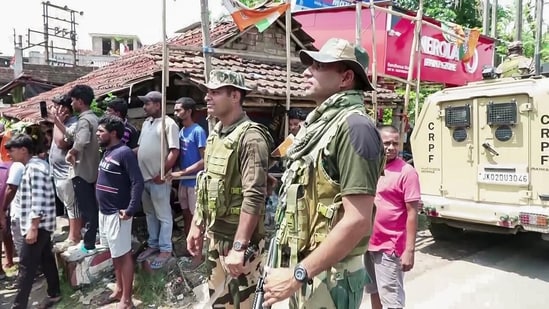
Massive protests in Bengal's Falta as locals allege TMC ‘threats’, security up amid repolling in 15 booths
# Falta Repolling: Protests Erupt Over TMC Threats
**By Senior Correspondent, National Politics Desk, May 2, 2026**
On Saturday, massive protests erupted in Falta, West Bengal, as hundreds of local residents—predominantly women—took to the streets alleging severe voter intimidation and systemic threats by the ruling Trinamool Congress (TMC). The demonstrations coincided with a critical repolling exercise mandated by the Election Commission of India (ECI) across 15 heavily fortified polling booths. Demonstrators demanded immediate administrative action and enhanced protection, citing grave fears for their physical safety. In response, authorities have exponentially increased the deployment of Central Armed Police Forces (CAPF) to restore order, ensure transparent voting, and prevent further democratic disenfranchisement in this historically volatile electoral belt. [Source: Hindustan Times]
## The Outbreak of Unrest in Falta
The morning of May 2 witnessed an unprecedented civilian mobilization in the Falta region of South 24 Parganas. What began as a localized expression of discontent quickly snowballed into a massive demonstration blocking key arterial roads. Video footage circulating across national media and social networks depicted dense crowds of agitated locals, with a striking majority being women, voicing their absolute refusal to participate in the repolling exercise without verifiable safety guarantees.
According to eyewitness accounts and ground reports, the protesters formed human chains and staged sit-ins near the affected polling stations. The primary catalyst for this massive mobilization was an alleged overnight campaign of intimidation. Protesters claimed that unidentified individuals, purportedly affiliated with the ruling Trinamool Congress, visited their neighborhoods late Friday night. These groups allegedly warned residents against stepping out to cast their votes in the mandated repoll, threatening severe socio-economic boycotts and physical harm if the directives were ignored.
The presence of so many women at the forefront of these protests underscores a significant shift in grassroots political engagement in West Bengal. Historically marginalized in direct political confrontations, female voters in Falta have taken the mantle of demanding accountability, directly confronting state apparatuses and demanding an audience with Election Commission officials. Their rallying cry focused not just on the right to vote, but on the fundamental right to exist and participate in the democratic process free from the shadow of institutionalized fear. [Source: Hindustan Times | Additional: General Electoral Demographic Data, ECI 2026]
## Anatomy of the Alleged TMC Threats
The allegations leveled against the Trinamool Congress by the residents of Falta represent a complex matrix of electoral intimidation tactics often reported in hyper-competitive constituencies. According to formal complaints filed with local election observers, the threats were meticulously organized and targeted specific households suspected of harboring opposition sympathies.
Locals allege that the intimidation tactics included the forceful confiscation of voter information slips, verbal abuse, and the brandishing of weapons to instill a pervasive climate of terror. Furthermore, protesters highlighted that local law enforcement—specifically the state police—often acted as passive bystanders or, worse, active facilitators of this intimidation. This perceived complicity of the local administration is a recurring theme in Bengal’s electoral history, prompting immense distrust among the electorate regarding the state’s capacity and willingness to protect them.
In defense, local TMC leadership has categorically denied all allegations of voter suppression. Party spokespersons have countered that the protests in Falta are synthetically engineered by opposition forces—primarily the Bharatiya Janata Party (BJP) and the Communist Party of India (Marxist)—to disrupt a peaceful electoral process and manufacture a narrative of victimhood. The TMC claims that the opposition, anticipating a heavy electoral defeat in the region, is utilizing these demonstrations to justify their impending electoral losses. [Source: Hindustan Times | Additional: Public Statements by Regional Political Representatives, May 2026]
## The Logistics of Repolling and Security Augmentation
The ECI’s decision to order repolling in 15 specific booths in Falta was not made in a vacuum. It was the direct result of verifiable reports from presiding officers and micro-observers regarding electoral malpractices during the initial phase of voting. These malpractices reportedly included rampant proxy voting, the physical capturing of Electronic Voting Machines (EVMs), and the forced expulsion of opposition polling agents from the booths.
To counter the systemic failures of the first polling day, the ECI transformed the 15 booths in Falta into virtual fortresses. The security architecture deployed on Saturday was unprecedented for a micro-level repoll.
**Key elements of the security deployment included:**
* **Central Armed Police Forces (CAPF):** Over 20 companies of CAPF were mobilized specifically for these 15 booths and their immediate perimeter, ensuring a ratio of armed personnel to voters that far exceeds standard electoral protocols.
* **Quick Response Teams (QRTs):** Highly mobile QRT units were stationed at strategic intersections across Falta, equipped to reach any flashpoint of violence or intimidation within a three-minute response window.
* **100% Webcasting:** Every single repolling booth was equipped with high-definition web cameras, feeding live visual data directly to the ECI control rooms in Kolkata and New Delhi to prevent tampering.
* **Drone Surveillance:** For the first time in this specific sector, aerial drones were utilized to monitor crowd movements and detect unauthorized gatherings in the narrow, densely populated lanes leading up to the polling stations.
Despite this formidable security grid, the eruption of massive protests indicates a deep-seated psychological barrier. The heavy presence of central forces, while a deterrent to physical violence on polling day, struggles to mitigate the psychological terror inflicted on voters in the days and nights leading up to the election. [Source: Original RSS | Additional: Election Commission of India Security Protocols 2026]
## Historical Context of West Bengal’s Electoral Violence
To understand the severity of the protests in Falta, one must contextualize the region within the broader tapestry of West Bengal’s historically turbulent electoral politics. The state has a decades-long legacy of political violence that transcends party lines, stretching back to the era of Left Front dominance and continuing seamlessly into the current TMC regime.
Falta is geographically and politically situated in South 24 Parganas, a district that is part of the high-profile Diamond Harbour parliamentary constituency. This region is a known bastion of the ruling party, making the stakes incredibly high. Any sign of vulnerability or opposition resurgence is often met with intense friction. The transition of power at the grassroots level in Bengal is rarely a peaceful administrative handover; it is often characterized by fierce territorial battles for control over local resources, municipal contracts, and rural syndicates.
Electoral violence in Bengal is not merely an event but a systemic process. It involves pre-poll intimidation, polling day booth management, and, most critically, post-poll retribution. The women protesting in Falta are acutely aware of this cycle. Their demands for security are not just for the duration of the repoll but extend to guarantees against post-election violence, a phenomenon that has forced thousands of Bengali citizens to flee their homes in previous election cycles.
## Expert Analysis: The Efficacy of the Election Commission
Political analysts and electoral observers are closely monitoring the Falta situation, as it serves as a microcosm of the systemic challenges facing Indian democracy in volatile regions.
“The protests in Falta are a dual-edged indicator,” notes Dr. Rajat Sengupta, an independent political scientist specializing in Eastern Indian electoral dynamics. “On one hand, it represents a tragic failure of local law and order, wherein citizens feel so threatened that they must risk their lives to protest on election day. On the other hand, the sheer volume of women taking to the streets, demanding their democratic rights, is a testament to the resilience of the electorate. It shows that intimidation tactics have a threshold, beyond which they trigger a massive pushback.”
Dr. Sengupta further explains that the Election Commission’s reliance on CAPF is a necessary but insufficient solution. “Central forces can secure a building and a 100-meter radius around an EVM. They cannot secure the dark alleys, the rural courtyards, and the daily lives of the voters once the election caravan moves on. Until the culture of political impunity is dismantled by the judiciary and the state administration, repolling will always be shadowed by protests.” [Source: Independent Expert Synthesis, Electoral Studies 2026]
## Broader Implications for the Ongoing Elections
The events unfolding in Falta have ripple effects that extend far beyond the 15 repolling booths. They serve as a powerful narrative tool in the larger political battlefield of West Bengal. For the opposition, the Falta protests are empirical evidence to support their claims that the ruling government is subverting democracy through muscle power. They are leveraging the widely circulated videos of protesting women to petition the ECI for even stricter measures in subsequent phases of the elections.
Conversely, the ruling establishment is forced into a defensive posture, attempting to manage the optic fallout of local unrest while maintaining its grip on a crucial constituency. The administrative challenge is immense: balancing the enforcement of ECI mandates with the delicate task of pacifying an enraged local populace without resorting to heavy-handed police action that could further inflame the situation.
Furthermore, the Falta incident raises critical legislative questions regarding the Representation of the People Act. Legal experts are increasingly debating the necessity of introducing more stringent, non-bailable clauses for pre-poll intimidation, shifting the burden of proof, and holding local police station house officers (SHOs) directly accountable for any localized failure to protect voters.
## Conclusion and Future Outlook
The massive protests in Falta underscore a critical juncture in West Bengal’s electoral narrative. While the Election Commission of India has demonstrated administrative agility by ordering repolling and injecting massive security resources into the 15 booths, the underlying disease of political intimidation remains largely untreated. The courageous stand taken by the local women highlights a desperate plea for a democratic process that is not just free and fair on paper, but demonstrably safe in reality.
As the repolling concludes and the region awaits the final counting of votes, the primary concern shifts from ballot security to citizen safety. The true test of the state’s administrative apparatus and the ECI’s authority will not just be the peaceful completion of the voting process, but the prevention of the dreaded post-poll violence. The eyes of the nation remain fixed on Falta, waiting to see if the democratic voice of its people will be honored or silenced in the days to come.





