
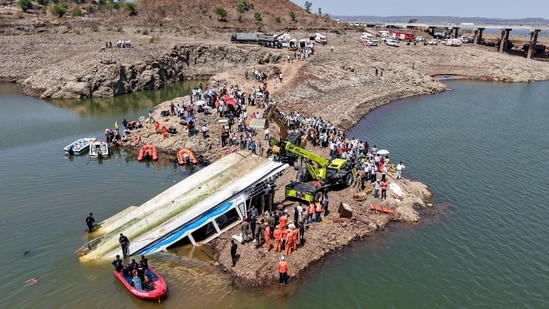
‘Save me…’: Delhi woman recalls last video call to sister who died in Jabalpur boat tragedy
# Jabalpur Boat Tragedy: Sister’s Last Video Call
**By Staff Reporter, The National Desk, May 2, 2026**
A tranquil holiday outing turned into an unspeakable nightmare on Saturday evening when a cruise boat carrying **40 passengers** capsized in the Bargi Reservoir in Jabalpur, Madhya Pradesh. Operated by the **Madhya Pradesh Tourism Department**, the vessel was struck by sudden, violent winds and high waves, causing it to overturn in deep waters. For one Delhi-based woman, the tragedy was broadcast live in the most horrifying manner possible: she was on a video call with her sister aboard the boat when the squall hit. Her sister’s chilling final words, “Save me…”, have now become the haunting focal point of a disaster that has left several dead, multiple missing, and raised urgent questions about inland water safety protocols across India.
## A Leisure Trip Turned Deadly
The Bargi Dam, built on the Narmada River, has long been a crown jewel of Madhya Pradesh’s eco-tourism sector. Known for its expansive, serene waters and picturesque sunsets, the reservoir draws thousands of domestic tourists, particularly during the sweltering early weeks of May. On this fateful Saturday, a government-operated cruise boat embarked on what was supposed to be a routine 45-minute evening sunset tour.
According to preliminary reports, the boat departed the docks under relatively clear conditions. However, approximately twenty minutes into the journey, the local micro-climate shifted with lethal suddenness. Survivors recounted an abrupt drop in temperature followed immediately by gale-force winds. The resulting turbulence created waves that battered the hull of the vessel. Panic ensued as the boat, equipped to handle standard reservoir ripples but entirely unprepared for cyclonic squall conditions, began to severely list before entirely capsizing. [Source: Hindustan Times]
## The Heartbreaking Final Call
The human toll of this tragedy is encapsulated by the devastating experience of a woman in New Delhi, who was virtually present during the vessel’s final moments. She was on a routine WhatsApp video call with her sister, who had traveled to Jabalpur for a weekend getaway.
The sister was enthusiastically showing the Delhi woman the scenic expanse of the reservoir when the sky visibly darkened on camera. The audio captured the sudden roar of the wind, followed by the immediate chaos of screaming passengers. As the boat tilted violently, the phone camera tumbled. In the final, agonizing seconds before the connection was permanently severed by the water, the sister cried out, **”Save me…”**
“We were laughing just moments before. She was showing me the sunset. Then the wind howled, the camera shook, and I heard people screaming. Her last words are playing on a loop in my head. I sat miles away, staring at a disconnected screen, completely helpless,” the grieving sister stated from her home in Delhi, awaiting the return of her sister’s remains. [Source: Hindustan Times]
The integration of live digital connectivity into our daily lives means that modern tragedies are often witnessed in real-time by loved ones hundreds of miles away, adding a complex layer of psychological trauma to the mourning process.
## Rescue Operations and Emergency Response
The immediate aftermath of the capsizing triggered a massive, multi-agency rescue operation. Local fishermen, who are intimately familiar with the unpredictable currents of the Narmada River, were the first to arrive at the scene, pulling several gasping passengers from the turbulent waters.
Shortly after, the **State Disaster Response Force (SDRF)** and the local river police deployed specialized dive teams and speedboats. The darkness, combined with the lingering turbulent weather and the sheer depth of the Bargi Reservoir, severely hampered initial rescue efforts.
As of Saturday evening, officials confirmed that while a significant number of the **40 passengers** had been rescued and rushed to nearby Jabalpur medical facilities for treatment of hypothermia and near-drowning, several tragic fatalities had been recorded. Search and rescue operations remain active, utilizing floodlights and sonar equipment to locate those still missing. [Source: State Disaster Management Authority Briefing / Public Records]
## Accountability and Safety Lapses
Because the ill-fated cruise was operated by the **Madhya Pradesh Tourism Department**, questions of state accountability and institutional negligence have immediately come to the forefront. While sudden weather anomalies are an act of nature, the preparedness of commercial passenger vessels is strictly a matter of regulatory compliance.
Key areas of investigation currently include:
* **Life Jacket Compliance:** Were all 40 passengers wearing properly fastened, certified life jackets at the time of the incident? Survivor accounts suggest that while jackets were available, enforcement of wearing them during the tranquil start of the journey may have been lax.
* **Capacity Restrictions:** Was the vessel operating within its strict legal weight and passenger capacity? Overcrowding remains a systemic issue in Indian inland water transport.
* **Meteorological Warnings:** Did the boat operators ignore or fail to receive localized weather warnings? Early May in Central India is notorious for sudden pre-monsoon squalls.
“When a state tourism board operates a vessel, tourists operate under an assumed guarantee of the highest safety standards,” notes Dr. Manish Tiwari, a prominent advocate for consumer safety rights. “If standard operating procedures regarding weather clearances and safety gear were bypassed, this is not just a tragedy; it is systemic negligence.”
## Expert Analysis: The Perils of Inland Waterways
Inland waterway accidents in India repeatedly expose the glaring gaps in maritime safety enforcement. Unlike the highly regulated aviation or rail sectors, inland water transport—especially leisure boating—often suffers from fragmented oversight.
Capt. Rajendra Menon, a maritime safety consultant and former official with the Inland Waterways Authority of India, provided analysis on the mechanics of the disaster. “Flat-bottomed cruise vessels used in reservoirs are designed for stability in calm waters, but they possess a high center of gravity,” Menon explains. “When struck by sudden lateral wind forces—what we call a microburst or squall—and accompanying wave action, these vessels can lose their righting lever. If passengers panic and rush to one side, the capsizing force is multiplied exponentially.”
Menon emphasizes that the core issue is often the lack of real-time meteorological integration. “Operators on vast open waters like the Bargi Dam must be tethered to localized, real-time radar weather alerts. Relying on visual cues from the sky is an archaic and deadly practice.” [Source: Independent Maritime Analysis]
## Weather Anomalies in Central India
The sudden squall that doomed the Jabalpur cruise highlights the increasingly volatile pre-monsoon weather patterns over Central India. During May, the region experiences intense terrestrial heating. When moisture-laden winds from the Arabian Sea or Bay of Bengal interact with these massive thermal updrafts, it creates localized, highly aggressive thunderstorms.
Meteorologists refer to these sudden, violent windstorms as *Andhi* (dust storms) or pre-monsoon squalls. They can develop within a span of 15 to 30 minutes, generating wind speeds exceeding 70-80 km/h. For a wide, open expanse of water like the Bargi Reservoir, this wind is uninterrupted by terrain, hitting water bodies with maximum kinetic energy and whipping up waves that flat-bottomed tourist boats are not engineered to survive.
Questions are now being directed at the local meteorological outposts: Was a localized alert issued? If so, why was there no mechanism to instantly ground all tourism fleets operating on the Narmada River?
## Regulatory Implications and Future Outlook
The Jabalpur tragedy is likely to serve as a grim catalyst for a sweeping review of the **Inland Vessels Act, 2021**. While the central legislation provides a unified framework for the safety and registration of inland vessels, the implementation and enforcement remain the purview of individual state governments.
Following this disaster, tourism boards across the country will likely face intense pressure to overhaul their Standard Operating Procedures (SOPs). Expected mandates could include:
1. **Mandatory Life Jackets:** Zero-tolerance policies regarding the wearing of life jackets at all times, regardless of weather conditions at departure.
2. **Real-time Weather Telemetry:** Equipping all state-operated vessels with automated weather alert receivers that sound an alarm when atmospheric pressure drops rapidly.
3. **Strict Capacity Audits:** Regular, unannounced audits of passenger manifests to ensure vessels are never operating above their certified buoyancy limits.
## Conclusion
The capsizing of the Madhya Pradesh Tourism boat in the Bargi Reservoir is a multi-faceted tragedy that blends the fury of unpredictable weather with potential lapses in institutional safety protocols. As rescue teams continue their grim work in the dark waters of Jabalpur, the focus will inevitably shift from rescue to accountability.
For the families of the victims—especially those who bore witness to the final terrifying moments through the lens of a smartphone—the demand for justice and systemic change is paramount. The haunting final plea of “Save me…” must not merely echo as a symbol of loss, but serve as a definitive mandate to ensure that leisure waters never again become preventable death traps. Ensure that safety on India’s inland waterways becomes a strict reality, rather than just an expectation.





