
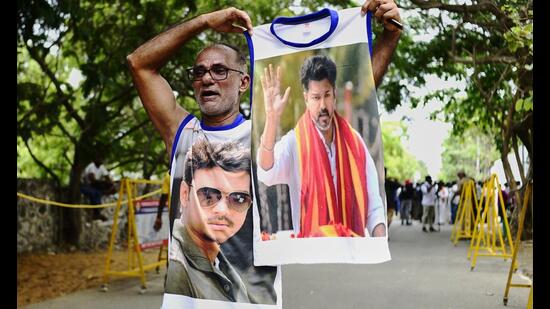
Tamil Nadu: Vijay’s TVK leads in 109 of 234 seats, threatens DMK-AIADMK duopoly
# Vijay’s TVK Leads: TN Duopoly Threatened
**By Staff Correspondent, The Election Desk**
**May 4, 2026**
On May 4, 2026, Tamil Nadu politics witnessed a seismic shift as early election results revealed actor-turned-politician Vijay’s Tamilaga Vettri Kazhagam (TVK) leading in 109 of the state’s 234 assembly constituencies. Capitalizing on his immense cinematic mass appeal and a palpable public desire for systemic change, Vijay has effectively threatened the five-decade duopoly of the Dravida Munnetra Kazhagam (DMK) and the All India Anna Dravida Munnetra Kazhagam (AIADMK). Overcoming a perceived lack of traditional political experience, TVK’s aggressive grassroots campaign has positioned the nascent party on the brink of a historic electoral upset. [Source: Hindustan Times].
## The Dawn of a New Dravidian Era
For over fifty years, the political landscape of Tamil Nadu has been a highly fortified battleground controlled almost exclusively by two Dravidian behemoths: the DMK and the AIADMK. Since 1967, no third front has successfully managed to form a government in the state, despite numerous attempts by prominent figures ranging from Vijayakanth to Kamal Haasan. However, the 2026 Assembly elections appear to have fundamentally rewritten this historical precedent.
Thalapathy Vijay, who officially launched his political party, Tamilaga Vettri Kazhagam, in February 2024, made the calculated decision to bypass the 2024 Lok Sabha elections to focus entirely on the 2026 state assembly polls. This laser-focused strategy seems to have paid immense dividends. By tapping into wide-reaching anti-incumbency sentiments and leveraging his colossal, deeply organized fan club network—formerly the Vijay Makkal Iyakkam (VMI)—he has created a formidable political machine that has caught veteran politicians completely off guard.
## Bridging the Gap: From Silver Screen to the Secretariat
The transition from cinema to politics is a well-trodden path in Tamil Nadu, a state where the lines between the silver screen and the Secretariat have historically been blurred. Iconic leaders like C.N. Annadurai, M. Karunanidhi, M.G. Ramachandran (MGR), and J. Jayalalithaa all utilized their cinematic popularity to build unshakable political empires.
Vijay’s rise is being heavily compared to that of MGR. Like the legendary founder of the AIADMK, Vijay spent decades cultivating an on-screen persona of the righteous savior of the poor, the protector of women, and the voice of the marginalized. However, critics long pointed to his lack of administrative and political experience as a fatal flaw.
“Many political veterans dismissed TVK as merely another fan-club vanity project,” notes Dr. S. Ramasamy, a Chennai-based political analyst. “What they drastically underestimated was the structural discipline of the VMI. For over ten years prior to the party’s launch, Vijay’s fan clubs were engaged in hyper-local social work—running blood banks, distributing food, and aiding in disaster relief. They weren’t just fans; they were grassroots political cadres in training.” [Additional Source: Public Political Analysis].
## Decoding the Election Data: The 109-Seat Surge
As of 2:00 PM on counting day, the Election Commission of India’s preliminary trends paint a startling picture of the mandate. With 118 seats required for a simple majority in the 234-member assembly, TVK is tantalizingly close to forming a government on its own.
**Current Assembly Election Leads (As of May 4, 2026)**
| Alliance / Party | Leading / Won | Change from 2021 |
| :— | :— | :— |
| **TVK** | 109 | +109 |
| **DMK Alliance** | 68 | -91 |
| **AIADMK Alliance** | 45 | -30 |
| **NDA (BJP+)** | 8 | +4 |
| **Others / Independents** | 4 | N/A |
The data indicates a massive vote-share swing. TVK has successfully breached traditional DMK strongholds in northern and central Tamil Nadu, while simultaneously severely denting the AIADMK’s traditional vote banks in the western (Kongu) and southern belts of the state.
## Capitalizing on Anti-Incumbency and Alliance Fatigue
The DMK, led by Chief Minister M.K. Stalin, campaigned heavily on its “Dravidian Model” of governance, highlighting welfare schemes and infrastructure development. However, five years in power naturally breeds anti-incumbency. Issues such as localized corruption, dissatisfaction over unfulfilled manifesto promises, the handling of Chennai’s recurring flood crises, and controversies surrounding state ministers alienated a significant portion of the neutral electorate.
Simultaneously, the AIADMK, under Edappadi K. Palaniswami, struggled to present itself as a cohesive and inspiring alternative. Still fractured by internal power struggles following the demise of J. Jayalalithaa and the subsequent ousting of figures like O. Panneerselvam, the AIADMK failed to capture the imagination of the youth.
Vijay seized this exact vacuum. By refusing to ally with national parties like the BJP or the Congress, and vehemently distancing himself from both the DMK and AIADMK, he presented TVK as the only genuinely clean, independent alternative. His campaign rhetoric focused heavily on a “corruption-free, progressive Tamil Nadu,” promising strict accountability and a focus on meritocracy.
## The Youth and Women: TVK’s Unshakable Base
Demographics played a crucial role in TVK’s astounding performance. Tamil Nadu has millions of young voters and first-time voters who have no deep ideological allegiance to the legacy of the Dravidian majors. For this demographic, the historical struggles of the 1960s anti-Hindi agitations resonate less profoundly than modern issues: unemployment, the controversies surrounding the NEET medical entrance exam, state-level educational reforms, and a burgeoning drug menace.
Vijay’s manifesto directly addressed these modern anxieties. He promised massive job creation initiatives linked to the IT and manufacturing sectors, pledged a complete overhaul of the state’s educational curriculum to better prepare students for global markets, and proposed aggressive new policies to combat substance abuse among the youth.
Furthermore, his appeal among women voters cannot be overstated. By promising an increase in financial independence schemes for rural women and enforcing strict law-and-order mandates regarding women’s safety, TVK managed to siphon a substantial portion of the female vote bank that has traditionally heavily favored the AIADMK since the days of Jayalalithaa.
## What This Means for the DMK and AIADMK
The current trends are a dire warning bell for Tamil Nadu’s established political order. For the DMK, dropping from a commanding majority in 2021 to potentially double digits in 2026 requires profound introspection. Party insiders, speaking on the condition of anonymity, admit that the leadership underestimated the “Vijay factor,” dismissing his massive rally crowds as mere celebrity stargazers rather than committed voters.
For the AIADMK, the crisis is existential. Relegated to a distant third in many constituencies, the party faces a severe crisis of leadership. Without a charismatic leader at the helm to counter Vijay’s star power and Stalin’s organizational grip, the AIADMK must completely reinvent itself or risk fading into political irrelevance.
“The Dravidian parties have relied heavily on binary voting behavior,” explains Dr. V. Nandhini, Professor of Political Science at Madras University. “Voters angry with the DMK would automatically vote for the AIADMK, and vice versa. Vijay has effectively broken this pendulum. He offered a third box on the ballot that was seen as credible, untainted by past political corruption, and deeply empathetic to the common man’s struggles.”
## The National Ripple Effect: Implications for New Delhi
While Tamil Nadu remains intensely regional in its political ethos, Vijay’s meteoric rise has significant implications for national politics. New Delhi is watching closely. The Bharatiya Janata Party (BJP), leading the NDA alliance, has long sought a foothold in Tamil Nadu, a state that has largely resisted the party’s pan-India dominance. By leading in 8 seats, the NDA has shown marginal improvement, but it remains a minor player compared to the regional giants.
If Vijay manages to form the government—either by crossing the 118-seat threshold or forming a minority government with outside support—he becomes a pivotal player in the federal dynamic. Throughout his campaign, Vijay has been vocal about protecting Tamil culture, state autonomy, and linguistic rights, signaling that while he is an alternative to the DMK, he shares the core Dravidian commitment to state sovereignty.
Both the NDA and the opposition INDIA bloc will likely begin aggressive back-channel negotiations to woo TVK ahead of future national legislative agendas. Vijay’s stance on central policies, tax devolution, and federal overreach will be closely monitored.
## Conclusion: The Road Ahead for Thalapathy’s TVK
As counting progresses late into the evening of May 4, the atmosphere outside the TVK headquarters in Chennai is electric. Thousands of cadres, waving the party’s flag, are celebrating what is already an undeniable victory in reshaping Tamil Nadu’s political destiny.
Whether TVK secures an absolute majority or emerges as the single largest party, the fundamental reality of Tamil Nadu politics has been permanently altered. Vijay has successfully utilized his cinematic mass appeal, transformed a dedicated fan base into a robust political cadre, and presented a compelling alternative to a fatigued electorate.
The immediate challenge for Vijay, should he ascend to the Chief Minister’s office, will be transitioning from a charismatic campaigner to an effective administrator. The promises of radical transparency, rapid industrial growth, and unyielding social justice are monumental. Tamil Nadu has voted for a change of the script; now, the actor must prove he can direct the state toward a prosperous reality. The duopoly is broken, and a new era in Tamil politics has officially commenced.





