
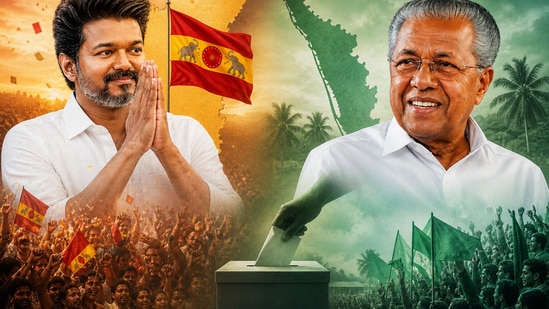
Vijay's win in Tamil Nadu; Kerala likely to oust LDF, but voters want Pinarayi Vijayan as CM: Axis My India exit poll
# Exit Polls: Vijay Wins TN, Kerala Ousts LDF
By Special Correspondent, India Elections Desk | May 04, 2026
**NEW DELHI/CHENNAI** — South India’s political landscape is standing on the precipice of a seismic transformation, according to the latest Axis My India exit polls released on Monday. In an unprecedented projection, actor-turned-politician Vijay is predicted to sweep the Tamil Nadu Assembly elections, dismantling the decades-old Dravidian duopoly. Meanwhile, neighboring Kerala presents a fascinating electoral paradox: voters are likely to oust the incumbent Left Democratic Front (LDF) government, yet a majority still prefer the LDF’s Pinarayi Vijayan as their Chief Minister. The elections witnessed massive democratic participation, with Tamil Nadu recording a historic voter turnout of 84.69%, while Kerala recorded a robust 78.27% across all 140 constituencies.
[Source: Hindustan Times / Axis My India Exit Poll | Additional: Election Commission of India Preliminary Voter Turnout Data, May 2026]
## The Tamil Nadu Earthquake: Vijay’s Political Ascendancy
For over half a century, the political narrative of Tamil Nadu has been exclusively dictated by two Dravidian behemoths: the Dravida Munnetra Kazhagam (DMK) and the All India Anna Dravida Munnetra Kazhagam (AIADMK). However, the Axis My India exit poll projects that Vijay, leading his newly minted political outfit Tamilaga Vettri Kazhagam (TVK), has successfully captured the imagination of the state’s electorate.
Since launching TVK, Vijay has rigorously campaigned on platforms of anti-corruption, youth empowerment, and an inclusive Tamil identity that sidesteps the traditional caste and religious fault lines that have historically influenced regional politics. If the exit poll numbers translate into actual seats on counting day, Vijay’s victory will be marked as the most significant political disruption in South India since M.G. Ramachandran broke away from the DMK to form the AIADMK in 1972.
According to preliminary analyses of the polling data, Vijay’s primary support base stems from first-time voters, young professionals, and rural women who have grown disillusioned with the incumbent DMK government led by M.K. Stalin. The AIADMK, which has struggled with internal factionalism since the demise of J. Jayalalithaa, appears to have hemorrhaged its traditional vote bank to TVK’s aggressive, grassroots-focused campaign.
## Decoding the Historic 84.69% Turnout
The staggering 84.69% voter turnout in Tamil Nadu is the highest recorded in the state’s contemporary electoral history. In Indian political psephology, a massive surge in voter turnout is frequently interpreted as a strong indicator of a “wave election”—usually driven by intense anti-incumbency sentiment or a highly mobilized new voter base.
“When you cross the 80% threshold in Tamil Nadu, you are looking at a highly polarized electorate that is highly motivated to enact change,” explains Dr. K.S. Parthasarathy, a Chennai-based political sociologist and independent election analyst. “The 84.69% figure is not just a statistic; it is a manifestation of the youth bulge asserting its democratic weight. Vijay’s fan clubs, which were meticulously converted into grassroots political cadres over the last two years, clearly managed to bring out the silent voters.”
The incumbent DMK had banked heavily on its extensive welfare schemes, including the monthly cash assistance for women and free breakfast schemes for school children. However, the exit polls suggest that while these schemes were popular, they were not enough to counter the fatigue associated with local-level corruption allegations and the desire for generational change in leadership.
## The Kerala Paradox: LDF Defeated, but Pinarayi Prevails
While Tamil Nadu prepares for a new cinematic-turned-political hero, Kerala’s political pendulum appears to be executing its traditional swing, but with a highly unusual caveat. The Axis My India exit poll projects that the United Democratic Front (UDF), spearheaded by the Indian National Congress, is likely to comfortably cross the halfway mark in the 140-seat assembly, thereby ousting the incumbent LDF government.
This return to the historic cyclical voting pattern—where Kerala alternates between the LDF and UDF every five years—comes after the LDF broke the trend in 2021 by securing a second consecutive term. The 78.27% voter turnout aligns with Kerala’s traditionally high political engagement, but the internal data reveals a fascinating psychological split among the electorate.
Despite projecting a clear loss for the Left coalition, the exit poll explicitly notes that **voters still overwhelmingly prefer Pinarayi Vijayan as their Chief Minister.**
## Dissecting the Split Vote: Anti-Incumbency vs. Leadership Charisma
How does a state vote out a government while simultaneously endorsing its leader? Political analysts suggest this paradox is a result of hyper-localized anti-incumbency combined with severe macroeconomic distress.
Over the past five years, Kerala has grappled with mounting public debt, delayed salary disbursements for government employees, and a stagnant industrial sector. Voters expressed immense frustration with their local LDF Members of Legislative Assembly (MLAs), many of whom were perceived as inaccessible or inefficient.
“Kerala voters are demonstrating extreme democratic sophistication,” notes Dr. Jisha Menon, a Thiruvananthapuram-based political analyst and author. “They are actively punishing local LDF legislators for governance fatigue and state-level economic stress. However, they continue to rate Pinarayi Vijayan’s executive leadership highly because of his crisis management skills during national disasters and his towering stature as a secular strongman. They want his leadership, but they reject his party’s current localized governance.”
For the UDF, this projection is a lifeline. A victory in Kerala would provide a massive morale booster for the Congress party on a national level, establishing a crucial foothold in the South. Yet, the fact that their own chief ministerial candidates are lagging behind a defeated incumbent in popularity polls suggests that their projected victory is more of a negative vote against the LDF rather than a positive mandate for the UDF’s vision.
## Electoral Data at a Glance
To understand the sheer scale of the May 2026 electoral projections, one must look at the comparative data from the Axis My India exit poll:
| State | Total Seats | Voter Turnout | Projected Winner | Key Exit Poll Insight |
| :— | :—: | :—: | :— | :— |
| **Tamil Nadu** | 234 | 84.69% | TVK (Vijay) | Massive youth consolidation; DMK/AIADMK vote share plummets. |
| **Kerala** | 140 | 78.27% | UDF (Congress-led) | LDF ousted, but Pinarayi Vijayan remains the #1 preferred CM. |
*Table: Projected electoral dynamics based on Axis My India May 2026 Exit Polls. Official results pending.*
## National Implications and Future Outlook
The ramifications of these exit polls extend far beyond the geographical borders of Tamil Nadu and Kerala. If the actual results mirror these projections, the national political calculus heading into the latter half of the decade will be fundamentally altered.
In Tamil Nadu, the decimation of the DMK—a crucial pillar of the national INDIA opposition bloc—would force national parties to completely renegotiate their southern strategies. A victory for Vijay would not only legitimize his transition from cinema to politics but would immediately elevate him as a national political figure. National parties, particularly the BJP and Congress, will likely scramble to assess whether TVK will remain a fiercely independent regional force or align with national coalitions.
In Kerala, a UDF victory will solidify the Congress party’s grip on the state, providing it with crucial administrative resources and a success story to showcase in its ongoing ideological battles with the Left and the Right. However, the LDF’s projected loss, despite Pinarayi Vijayan’s popularity, will trigger a deep ideological and structural introspection within the Communist Party of India (Marxist). The Left will need to urgently groom a second line of mass leaders who can match Vijayan’s administrative aura.
## Conclusion
Exit polls, while scientifically grounded, are not exact predictions and have historically faced margins of error. However, the Axis My India poll for the May 2026 elections highlights undeniable undercurrents in South Indian politics. The historic 84.69% turnout in Tamil Nadu signals a restless electorate demanding systemic change, propelling a cinematic icon to the brink of executive power. Conversely, Kerala’s 78.27% turnout reflects a highly critical voter base that is surgically separating local administrative failures from executive leadership admiration.
As the nation waits for the Election Commission of India to commence the official counting of votes, the political corridors in Chennai and Thiruvananthapuram remain tense. Whether “Thalapathy” Vijay will officially wear the Chief Minister’s crown, and whether Kerala will definitively show the door to the LDF, will only be confirmed when the ballot boxes are opened. Until then, these projections guarantee that South India remains the most dynamic and unpredictable theater of Indian democracy.





