
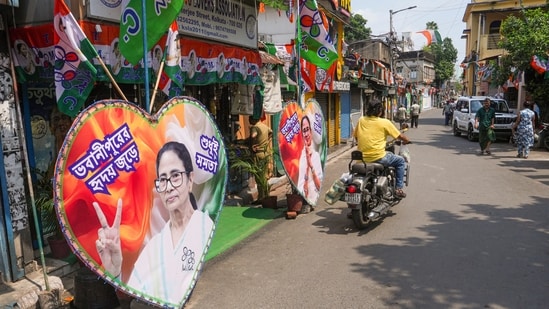
Who won West Bengal election: Full list of BJP, TMC leads and trails in high-stakes battle
# West Bengal 2026: BJP Leads High-Stakes Election
**By Staff Reporter, The National Desk**
**May 04, 2026**
**Kolkata** — In a dramatic electoral shift that could redefine India’s regional political map, the Bharatiya Janata Party (BJP) has taken a commanding lead over the incumbent Trinamool Congress (TMC) in the 2026 West Bengal Assembly elections. As the pivotal counting of votes progressed on Monday, May 4, 2026, early trends from the Election Commission indicated the BJP surging ahead in at least 180 of the 293 constituencies being tallied as of 1:40 pm. This high-stakes battle, following a deeply polarized and grueling campaign, threatens to upend Chief Minister Mamata Banerjee’s 15-year continuous rule and establish a new governing order in the crucial eastern state. [Source: Hindustan Times | Additional: Election Commission of India Public Trends].
## Early Trends and Electoral Mathematics
The West Bengal Legislative Assembly comprises 294 seats, with 148 required for a simple majority. Voting in one constituency was deferred earlier in the electoral cycle due to the passing of a local candidate, leaving 293 seats in play for the May 4 counting day.
According to the 1:40 pm updates, the electoral landscape presents a stark contrast to the 2021 assembly polls, where the TMC secured a landslide victory. Current data shows the BJP crossing the halfway mark with a comfortable buffer, leading in 180 seats. The TMC, meanwhile, trails significantly, maintaining leads in approximately 105 to 110 constituencies. The Left Front-Congress alliance, continuing its historical decline in the state, appears relegated to the single digits, leading in merely 3 to 5 seats.
**1:40 PM Snapshot: West Bengal Assembly Leads**
| Political Party / Alliance | Seats Leading | Change from 2021 (Estimated) |
| :— | :— | :— |
| **Bharatiya Janata Party (BJP)** | 180 | + 103 |
| **Trinamool Congress (TMC)** | 105 | – 110 |
| **Left Front + INC** | 5 | + 5 |
| **Others / Independents** | 3 | + 2 |
*Note: Data reflects early counting trends and is subject to change as final rounds conclude.*
## Regional Shifts: Where the Battle is Being Decided
The structural foundations of this projected outcome lie in massive regional shifts across West Bengal’s diverse geographic and demographic zones.
**North Bengal:** Historically a fertile ground for the BJP in recent parliamentary elections, North Bengal appears to have consolidated entirely behind the saffron party. Issues of infrastructure development, tea garden worker wages, and border security resonated deeply here. Early trends suggest the BJP is sweeping districts like Darjeeling, Jalpaiguri, and Alipurduar.
**Jangalmahal:** The tribal-dominated southwestern belt, which swung wildly between the TMC and BJP over the last three election cycles, shows a decisive tilt toward the BJP in 2026. Analysts attribute this to local grievances regarding the implementation of state welfare schemes and a robust grassroots campaign by BJP organizers addressing tribal land rights and employment.
**South Bengal and Greater Kolkata:** The most shocking development for political observers is the apparent breach of the TMC’s traditional fortress in South Bengal. While the TMC retains its grip on several core Kolkata constituencies, the suburban and rural districts of South 24 Parganas, North 24 Parganas, and Hooghly are witnessing intense, neck-and-neck battles, with the BJP picking up significant leads in areas that were previously considered impenetrable TMC bastions. [Source: Hindustan Times | Additional: Regional Polling Data Analysis].
## The Incumbency Factor: Welfare Versus Governance
To understand the 2026 electoral trends, observers point to the complex interplay between the TMC’s extensive welfare state and the mounting burden of a 15-year anti-incumbency sentiment.
Since ending the Left Front’s 34-year rule in 2011, Mamata Banerjee’s administration constructed a formidable political base heavily reliant on direct cash transfer schemes. Programs like *Lakshmir Bhandar* (financial assistance for women) and *Swasthya Sathi* (health insurance) have been the bedrock of TMC’s electoral successes, creating a massive, loyal constituency of women and rural voters.
However, the 2026 trends suggest that the efficacy of these programs may have reached a saturation point against competing narratives. Over the past few years, the TMC has battled severe public relations crises stemming from central agency investigations into alleged recruitment scams in the education sector and controversies surrounding local governance. The BJP strategically weaponized these issues, framing the election as a referendum on systemic corruption and the need for industrial revitalization.
“What we are witnessing is the classic fatigue that haunts any government in its third term,” explains Dr. Anirban Chatterjee, a Kolkata-based political sociologist. “While the welfare schemes kept the TMC afloat in 2021, by 2026, a newly mobilized demographic of young voters prioritized private-sector job creation and transparent governance over baseline financial assistance. The BJP successfully tapped into this aspirational anxiety.”
## BJP’s Strategic Overhaul in Bengal
The BJP’s performance, if sustained through the final counts, reflects a major strategic recalibration. Following their defeat in the 2021 assembly polls—where they won 77 seats despite a massive central push—the party faced internal fractures and a steady attrition of local leaders returning to the TMC.
Between 2022 and 2026, the BJP shifted its operational paradigm in Bengal. Instead of relying exclusively on the charisma of its national leadership, the party invested heavily in building hyper-local organizational structures. They promoted indigenous Bengali leadership, countering the TMC’s long-standing accusation that the BJP was a “party of outsiders.”
Furthermore, the BJP heavily centralized the narrative around the “double-engine government” proposition—arguing that aligning the state government with the national government in New Delhi would unlock unprecedented federal funding for infrastructure and industrial corridors essential for Bengal’s economic revival.
## Heavyweights in the Crosshairs
Elections in West Bengal are notoriously personality-driven, and 2026 has been no exception. The 1:40 pm trends indicate intense battles for the state’s most prominent political figures.
In the high-stakes constituency of Nandigram, scenes of dramatic fluctuations defined the counting center. State Opposition Leader Suvendu Adhikari (BJP) was reported to be holding a narrow but steady margin over his TMC challenger.
Meanwhile, in the Kolkata metropolitan region, several senior TMC cabinet ministers are facing unexpectedly tight races against BJP newcomers. The localized anger over civic amenities, real estate controversies, and the demand for better urban infrastructure has made traditionally safe urban seats highly competitive.
Conversely, Chief Minister Mamata Banerjee continues to demonstrate her enduring personal popularity, maintaining a comfortable lead in her respective constituency, even as her party struggles in the broader state-wide aggregation.
## National Implications of a Power Shift
The ramifications of the West Bengal election results extend far beyond the borders of the state. As the third-largest state in India by population, West Bengal is a critical piece on the national political chessboard.
If the BJP successfully forms the government in West Bengal, it will mark a historic ideological milestone for the party. West Bengal has been the elusive crown jewel for the saffron party for decades, a state whose intellectual and cultural milieu had long resisted right-wing political ascendance.
From a practical standpoint, a BJP victory in Bengal would significantly alter the balance of power in the Rajya Sabha (the upper house of India’s Parliament) over the next few years. It would also serve a severe psychological blow to the national opposition bloc, for whom Mamata Banerjee has been a crucial anchor and a vocal, unifying force against the central government.
“A loss in Bengal forces a complete reorganization of the national opposition,” notes political analyst Sunita Rao. “The TMC is not just a regional party; it is the ideological vanguard against the BJP. If the BJP can dismantle the TMC’s majority on its home turf, it fundamentally alters the narrative of regional invincibility that opposition parties have relied upon.”
## The TMC’s Posture and the Road Ahead
Despite the daunting trends at 1:40 pm, the Trinamool Congress has urged caution. Party spokespersons addressing the media in Kolkata emphasized that early trends disproportionately represent urban and semi-urban postal ballots and early EVM rounds. The party maintains hope that as counting shifts heavily into the deep rural interiors of South Bengal—where their welfare networks are most entrenched—the margins will narrow.
However, the mood outside the respective party headquarters tells a compelling story. Jubilant crowds have begun gathering outside the BJP’s state office in Kolkata, armed with sweets and party flags. In contrast, an uncharacteristic silence has settled over the TMC’s Kalighat base.
## Conclusion: A New Era for Bengal?
As the sun sets on May 4, 2026, the final tallies will officially dictate West Bengal’s future. Yet, the early trends of the BJP leading in at least 180 of the 293 contested seats signal a profound democratic evolution within the state.
Whether driven by a genuine desire for economic and industrial change, exhaustion with incumbent controversies, or a fundamental shift in political ideology, the voters of West Bengal have delivered a resounding message. If the final results align with these early afternoon trends, the state is poised to close the chapter on the TMC’s 15-year era and inaugurate a radically different political reality under the Bharatiya Janata Party.
The coming days will be critical as transition dynamics take shape, newly elected representatives convene, and India digests the reality of a transformed political landscape in its vibrant eastern corridor.





