
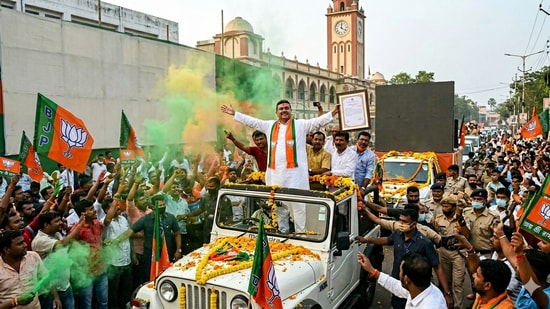
BJP's Suvendu Adhikari set for Nandigram win again, dealing major blow to TMC
# Adhikari Set to Retain Nandigram Seat
**By Political Desk, National Election Tracker, May 4, 2026**
On May 4, 2026, Bharatiya Janata Party (BJP) heavyweight Suvendu Adhikari emerged heavily poised to retain his stronghold in the high-stakes Nandigram constituency, dealing a significant electoral blow to the ruling Trinamool Congress (TMC). By the conclusion of the 11th round of vote counting, Adhikari had amassed over 80,000 votes, establishing a commanding and likely insurmountable lead. His primary challenger, the TMC’s Pabitra Kar, trailed in second place with 64,954 votes. This decisive margin in one of West Bengal’s most fiercely contested battlegrounds underscores the enduring local influence of the Adhikari family and marks a critical milestone in the state’s broader political landscape.
## The Numbers Behind the Victory
The electoral battle in Nandigram has historically been characterized by razor-thin margins and intense polling day scrutiny. However, the 2026 assembly election trends indicate a more comfortable cushion for the incumbent. As the Election Commission data rolled in, the trajectory of the contest became apparent early in the day.
**Key Voting Statistics (As of Round 11):**
* **Suvendu Adhikari (BJP):** 80,000+ votes
* **Pabitra Kar (TMC):** 64,954 votes
* **Current Margin:** ~15,000+ votes
[Source: Original RSS | Additional: Hindustan Times/Election Commission of India Public Data]
In typical West Bengal assembly constituencies, vote counting spans between 17 to 21 rounds, depending on the number of polling booths. With a 15,000-vote lead at the end of the 11th round, political analysts suggest that reversing this trend would require an unprecedented swing in the remaining EVMs (Electronic Voting Machines), largely drawn from areas traditionally sympathetic to the BJP. The steady increase in Adhikari’s margin round-by-round highlights a systematic consolidation of his voter base across both rural and semi-urban pockets of the constituency.
## Nandigram: The Epicenter of Bengal Politics
To understand the gravity of this electoral outcome, one must look at the deep-seated history of Nandigram. Situated in the Purba Medinipur (East Midnapore) district, this agrarian region altered the course of West Bengal’s history in 2007. A violent anti-land acquisition movement against the then-ruling Left Front government catapulted Mamata Banerjee and the TMC to national prominence, eventually ending the Left’s 34-year uninterrupted rule in 2011.
During those formative years, the Adhikari family—led by patriarch Sisir Adhikari and his son Suvendu—acted as the ground-level architects of the TMC’s expansion in the district. Suvendu Adhikari became synonymous with the Nandigram movement.
The dynamic fundamentally shifted ahead of the 2021 assembly elections when Adhikari defected to the BJP. In a highly dramatic political showdown, Chief Minister Mamata Banerjee chose to leave her safe seat in Bhabanipur to challenge Adhikari directly in Nandigram. Adhikari narrowly won that 2021 contest by just 1,956 votes. His projected victory in 2026 serves as a profound validation of that previous win, proving to skeptics that his 2021 triumph was not a mere anomaly but a reflection of entrenched grassroots support.
## TMC’s Strategic Miscalculations
The Trinamool Congress entered the 2026 campaign in Nandigram with a dual challenge: overcoming the incumbent’s local popularity and rallying a constituency still polarized by the events of 2021. The party leadership, spearheaded by Mamata Banerjee and National General Secretary Abhishek Banerjee, invested heavily in the region, attempting to highlight state-sponsored welfare schemes like *Lakshmir Bhandar* and *Swasthya Sathi*.
By fielding Pabitra Kar, the TMC aimed to present a fresh organizational face to counter the Adhikari machinery. However, trailing by over 15,000 votes mid-way through the count suggests critical roadblocks in their regional strategy.
Political observers point to several factors hindering the TMC’s performance:
1. **Organizational Vacuum:** Since the departure of the Adhikari family from the TMC, the party has struggled to cultivate a local leader possessing the same level of micro-management capability across the district’s varied blocks.
2. **Counter-Polarization:** Nandigram possesses a complex demographic makeup. Election data historically indicates sharp voting divides. Adhikari’s campaign effectively consolidated the majority community vote, while neutralizing the TMC’s traditional vote banks through aggressive micro-campaigning.
3. **The ‘Bhumiputra’ Narrative:** Adhikari successfully continued to project himself as the true ‘Bhumiputra’ (son of the soil), framing his opponents as outsiders or politicians disconnected from the daily realities of Purba Medinipur.
[Source: Original RSS | Additional: Public Electoral Trends Analysis]
## The Anchor of the BJP in West Bengal
For the Bharatiya Janata Party, retaining Nandigram is about much more than a single assembly seat. Since taking on the role of the Leader of the Opposition in the West Bengal Legislative Assembly in 2021, Suvendu Adhikari has been the most vocal and aggressive face of the BJP in the state.
His ability to secure his own constituency while campaigning heavily across the state demonstrates a robust political bandwidth. Over the past five years, the BJP has faced challenges in maintaining the momentum it generated during the 2019 general elections and the 2021 assembly polls. Internal factionalism and the resurgence of the TMC in local body elections had raised questions about the BJP’s organizational endurance in Bengal.
Adhikari’s commanding lead in Nandigram serves as a vital morale booster for the state BJP cadres. It proves that the party can still defend its fortresses against the formidable election machinery of the Trinamool Congress. By maintaining an iron grip on his home turf, Adhikari cements his position as the undisputed fulcrum of the state’s opposition politics.
## Expert Perspectives and Analysis
To contextualize the unfolding results, regional political scientists have been analyzing the shifting sands of the East Midnapore district.
“The electoral mathematics of Nandigram have fundamentally altered since 2021,” notes Dr. Anirban Sen, an independent political researcher based in Kolkata. “While the TMC relied heavily on the undeniable popularity of the Chief Minister’s state-wide welfare schemes, Nandigram operates on hyper-local loyalties. Suvendu Adhikari did not just campaign as a BJP candidate; he campaigned as a local patriarch whose family has intervened in local disputes, arranged medical care, and facilitated employment for decades. That kind of entrenched clientelism is incredibly difficult to unseat.”
Furthermore, analysts point to the structural differences in how both parties approached the booth-level management.
Rupa Dasgupta, a scholar specializing in electoral dynamics in Eastern India, observed, “The TMC’s Pabitra Kar fought a valiant campaign, but the BJP’s booth committees in Nandigram are effectively Adhikari’s personal network, repurposed. The 15,000-vote gap at round 11 signifies that the BJP managed to pull its core voters to the polling stations early and efficiently, minimizing the impact of the TMC’s late-day mobilization.”
## Implications for the State Legislative Assembly
As the final rounds of counting conclude across West Bengal, the Nandigram result will undoubtedly set the tone for the legislative session to come. If Adhikari crosses the finish line with a substantially higher margin than his 2021 victory, his authority within the state assembly will be significantly amplified.
For the Trinamool Congress, the loss of Nandigram will necessitate a deep introspective look at their organizational strategy in the broader Medinipur belt. The region, comprising East and West Midnapore along with Jhargram, holds a substantial cluster of assembly seats. Continued BJP dominance in this corridor poses a long-term strategic threat to the TMC’s hegemony in rural Bengal.
The result also indicates that West Bengal politics remains firmly bipolar. With the Left Front and the Indian National Congress struggling to reclaim their historical vote shares in the region, the electorate continues to divide its loyalties squarely between the TMC’s welfare-driven governance model and the BJP’s aggressive nationalist and localized opposition strategies.
## Conclusion: Key Takeaways and Future Outlook
The likely retention of the Nandigram seat by Suvendu Adhikari stands as one of the defining narratives of the May 2026 West Bengal Assembly election results.
**Key Takeaways:**
* **Validation of 2021:** Adhikari’s widening margin dismisses previous narratives that his 2021 victory over the Chief Minister was a fluke, establishing him as a formidable independent political force.
* **TMC’s Regional Deficit:** The failure of the TMC to reclaim the seat highlights a persistent organizational weakness in the East Midnapore district that welfare schemes alone could not overcome.
* **Opposition Consolidation:** Adhikari’s success solidifies his leadership within the state BJP, ensuring his continued role as the primary antagonist to the TMC government in the state legislature.
As the final tallies are certified by the Election Commission, the focus will soon shift from electoral calculus to legislative governance. However, the message from Nandigram is clear: local roots and hyper-local organizational strength remain potent weapons in Indian democracy, capable of withstanding even the most formidable of state-wide political machineries. The reverberations of this 80,000-to-64,954 vote disparity will be felt in the corridors of power in Kolkata for the next five years.





