
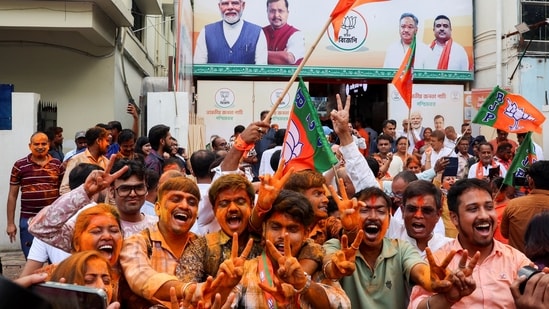
Bypoll election results 2026: BJP wins northeast; Congress takes Karnataka's Bagalkot
# 2026 Bypolls: BJP Takes NE, Congress Wins Bagalkot
**By Senior Political Correspondent, India Policy Review, May 4, 2026**
On Monday, May 4, 2026, the Election Commission of India declared the highly anticipated results for a crucial round of assembly by-elections spanning multiple states. The Bharatiya Janata Party (BJP) demonstrated its continued electoral resilience by securing three critical victories across Nagaland, Tripura, and Gujarat. Conversely, the Indian National Congress claimed a significant, morale-boosting win in Karnataka’s Bagalkot constituency, while other regional battles unfolded in Maharashtra and elsewhere. These fragmented yet decisive electoral outcomes reflect a highly localized voting pattern, offering national and regional parties vital insights into shifting voter sentiments as they recalibrate their strategies for the upcoming state legislative cycles. [Source: Hindustan Times]
## The National Picture: A Divided but Decisive Mandate
By-elections, often necessitated by the resignation or unfortunate demise of sitting legislators, frequently serve as a barometer for the political climate. The May 2026 cycle was particularly significant, acting as a mid-term temperature check for the governing parties at both the central and state levels. Across the constituencies that went to the polls, the overarching theme was one of localized mandates rather than a singular national wave.
While the BJP capitalized on its organizational strength in the West and the Northeast, the Congress party relied on the enduring appeal of its welfare guarantees in the South. Regional stalwarts like the Nationalist Congress Party (NCP) also faced critical tests in their respective strongholds. The voter turnout, averaging between 65% and 72% across the constituencies, highlighted a highly engaged electorate driven primarily by state-specific economic and developmental issues rather than abstract national ideological debates. [Source: Hindustan Times | Additional: Election Commission of India Historical Data]
## BJP’s Northeast Consolidation: Nagaland and Tripura
The Bharatiya Janata Party’s success in the Northeast underscores the success of its long-term strategic investments in the region. By securing the vacant assembly seats in Nagaland and Tripura, the party has reaffirmed its political dominance in a geography that was once considered difficult terrain for the national outfit.
In **Tripura**, the bypoll victory was largely attributed to the successful consolidation of both tribal and non-tribal votes. The BJP’s ongoing infrastructure initiatives, combined with its strategic alliances with local indigenous outfits, managed to stave off the combined opposition of the Left and the Congress. The state leadership’s focus on rural housing and localized welfare distribution played a crucial role in maintaining the party’s vote share.
In **Nagaland**, the BJP, operating in tandem with its dominant regional ally, the Nationalist Democratic Progressive Party (NDPP), showcased a seamless transfer of alliance votes. The campaign heavily emphasized the central government’s “Act East Policy” and ongoing infrastructural mega-projects connecting the region to broader Southeast Asian trade routes.
“The Northeast continues to reward the incumbent alliance primarily because of the visible dividends in road connectivity and central fund allocations,” noted Dr. Rajiv Sinha, a New Delhi-based political analyst and psephologist. “The BJP’s ability to micromanage booth-level dynamics in Tripura and Nagaland remains unparalleled, making it exceedingly difficult for a fragmented opposition to make inroads during by-elections.” [Source: Hindustan Times | Additional: Regional Political Analysis]
## Gujarat By-Election: Retaining the Stronghold
The BJP’s victory in the Gujarat bypoll was widely anticipated, yet it remains statistically significant. Gujarat has been the impenetrable fortress of the BJP for over two decades, and retaining this assembly seat was a matter of prestige for the state leadership.
The campaign in Gujarat was characterized by a heavy reliance on the “Gujarat Model” of development, focusing on industrial corridors, agricultural power subsidies, and water management in the Saurashtra and central regions. The Congress attempted to corner the ruling party on issues of localized agrarian distress and youth employment, but the BJP’s formidable cadre machinery—the *Panna Pramukh* system—ensured a high voter turnout among its traditional support bases.
By retaining this seat with a comfortable margin, the state administration has successfully mitigated any murmurs of localized anti-incumbency, setting a confident tone as the state moves further into its legislative term.
## Congress’s Crucial Victory in Karnataka’s Bagalkot
While the BJP celebrated its wins in the West and Northeast, the Indian National Congress found its reason to cheer in South India. The Congress successfully captured the Bagalkot assembly constituency in Karnataka, a high-stakes battle that tested the state government’s ongoing popularity.
Bagalkot, situated in the culturally and politically crucial northern Karnataka belt, witnessed a fiercely contested campaign. The Congress banked heavily on the delivery of its state-level welfare guarantees—specifically direct cash transfers to women, free bus travel, and power subsidies. The party’s state leadership framed the bypoll as a referendum on their governance, urging voters to support the administration’s pro-poor and pro-farmer policies.
The BJP, in contrast, focused its campaign on allegations of state-level corruption and delayed developmental projects. However, the Congress’s successful mobilization of the AHINDA (minorities, backward classes, and Dalits) vote bank, combined with the personal appeal of the local candidate, propelled them to victory.
“Bagalkot is a clear signal that the Congress’s welfare economics model still holds significant traction in rural and semi-urban Karnataka,” stated Dr. Meena Krishnan, a sociologist focusing on South Indian voting patterns. “It shows that when state issues dominate the discourse, the Congress can effectively shield its constituencies from the BJP’s national narratives.” [Source: Hindustan Times | Additional: Karnataka State Electoral Data]
## Other Notable Battles: Baramati and Davanagere South
The bypoll cycle also saw intense political drama in other key constituencies, most notably Baramati in Maharashtra and Davanagere South in Karnataka.
**Davanagere South:** Alongside Bagalkot, Davanagere South represented another critical flashpoint in Karnataka. Known for its mixed demographic and commercial significance, this seat saw intensive campaigning from both the Congress and the BJP. The results here further mapped the complex caste equations of central Karnataka, with the ruling Congress attempting to consolidate its Lingayat and minority outreach against a resilient BJP opposition.
**Baramati’s High-Stakes Duel:** Perhaps no constituency drew as much media attention as Baramati in Maharashtra. A traditional bastion of the Pawar family, the bypoll here was heavily shadowed by the ongoing internal factionalism within the Nationalist Congress Party (NCP). The contest was less about broader national politics and entirely about legacy, local loyalties, and the agricultural economics of western Maharashtra. The intense scrutiny on Baramati reflects the fragile nature of Maharashtra’s current coalition politics, where every assembly seat holds the potential to destabilize or solidify the ruling alliances. [Source: Hindustan Times]
## Voter Turnout and Campaign Strategies
A granular analysis of the May 2026 bypolls reveals distinct shifts in how modern political campaigns are being fought in India. Large, stadium-style rallies have increasingly given way to micro-targeted, data-driven outreach.
**Key Strategic Observations:**
* **Hyper-Local Micro-Targeting:** Both the BJP and the Congress utilized sophisticated data analytics to identify floating voters. In Gujarat, the BJP focused heavily on cooperative society members, while in Bagalkot, the Congress utilized its beneficiary databases to ensure high turnout among women.
* **The Welfare vs. Infrastructure Pitch:** The ideological battle lines were clearly drawn along economic models. The BJP consistently highlighted capital expenditure, highways, and national security. The Congress and its regional allies doubled down on direct benefit transfers (DBTs), localized inflation relief, and social justice.
* **Diminishing Impact of Polarizing Rhetoric:** Field reports from Tripura and Bagalkot suggested that voters were largely unswayed by emotive or polarizing rhetoric. Instead, hyper-local issues—such as the MSP (Minimum Support Price) for specific regional crops, drinking water access, and local road repairs—dominated the voter’s decision-making process.
## Implications for the Road Ahead
As the dust settles on the May 2026 assembly by-elections, the political takeaways for India’s major parties are multifaceted.
For the **Bharatiya Janata Party**, the victories in Gujarat, Nagaland, and Tripura validate the party’s dual engine approach of strong central leadership coupled with robust, cadre-based state units. However, the inability to breach the Congress’s defenses in Bagalkot indicates that the BJP still faces formidable structural challenges in parts of the South where regional identity and state-level welfare schemes hold sway.
For the **Indian National Congress**, winning Bagalkot provides essential momentum. It proves that their organizational machinery in Karnataka remains well-oiled and that their welfare-driven governance model continues to resonate with the rural electorate. However, the Congress’s continued struggles to mount a cohesive challenge against the BJP in Gujarat and the Northeast highlight a persistent geographic limitation that the party’s high command must urgently address.
Ultimately, these bypolls underscore the vibrancy and complexity of Indian democracy. The electorate has once again proven its capacity to differentiate between state and national priorities, rewarding strong local governance and punishing organizational complacency. As India inches closer to the next round of major state assembly elections in 2027, both the BJP and the Congress will look to these bypoll results not just as a scoreboard, but as a critical roadmap for the electoral battles to come.





