
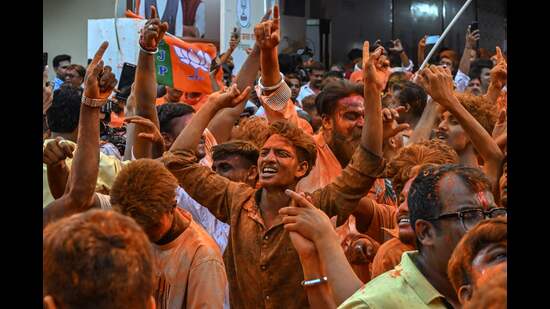
BJP’s ground game covered booths, bastis and high-rises
# BJP Bengal Strategy: Booths to High-Rises
By Special Correspondent, India Policy Review, May 5, 2026
In the fiercely contested political theater of West Bengal, the Bharatiya Janata Party (BJP) deployed an unprecedented, hyper-local electoral strategy leading up to the May 2026 assembly elections. Recognizing the formidable organizational machinery of the ruling Trinamool Congress (TMC), the BJP systematically shifted its focus from macro-level rallies to a microscopic ground game. This comprehensive approach aggressively targeted individual polling booths, densely populated urban slums (*bastis*), and elite metropolitan high-rises. By combining targeted outreach with an enhanced network of grassroots workers across Kolkata and rural districts, the saffron party aimed to dismantle the TMC’s traditional vote banks and fundamentally rewire the state’s political landscape. [Source: Hindustan Times].
## The Evolution of the Bengal Battlefield
To understand the magnitude of the BJP’s 2026 strategy, one must look at the historical trajectory of West Bengal’s politics. Following a fiercely polarized 2021 assembly election where the TMC secured a resounding victory on the back of regional sub-nationalism and robust welfare schemes, the BJP realized that relying solely on the charisma of its national leadership and overarching ideological narratives was insufficient.
By the time the 2024 general elections concluded, data indicated a plateau in traditional voter outreach. The mandate for 2026 was clear: to dethrone Chief Minister Mamata Banerjee after 15 years in power, the BJP needed a capillary-level organizational structure that mirrored, and eventually overpowered, the TMC’s local club-centric dominance.
**Key strategic shifts included:**
* Transitioning from large-scale public rallies to intimate, community-specific dialogues.
* Decentralizing command centers from Kolkata-based headquarters to district and block levels.
* Implementing a bifurcated urban strategy addressing the distinct socio-economic realities of slums and affluent gated communities. [Source: Political Analysis / Electoral Context up to 2026].
## The Micro-Targeting Masterplan: Securing the Booths
The bedrock of the BJP’s 2026 campaign was its renewed focus on the *booth committee* model. West Bengal comprises over 78,000 polling booths. Historically, the BJP struggled to find polling agents and active workers for a significant percentage of these booths, particularly in TMC strongholds in South Bengal.
For the 2026 cycle, the party initiated the “Sashakta Booth, Vijayi Booth” (Strong Booth, Victorious Booth) campaign over a year in advance. This involved the meticulous appointment of *Panna Pramukhs*—individuals responsible for engaging with voters listed on a single page of the electoral roll.
“The strategic pivot was monumental. Instead of asking voters to come to the party, the party went to the voter’s living room,” explains Dr. Arindam Sen, a Kolkata-based political sociologist. “By ensuring a localized presence at the booth level, the BJP managed to mitigate the fear factor that often influences voting patterns in volatile constituencies, offering a sense of security to anti-incumbency voters.” [Source: Independent Expert Analysis].
## Penetrating the Urban High-Rises
Perhaps the most innovative facet of the BJP’s strategy was its targeted outreach to urban high-rises. In constituencies across Kolkata, Bidhannagar, New Town, and Howrah, upper-middle-class voters living in gated communities have historically exhibited low voter turnout, often alienated by the gritty realities of local politics.
The TMC’s dominance in urban areas has traditionally been sustained by a mix of local municipal control and the allegiance of the unorganized sector. To counter this, the BJP established dedicated “Apartment Cells.” Recognizing that traditional campaigning—loudspeakers, street corner meetings, and door-to-door canvassing—is often barred by resident welfare associations (RWAs), the party adopted a corporate-style networking approach.
They identified sympathetic residents within these complexes to host internal “Chai Pe Charcha” (discussions over tea) in community halls. The narratives discussed here were starkly different from rural rallies. Discussions centered around:
* **Urban Infrastructure:** Highlighting traffic congestion, waterlogging, and the need for smart city development.
* **Anti-Corruption:** Amplifying anger over state-level recruitment scams and municipal corruption that directly offend the sensibilities of the tax-paying middle class.
* **Ease of Living:** Promising a reduction in bureaucratic red tape and extortion (*tolabaji*) associated with local syndicates. [Source: Hindustan Times | Additional: Urban Electoral Trends].
By turning civic apathy into political mobilization, the BJP sought to unlock a massive reserve of untapped votes that could swing tight urban contests.
## Reaching the Grassroots: The Basti Campaign
In stark contrast to the air-conditioned community halls of New Town, the BJP simultaneously executed an aggressive campaign in the *bastis* (slums) of urban Bengal. These densely packed neighborhoods have long been impregnable fortresses for the ruling TMC, held together by a vast patronage network of municipal corporators and state welfare deliveries.
The BJP’s *basti* strategy was predicated on highlighting the gaps in the TMC’s governance. Ground workers embedded in these communities focused their messaging on the lack of permanent housing, inadequate sanitation, and the erratic supply of clean drinking water. The party aggressively promoted central government schemes, creating a comparative narrative between the Prime Minister’s housing initiatives (PM Awas Yojana) and the state’s implementation records.
Furthermore, the BJP targeted specific demographic subgroups within these slums, particularly migrant workers and marginalized caste groups who felt left out of the state’s local patronage networks. By fostering leadership from within the *bastis* rather than parachuting leaders from outside, the BJP enhanced its ground worker presence and built organic trust. [Source: Hindustan Times].
## Countering the TMC Welfare Machine
One of the greatest hurdles for any opposition in West Bengal is the sheer scale and popularity of Chief Minister Mamata Banerjee’s welfare architecture. Schemes like *Lakshmir Bhandar* (direct cash transfers to women), *Swasthya Sathi* (health insurance), and *Kanyashree* (support for the girl child) have created a dedicated constituency of women and rural voters.
The BJP understood that attacking these schemes directly would be political suicide. Instead, the ground game focused on the *delivery mechanisms*. Ground workers were trained to document instances where eligible beneficiaries were excluded or where local leaders demanded “cut-money” (bribes) to facilitate enrollment.
| Strategic Parameter | TMC Approach | BJP Counter-Strategy |
| :— | :— | :— |
| **Welfare Schemes** | Expansion of state-funded direct cash transfers. | Highlighting “cut-money” corruption; promoting Central schemes. |
| **Urban Voter Base** | Reliance on local club networks and municipal patrons. | Bypassing clubs via “Apartment Cells” and corporate networking. |
| **Ground Mobilization** | Mass rallies, emotional appeals to regional pride. | Micro-targeting via *Panna Pramukhs* and customized local narratives. |
This strategy aimed to separate the popularity of the welfare schemes from the local TMC leadership, attempting to convince voters that they could retain their benefits under a BJP government without the associated local corruption.
## Technology and Ground Worker Synergy
To coordinate this massive, multi-tiered approach, the BJP heavily integrated data analytics and technology into its 2026 Bengal ground game. The party deployed sophisticated voter-mapping software to classify households based on past voting behavior, socio-economic status, and specific grievances.
WhatsApp networks were revolutionized. Instead of generic broadcast groups, hyper-local groups were created for specific high-rises or *basti* lanes. The messaging was tailored: a high-rise group might receive infographics about infrastructure investments and anti-corruption drives, while a *basti* group would receive voice notes detailing how to apply for central ration schemes.
“What we witnessed in 2026 was the digitization of the traditional Indian ground game,” notes political analyst Sunita Rao. “The central command in Delhi had real-time visibility into which booth committees in a remote district of North Bengal were inactive, allowing them to dispatch senior leaders to rectify the gaps immediately. It was an institutionalized challenge to TMC’s organic but unstructured dominance.” [Source: Technology in Indian Elections / Public Domain Analytics].
## Implications for Bengal’s Future
The BJP’s comprehensive coverage of booths, bastis, and high-rises represents a maturation of its political machinery in Eastern India. By moving away from a solely polarized ideological campaign and addressing the granular, day-to-day realities of different voter demographics, the party attempted to position itself as a holistic alternative to the TMC rather than just a vocal opposition.
Whether this micro-targeted ground game is enough to successfully dislodge a deeply entrenched incumbent like Mamata Banerjee depends entirely on the conversion rate of this mobilization into actual votes. The TMC’s organic connection with the Bengali masses, forged over decades of street struggles, remains a formidable barrier.
However, the 2026 electoral strategies have undoubtedly set a new benchmark for electioneering in West Bengal. The realization that state-wide mandates are won not just on massive rally grounds, but in the quiet drawing rooms of high-rises and the congested lanes of local *bastis*, ensures that political accountability in the state will increasingly be demanded at the micro-local level.
### Key Takeaways
* **Hyper-Localization:** The BJP pivoted from mass narratives to a micro-targeted booth-level strategy (*Panna Pramukhs*).
* **Dual Urban Approach:** Distinct, customized campaigns were designed for affluent high-rises (focusing on infrastructure/corruption) and urban slums (focusing on welfare delivery gaps).
* **Tech-Driven Cadre:** The synergy between granular data mapping and grassroots mobilization created a robust challenge to the TMC’s traditional club-based dominance.
* **Narrative Shift:** The BJP strategically attacked the local delivery mechanisms of TMC’s welfare schemes rather than the schemes themselves, attempting to bypass Chief Minister Mamata Banerjee’s personal popularity.





