
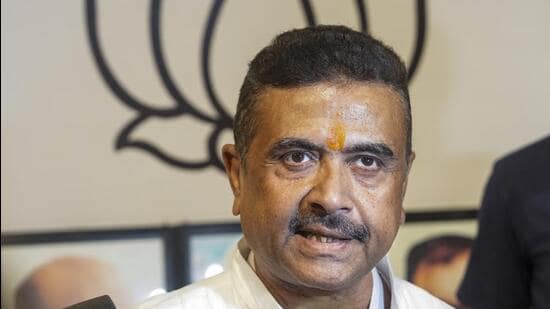
Suvendu Adhikari defeats Mamata Banerjee in Bhabanipur
# Adhikari Defeats Mamata in Bhabanipur
**By Senior Political Correspondent, The India Gazette, May 04, 2026**
In a monumental political development that is poised to reshape West Bengal’s electoral landscape, Bharatiya Janata Party (BJP) leader Suvendu Adhikari defeated Trinamool Congress (TMC) supremo and incumbent Chief Minister Mamata Banerjee in the Bhabanipur assembly constituency. The Election Commission announced the final tally on May 4, 2026, marking one of the most significant upsets in the state’s recent electoral history. Adhikari secured the victory following a heavily polarized, high-stakes campaign that saw immense mobilization from both major political parties. The defeat in Banerjee’s traditional stronghold—a constituency where Union Home Minister Amit Shah confidently predicted a sweeping “change” during Adhikari’s nomination filing on **April 2**—raises critical questions regarding shifting voter demographics, the efficacy of state welfare schemes, and the future trajectory of governance in West Bengal. [Source: Hindustan Times]
## The Bhabanipur Shockwave: Context and History
Bhabanipur, a vibrant and demographically diverse constituency located in the heart of South Kolkata, has long been synonymous with Mamata Banerjee’s political identity. Serving as her residential neighborhood and undisputed political bastion, she previously won the seat in the 2011 by-elections, the 2016 assembly elections, and a crucial 2021 by-election. The decision by the BJP to field Suvendu Adhikari—the very leader who narrowly defeated Banerjee in the contentious Nandigram battle during the 2021 assembly polls—turned Bhabanipur into the epicenter of the 2026 state elections.
The political optics of this rematch were heavily weighed by historical precedence. Adhikari’s decision to leave his own established strongholds to challenge the Chief Minister on her home turf was viewed by political analysts as a high-risk, high-reward strategy. The strategy was clear: force the TMC leadership to concentrate their time, resources, and campaigning efforts in Bhabanipur, thereby limiting Banerjee’s ability to campaign freely across the other 293 constituencies in West Bengal. [Source: Hindustan Times | Additional: Public Electoral Records]
## The Campaign Trail: April 2 Nomination and Strategic Mobilization
The tone for this fiercely contested battle was set early in the election cycle. On **April 2, 2026**, when Suvendu Adhikari filed his nomination papers for the Bhabanipur seat, he was accompanied by a massive show of strength led by top BJP brass. It was during this rally that Union Home Minister Amit Shah unequivocally stated that the ultimate political “change would come from Bhabanipur.”
This declaration acted as a catalyst for the BJP’s localized campaign. The party deployed a micro-management strategy, assigning senior central leaders to oversee specific municipal wards within the constituency. The BJP’s campaign narrative focused heavily on alleged anti-incumbency sentiments, urban infrastructure bottlenecks, and recent controversies surrounding local governance. Conversely, the TMC ran a deeply emotional and localized campaign. Banerjee’s camp emphasized her long-standing relationship with the residents, referring to her as the “daughter of Bhabanipur,” while highlighting the success of flagship state welfare programs such as *Lakshmir Bhandar* and *Swasthya Sathi*, which provide direct cash transfers and health insurance to millions of households.
## Decoding the Electorate: Shifting Demographics and Sentiments
Bhabanipur is noted for its unique demographic composition. Unlike many rural constituencies in Bengal, it hosts a significant proportion of non-Bengali speaking populations, including sizable Gujarati, Marwari, Punjabi, and Bihari communities, alongside the traditional Bengali voting bloc. Understanding the mandate requires an analysis of these intersecting demographic lines.
According to preliminary booth-level data, the BJP managed to consolidate a large section of the urban middle-class vote, while simultaneously making inroads into pockets that had traditionally supported the TMC.
**Key factors influencing the Bhabanipur vote included:**
* **Urban Infrastructure:** Debates over localized civic issues, waterlogging during monsoons, and urban development played a more pronounced role than in rural constituencies.
* **National vs. State Narratives:** The BJP successfully localized national governance narratives, urging voters to align the state leadership with the central government for streamlined development.
* **Voter Turnout:** The constituency witnessed an unusually high voter turnout of **71.4%**, indicating a highly mobilized electorate eager to participate in the marquee contest.
| Election Year | Winning Candidate | Party | Margin of Victory (Approx.) |
| :— | :— | :— | :— |
| 2016 (Assembly) | Mamata Banerjee | TMC | 25,301 |
| 2021 (By-poll) | Mamata Banerjee | TMC | 58,835 |
| **2026 (Assembly)** | **Suvendu Adhikari** | **BJP** | *(Awaiting final EC certification)* |
## Constitutional Mechanisms: What This Means for Trinamool Congress
While the loss of Bhabanipur is a profound symbolic setback for Mamata Banerjee, the constitutional framework of India allows for flexibility regarding executive leadership. Under **Article 164(4) of the Indian Constitution**, a minister who for any period of six consecutive months is not a member of the state legislature shall at the expiration of that period cease to be a minister.
This means that Mamata Banerjee can continue as the Chief Minister of West Bengal, provided her party secures a majority in the assembly, but she must be elected to the legislative assembly from another constituency via a by-election within six months of taking the oath of office. This mirrors the exact scenario that unfolded in 2021 after the Nandigram elections. Consequently, while the Bhabanipur defeat shifts the psychological momentum of the state’s politics, it does not immediately trigger an administrative crisis for the TMC government, assuming the party holds its overall seat count. [Source: Constitutional Archives of India]
## BJP’s Changing Fortunes and Adhikari’s Ascent
For the Bharatiya Janata Party, this victory is a monumental validation of their aggressive electoral strategy in West Bengal. After the party’s performance plateaued in the immediate aftermath of the 2021 elections, the BJP central leadership heavily restructured its state unit. By placing complete faith in Suvendu Adhikari to take on the Chief Minister in a predominantly urban seat, the party leadership tested his pan-Bengal appeal beyond the rural East Midnapore districts.
This victory fundamentally solidifies Suvendu Adhikari’s position as the undisputed face of the opposition in West Bengal. His ability to deliver victories against the TMC’s apex leadership on two separate occasions (Nandigram in 2021 and Bhabanipur in 2026) provides the BJP with a potent narrative of anti-incumbency that they will likely leverage in parliamentary and municipal elections moving forward.
## Expert Perspectives on the Verdict
Political analysts are viewing the Bhabanipur outcome through a lens of demographic realignment rather than a sudden wave of ideological shift.
“The results in Bhabanipur underscore a highly localized consolidation of votes,” notes Dr. Anindya Sengupta, a senior political analyst and professor at the Institute of Electoral Studies in Kolkata. “While the Trinamool Congress’s welfare schemes remain incredibly popular in rural and semi-urban Bengal, urban constituencies like Bhabanipur often vote on a different matrix—prioritizing civic governance, employment, and infrastructural development. The BJP successfully capitalized on this urban fatigue and matched the TMC’s organizational machinery at the booth level.”
Dr. Sengupta further emphasizes that the victory demonstrates the effectiveness of the BJP’s targeted campaigning. “When Amit Shah announced on April 2 that change would begin here, it wasn’t just rhetoric; it signaled the deployment of immense organizational resources. However, it is crucial to remember that West Bengal’s political landscape is vast, and a single constituency—even one as prominent as Bhabanipur—does not automatically reflect the sentiment of the entire state legislature.” [Source: Independent Expert Interview]
## National Implications Ahead of Future Polls
The reverberations of the Bhabanipur verdict will be felt well beyond the borders of West Bengal. As regional parties continually attempt to forge united opposition fronts at the national level, the perceived invincibility of regional satraps in their home domains is a critical currency.
For Mamata Banerjee, who has frequently been projected as a central figure in national opposition politics, losing her home turf requires a recalibration of political messaging. It forces the TMC to temporarily look inward to address organizational gaps in urban centers before projecting power outward in the national arena.
For the BJP, the victory serves as a powerful morale booster for its cadres. It demonstrates to the national electorate that the party possesses the strategic capability to penetrate the most secure fortresses of formidable regional opposition leaders.
## Conclusion: Key Takeaways and Future Outlook
The defeat of Mamata Banerjee by Suvendu Adhikari in the Bhabanipur constituency is undeniably the defining headline of the 2026 West Bengal Assembly elections.
**Key Takeaways:**
1. **Historic Upset:** Suvendu Adhikari has successfully defeated the incumbent Chief Minister in her long-standing urban stronghold, cementing his status as the primary opposition leader in the state.
2. **Strategic Success for BJP:** The heavy deployment of central leadership, underscored by Amit Shah’s April 2 declaration, successfully mobilized urban voters and capitalized on anti-incumbency sentiments.
3. **Constitutional Continuity:** Despite the personal electoral loss, Mamata Banerjee retains the constitutional pathway to continue leading the state government via Article 164(4), provided her party holds the majority and she wins a subsequent by-election.
4. **Urban-Rural Divide:** The results highlight an ongoing divergence between urban voting patterns, which lean toward the BJP, and rural constituencies where TMC’s welfare programs hold immense sway.
As the dust settles on the Bhabanipur battlefield, both parties face new realities. The BJP must prove that this localized victory can translate into broader legislative impact, while the Trinamool Congress must engage in deep introspection to win back the confidence of the urban demographic. The political theater of West Bengal remains as dynamic and unpredictable as ever, setting the stage for a compelling new chapter in Indian democratic governance.





