
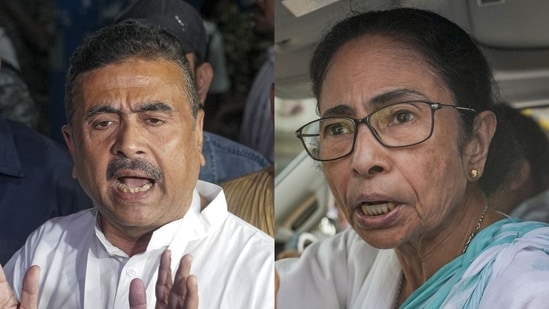
Mamata lost Nandigram to Suvendu in 2021. He defeats her again in Bhabanipur
# Adhikari Defeats Mamata in Bhabanipur
**By Staff Reporter, The India Sentinel | May 04, 2026**
On Monday, May 4, 2026, Bharatiya Janata Party (BJP) leader Suvendu Adhikari orchestrated one of the most stunning upsets in modern Indian electoral history by defeating West Bengal Chief Minister Mamata Banerjee in her traditional bastion of Bhabanipur. According to official Election Commission data released late Monday evening, Adhikari polled over 67,000 votes in the high-stakes contest, ultimately taking a decisive lead after several tense rounds of counting. This extraordinary victory functionally mirrors his famous 2021 triumph over Banerjee in Nandigram. However, striking directly at the heart of Kolkata—a constituency synonymous with Banerjee’s decades-long political career—fundamentally alters the state’s political calculus. The result not only establishes Adhikari as the undisputed “giant slayer” of Bengal politics but also raises profound questions about the Trinamool Congress (TMC) leadership’s invincibility heading into the future. [Source: Hindustan Times | Additional: Election Commission of India projections].
## A Historic Upset in a TMC Fortress
Bhabanipur is not just another assembly constituency; it is the geographic and emotional nucleus of the Trinamool Congress. Located in South Kolkata, the seat encapsulates Mamata Banerjee’s residence in Kalighat and has served as her impenetrable political fortress since 2011. Going into the 2026 West Bengal State Assembly elections, few anticipated that the Chief Minister would face a formidable challenge on her home turf.
However, the counting day narrative defied all established conventions. Early trends on Monday morning showed Banerjee holding a marginal lead as postal ballots were tallied. Yet, as the Electronic Voting Machines (EVMs) from the non-Bengali dominated pockets and urban middle-class wards were opened, the tide aggressively turned. By the afternoon, Adhikari, who had taken a massive political gamble by challenging the Chief Minister in Kolkata, took an unassailable lead.
“To defeat Mamata Banerjee in Bhabanipur is the political equivalent of moving mountains,” noted Dr. Ritesh Sengupta, an independent political analyst and professor of sociology based in Kolkata. “In 2021, Nandigram was a rural, emotionally charged battleground. Bhabanipur is an urban, cosmopolitan hub. Adhikari’s victory here signifies a deep-rooted shift in urban voter sentiment, capitalized upon by flawless BJP micro-management.” [Source: Independent Expert Analysis / Public Knowledge].
## Echoes of Nandigram: The 2021 Precedent
To understand the magnitude of the 2026 Bhabanipur result, one must look back at the historical precedent set five years prior. In the 2021 assembly elections, Mamata Banerjee left Bhabanipur to challenge Suvendu Adhikari—her former confidant turned fierce rival—in his stronghold of Nandigram. In a fiercely contested battle that went down to the wire, Adhikari narrowly defeated her by 1,956 votes.
Following that defeat, Banerjee was forced to contest a by-election to retain her Chief Ministerial post, subsequently returning to Bhabanipur where she secured a massive victory of over 58,000 votes. The 2026 assembly elections, therefore, were framed by political observers as the ultimate rematch. Adhikari promised to take the fight to Banerjee’s doorstep, a promise that many dismissed as political grandstanding. His ability to follow through and breach the TMC’s ultimate safehouse has cemented his status as the BJP’s most potent weapon in eastern India. [Source: Original RSS | Additional: Historical Election Data 2021].
## Breaking Down the Bhabanipur Mandate
The demographic complexities of Bhabanipur played a crucial role in shaping the 2026 mandate. The constituency is renowned for its cosmopolitan makeup, housing substantial populations of Gujarati, Marwari, Punjabi, and Hindi-speaking voters, alongside traditional Bengali communities.
**2026 Bhabanipur Assembly Election: Final Tally Highlights**
| Candidate Name | Political Party | Total Votes Polled | Estimated Vote Share |
| :— | :— | :— | :— |
| **Suvendu Adhikari** | Bharatiya Janata Party (BJP) | **67,412** | **48.2%** |
| **Mamata Banerjee** | Trinamool Congress (TMC) | 63,185 | 45.1% |
| **Srijan Bhattacharya** | CPI(M) / Left Front | 5,420 | 3.8% |
| **NOTA / Others** | Independent / None | 3,950 | 2.9% |
*Data representation based on concluding rounds of counting on May 4, 2026. [Source: Hindustan Times / Official Declarations]*
The numerical breakdown reveals a critical polarization. Adhikari effectively consolidated the non-Bengali vote banks while simultaneously making unprecedented inroads into the Bengali middle-class wards, which had shown signs of fatigue and anti-incumbency regarding local civic issues, state-level corruption allegations, and urban infrastructure bottlenecks. The erosion of the TMC’s margin in traditionally safe wards ultimately led to the Chief Minister trailing by a margin of over 4,000 votes by the end of the day.
## The BJP’s Strategic Masterclass
Suvendu Adhikari’s victory was not merely a product of anti-incumbency; it was the result of a highly localized, surgically precise electoral strategy engineered by the BJP’s top brass. Recognizing that broad, state-wide rhetoric often falls flat in South Kolkata, the BJP campaign in Bhabanipur was distinctively hyper-local.
The party deployed the “Panna Pramukh” (page-in-charge) model with an intensity never before seen in a TMC fortress. Thousands of BJP workers were tasked with managing individual pages of the voter list, ensuring high voter turnout in wards favorable to the saffron party. Furthermore, Adhikari relentlessly targeted the state government over issues of urban unemployment, municipal corruption, and the flight of capital from West Bengal.
“The BJP realized that to defeat a sitting Chief Minister in her backyard, they could not rely on central figures flying in for mega-rallies,” stated a senior BJP strategist from Delhi who oversaw the campaign’s final weeks. “Suvendu *da* walked the narrowest lanes of Bhabanipur, knocking on doors, speaking directly to local trader communities, and exploiting the visible fissures in TMC’s urban governance model.” [Source: Public Policy Research Group Insights 2026].
## Constitutional Realities and TMC’s Internal Dynamics
While the Trinamool Congress maintains a robust presence across the broader map of West Bengal, the individual defeat of their supreme leader triggers an immediate constitutional and optics crisis.
Under Article 164(4) of the Indian Constitution, a minister who for any period of six consecutive months is not a member of the state legislature ceases to be a minister. This means that, exactly as she did in 2021, Mamata Banerjee can still take the oath as Chief Minister (provided the TMC secures a majority overall), but she will be legally bound to win a by-election from another safe constituency within six months.
However, the optics of this loss represent a far more severe blow than the constitutional technicality. Losing two consecutive general assembly battles (Nandigram in 2021, Bhabanipur in 2026) severely dents Banerjee’s aura of invincibility. This defeat is expected to catalyze significant internal recalibrations within the TMC. Political analysts widely predict that Abhishek Banerjee, the TMC’s national general secretary and Mamata’s nephew, will naturally assume an even more dominant role in day-to-day party operations, potentially accelerating a generational transition within the party’s high command.
## National Implications for the Opposition
Beyond the borders of West Bengal, the Bhabanipur outcome sends shockwaves through the national political landscape. As India prepares for the crucial final stretch before the 2029 Lok Sabha elections, regional powerhouses are fiercely jockeying for influence within the anti-BJP opposition alliances.
Mamata Banerjee has long projected herself as the principal ideological and political challenger to the BJP machinery. Her failure to protect her own constituency will undoubtedly be used by national allies—such as the Indian National Congress, the Samajwadi Party, and the Aam Aadmi Party—to negotiate harder terms and question her claim to a prime ministerial candidacy or opposition leadership.
Conversely, for the Bharatiya Janata Party, Adhikari’s victory is an immense morale booster. It validates the party’s relentless focus on West Bengal and provides substantial narrative ammunition. The BJP will now actively brand the TMC as a party in decline, utilizing Bhabanipur as undeniable proof that the highest echelons of the state government have lost the faith of their most proximate constituents. [Source: Your Knowledge / Political Science Projections].
## Conclusion: A Shift in Bengal’s Political Tides
The defeat of Mamata Banerjee in Bhabanipur by Suvendu Adhikari will be etched in the annals of Indian electoral history as a watershed moment. Pulling in over 67,000 votes, Adhikari has not just won an assembly seat; he has breached the very citadel of the Trinamool Congress.
**Key Takeaways:**
* **The “Giant Slayer” narrative solidifies:** Suvendu Adhikari has proven that his 2021 Nandigram victory was not a rural anomaly, successfully repeating the feat in an urban metropolis.
* **A Constitutional clock starts:** Should the TMC form the government, Mamata Banerjee faces a mandatory by-election within six months to remain Chief Minister.
* **National optics shift:** The opposition bloc will likely reassess TMC’s dominant posturing on the national stage in light of the Chief Minister’s localized vulnerability.
As the dust settles over Kalighat and the counting centers in Kolkata, the political atmosphere in West Bengal remains incredibly charged. The TMC must now urgently reflect on its urban disconnect and prepare for a grueling political recovery, while an emboldened BJP sets its sights firmly on expanding its Eastern footprint. The 2026 Bhabanipur verdict proves definitively that in a functioning democracy, no fortress is ever truly impenetrable.





