
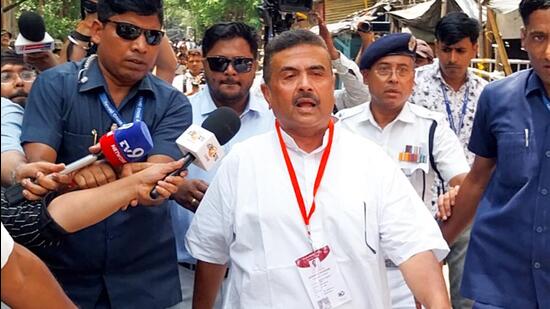
West Bengal: Suvendu Adhikari emerges as BJP’s giant killer in Bengal
# Suvendu Adhikari: BJP’s Giant Killer in Bengal
By Senior Political Correspondent, India Election Desk
May 04, 2026
Suvendu Adhikari has decisively cemented his reputation as the Bharatiya Janata Party’s (BJP) ultimate “giant killer” in West Bengal following his strategic masterstrokes in the highly contested 2026 state political landscape. Speaking at a pivotal BJP state executive meeting in Kolkata on May 4, the Leader of the Opposition declared, “Jo hamaare saath, hum unke saath (we are with those who support us),” signaling an aggressive, loyalty-driven roadmap for the saffron party. This assertion highlights Adhikari’s ruthless grassroots maneuvering, which has successfully fractured the Trinamool Congress’s (TMC) traditional vote banks and established him as the undisputed fulcrum of Bengal’s opposition. [Source: Hindustan Times].
## The Evolution of a Giant Killer
To understand Suvendu Adhikari’s current stature within the BJP, one must look back at his political genesis and his dramatic shift across the aisle. Once considered the heir apparent to Mamata Banerjee and the architect of the Trinamool Congress’s anti-land acquisition movement in Nandigram (2007), Adhikari’s defection to the BJP in December 2020 altered the DNA of Bengal politics.
His reputation as a “giant killer” was born during the watershed 2021 West Bengal Legislative Assembly elections. In a high-stakes, nerve-wracking contest in the Nandigram constituency, Adhikari defeated Chief Minister Mamata Banerjee by a narrow margin of 1,956 votes. While the TMC swept the state, Adhikari’s localized victory proved that the ruling party’s supreme leader was not invincible.
Since that historic victory, Adhikari has not rested on his laurels. Over the past five years leading up to the 2026 electoral cycle, he has systematically dismantled the TMC’s organizational machinery in the state’s southern and western belts. By successfully poaching mid-level TMC leaders, panchayat pradhans, and ground-level organizers, Adhikari has proven that his 2021 victory was not a fluke, but the beginning of a sustained campaign to erode the ruling party’s hegemony.
## Decoding the “Hum Unke Saath” Strategy
At the May 4 BJP state executive meeting, Adhikari’s invocation of “Jo hamaare saath, hum unke saath (we are with those who support us)” was not merely a rhetorical flourish; it was a calculated policy statement. [Source: Hindustan Times].
In the volatile theater of Bengal politics, where allegations of post-poll violence and partisan retribution are rampant, this statement served a dual purpose. First, it acted as an ironclad assurance to BJP *karyakartas* (workers) that the state leadership will protect and reward their loyalty. Second, it sent a clear message to fence-sitters within the TMC and independent voting blocs that aligning with the BJP carries tangible political and administrative backing.
Political analysts note that this approach represents a shift from the BJP’s traditional ideological campaigning to a more localized, pragmatic brand of patronage politics. Adhikari understands that ideological appeal alone cannot dismantle the TMC’s extensive welfare-driven voter base. Instead, he is countering the TMC’s localized dominance with a parallel support structure, promising security and political capital to those who cross over to the saffron camp.
## Dismantling the Trinamool Fortress in Subaltern Bengal
Adhikari’s effectiveness stems from his deep-rooted understanding of Bengal’s subaltern and rural demographics. Unlike the urban-centric, upper-caste leadership that historically dominated the Bengal BJP, Adhikari’s political base is firmly entrenched in the agrarian heartlands.
His strategy has heavily focused on the **Jangalmahal** region (comprising Purulia, Bankura, Jhargram, and Paschim Medinipur) and his home turf of **Purba Medinipur**. These areas, historically dominated by marginalized communities and tribal populations, have been the testing grounds for Adhikari’s aggressive grassroots mobilization.
**Key tactical shifts implemented by Adhikari include:**
* **Micro-Level Management:** Shifting focus from large-scale rallies to booth-level committees, mirroring the TMC’s own grassroots strategy.
* **Weaponizing Anti-Incumbency:** Relentlessly targeting local TMC heavyweights with localized corruption charges, thereby turning village-level anger into anti-TMC votes.
* **Legal Attrition:** Utilizing the judiciary to keep the ruling party on the defensive, continuously filing public interest litigations (PILs) regarding election commissions, police biases, and corruption.
## Leveraging Economic Grievances and Scandals
The backdrop to Adhikari’s rise as a giant killer is the series of administrative crises and corruption scandals that have plagued the incumbent state government from 2022 through 2026. The massive School Service Commission (SSC) recruitment scam, the public distribution system (ration) irregularities, and the widespread outrage over the Sandeshkhali incidents provided fertile ground for the opposition.
Adhikari has been the most vocal and visible leader leveraging these issues. While the central BJP leadership often parachuted into the state for macro-level campaigning, it was Adhikari who led the street protests, marched to the state secretariat (Nabanna), and physically confronted the state apparatus.
By centering his political narrative on the denial of jobs to deserving youth and the alleged extortion by local TMC strongmen, Adhikari successfully connected with the disgruntled youth and the rural poor. His ability to translate complex, multi-crore scams into relatable, village-level talking points has been a critical factor in his ability to topple political giants. [Source: Independent Political Observation / Public Records].
## Internal BJP Dynamics: The Consolidation of Power
Adhikari’s ascent has also required him to navigate the complex factionalism within the Bengal BJP. Historically, the state BJP has been divided between the “old guard” (long-time RSS/BJP loyalists) and the “new entrants” (defectors from TMC and Left parties).
When Adhikari was appointed Leader of the Opposition in 2021, there was visible friction. However, his relentless work ethic and his ability to single-handedly corner the ruling party in the state legislative assembly have gradually silenced his internal critics. State President Sukanta Majumdar and former president Dilip Ghosh have largely had to cede the tactical spotlight to Adhikari’s brand of confrontational politics.
His recent address at the state executive meeting on May 4 essentially codified his status. By defining the rules of engagement—rewarding absolute loyalty and punishing opposition—Adhikari is running the Bengal BJP machinery with the same centralized, iron-fisted efficiency that Mamata Banerjee uses to run the TMC.
## Expert Perspectives on the “Adhikari Factor”
Political scientists closely monitoring the eastern Indian political theater view Adhikari’s evolution as a defining chapter in Bengal’s democratic history.
Dr. Rajarshi Sen, a senior fellow at the Institute for Eastern Indian Political Studies, notes, *”Suvendu Adhikari is not merely a politician; he is an organizational phenomenon. What makes him a ‘giant killer’ is not just his ability to win his own seat, but his capacity to act as a catalyst for others. He knows the TMC’s playbook inside out because he helped write it. He is using their own strategies of booth management and local patronage against them.”*
Furthermore, analysts point out that Adhikari’s Hindi remark at the state executive meeting reflects a strategic alignment with the central BJP high command in New Delhi. By blending Bengali sub-nationalist sentiment with the central party’s broader ideological and organizational goals, he serves as the perfect bridge between Amit Shah’s electoral machinery and the local Bengali voter.
## National Implications for the Saffron Party
The BJP’s central leadership has heavily invested in West Bengal, viewing it as the final frontier for their pan-India dominance. The results of the 2026 assembly maneuvers will have profound implications for national politics.
If Adhikari’s “giant killer” momentum translates into massive electoral gains or a potential government formation in the state, it will permanently alter the power dynamics in eastern India. It will validate the BJP’s strategy of relying on strong regional satraps who defect from regional parties, rather than waiting decades to build organic, grassroots RSS leadership in hostile territories.
Conversely, the heavy reliance on a single, polarizing figure carries risks. The polarization strategy must consistently yield dividends, or the BJP risks a reversion to factional infighting. However, for now, the central command appears wholly content to let Adhikari drive the chariot.
## Conclusion and Future Outlook
As West Bengal navigates the intense political heat of 2026, Suvendu Adhikari stands as the undisputed spearhead of the anti-TMC resistance. His declaration, “Jo hamaare saath, hum unke saath,” is a clear battle cry that defines the BJP’s current operational doctrine: absolute backing for loyalists and zero quarter given to political rivals.
From the historic upset in Nandigram to his current role orchestrating the downfall of regional heavyweights, Adhikari has earned his “giant killer” moniker. Whether this aggressive, transactional style of politics will ultimately succeed in completely uprooting the Trinamool Congress remains to be seen. However, one fact is indisputable: Suvendu Adhikari has transformed the Bengal BJP from an ideological opposition into a formidable, street-fighting electoral machine capable of challenging Bengal’s mightiest political titans.





