
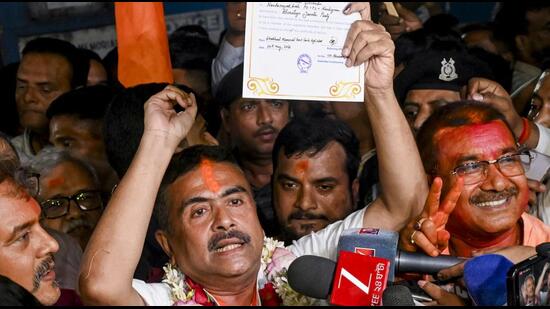
New BJP govt in West Bengal to take oath on May 9; focus on probable CM post
# BJP Sweeps Bengal: May 9 Oath & CM Race
By Senior Political Correspondent, The National Desk, May 5, 2026
In a landmark political shift, the Bharatiya Janata Party (BJP) has secured a decisive victory in the 2026 West Bengal Assembly elections, winning a sweeping 206 seats and ending the 15-year rule of the Trinamool Congress (TMC). The TMC, led by incumbent Chief Minister Mamata Banerjee, was reduced to 81 seats in the 294-member house. According to party officials, the newly elected BJP government is scheduled to take the oath of office on May 9. As preparations for the swearing-in ceremony begin at Raj Bhavan in Kolkata, the central leadership’s immediate focus shifts to selecting the state’s next Chief Minister. [Source: Hindustan Times].
## Decoding the Historic Electoral Mandate
The 2026 assembly election results represent one of the most significant electoral realignments in the recent history of Eastern India. After falling short in the highly polarized 2021 elections—where the TMC secured 215 seats and the BJP managed 77—the saffron party has systematically re-engineered its ground-level strategy to secure a commanding two-thirds majority.
**Election 2026 Seat Tally Summary:**
| Political Party / Alliance | Seats Won (2026) | Change from 2021 |
| :— | :— | :— |
| **Bharatiya Janata Party (BJP)** | **206** | +129 |
| **Trinamool Congress (TMC)** | **81** | -134 |
| **Left Front + Congress Alliance** | **7** | +7 |
| **Others / Independents** | **0** | -2 |
Political analysts point to a massive consolidation of anti-incumbency votes in favor of the BJP. Unlike previous elections where the Left-Congress alliance acted as a viable third pole or a spoiler, the 2026 mandate highlights a strictly bipolar contest. Voters seeking a change in administration largely bypassed the traditional Left, opting instead for the BJP as the primary vehicle to challenge the TMC apparatus. [Source: Additional historical election data context].
## The Race for the Chief Minister’s Post
With the swearing-in ceremony slated for **May 9**, the BJP’s parliamentary board is currently engaged in intensive deliberations to finalize the Chief Ministerial candidate. Because the BJP traditionally contests state elections in West Bengal without formally declaring a Chief Ministerial face, the sweeping victory has triggered intense speculation regarding who will lead the state.
Several prominent names are currently circulating within the political corridors of New Delhi and Kolkata:
* **Suvendu Adhikari:** The Leader of the Opposition from 2021 to 2026, Adhikari has been the most vocal face of the BJP’s state unit. His ability to directly challenge the TMC leadership and his strong mass base in the Medinipur region make him a frontrunner.
* **Sukanta Majumdar:** As the State BJP President, Majumdar has been instrumental in unifying the party’s various factions. A former academic, he is viewed favorably by the Rashtriya Swayamsevak Sangh (RSS) and presents a softer, more administrative face.
* **Dilip Ghosh:** A veteran organizational man and former state president, Ghosh laid the foundation for the BJP’s initial rise in Bengal between 2016 and 2021.
* **Technocratic Alternatives:** There is also speculation that the central leadership might appoint a dark-horse candidate—a technocrat or a prominent apolitical figure who joined the party recently—to signal a complete break from traditional Bengal politics and focus entirely on industrialization and governance.
Dr. Arindam Sen, a political science professor and independent electoral analyst, observes, *”The BJP’s central leadership is well aware that winning Bengal is only half the battle. Governing a state with deeply entrenched local political networks requires a Chief Minister who balances administrative rigor with an understanding of Bengal’s complex socio-cultural fabric. The choice will dictate the party’s long-term sustainability in the state.”* [Source: Expert Analysis].
## Factors Behind the Trinamool’s Defeat
Understanding the Trinamool Congress’s drop from a dominant 215 seats to just 81 requires examining multiple converging factors. Mamata Banerjee’s government, which came to power in 2011 by dismantling the 34-year-old Left Front regime, faced severe anti-incumbency after three consecutive terms in office.
While the TMC’s expansive welfare schemes—such as *Lakshmir Bhandar* (direct cash transfers for women) and *Swasthya Sathi* (health insurance)—maintained a robust support base for over a decade, electoral fatigue eventually set in. Public frustration was compounded by long-running controversies, most notably the state-level recruitment irregularities and the School Service Commission (SSC) controversies that dominated headlines in the mid-2020s.
Furthermore, the BJP successfully capitalized on allegations of local-level corruption and “syndicate raj” (a local term for organized extortion rings involving construction materials). By consistently framing the 2026 election as a referendum on governance, law and order, and industrial stagnation, the BJP managed to peel away crucial segments of the TMC’s traditional voter base, including a significant portion of the urban middle class and rural agrarian communities.
## Demographics and Shifting Allegiances
A closer look at the regional voting patterns reveals how the BJP achieved its **206-seat** landslide.
In **North Bengal**, a region where the BJP had already established a strong foothold during the 2019 and 2024 parliamentary elections, the party nearly swept all assembly segments. Issues of regional neglect and the demand for better infrastructure resonated strongly with the Gorkha, Rajbanshi, and tribal populations.
In the **Junglemahal** region (the western districts of Purulia, Bankura, Jhargram, and West Medinipur), the BJP recovered the ground it had lost in 2021. The tribal belts, which had swung back to the TMC previously, consolidated behind the saffron party due to targeted outreach programs and promises of localized economic development.
Most importantly, the BJP breached the TMC’s impenetrable fortress: **South Bengal and the Greater Kolkata region**. For the first time, the BJP secured a substantial number of urban and semi-urban constituencies around the state capital. The Matua community in the border districts of Nadia and North 24 Parganas also voted overwhelmingly for the BJP, largely influenced by the implementation of the Citizenship Amendment Act (CAA) rules leading up to the election.
## Economic and Policy Implications for West Bengal
The transition to a BJP-led state government brings profound implications for West Bengal’s economic trajectory. The state has historically struggled with a massive debt burden, which currently stands as one of the highest among Indian states relative to its Gross State Domestic Product (GSDP).
The incoming government has heavily campaigned on a “Double Engine Sarkar” promise—the premise that having the same political party in power at both the state and central levels accelerates development and bureaucratic efficiency.
Key economic shifts expected include:
1. **Implementation of Central Schemes:** The immediate rollout of central schemes that the previous administration had opted out of or rebranded, such as the Ayushman Bharat health insurance program and full adoption of the PM-Kisan Samman Nidhi parameters.
2. **Industrialization Focus:** West Bengal has faced deindustrialization for decades. The BJP has promised a new single-window clearance system for manufacturing entities and large-scale infrastructure investments to attract domestic and foreign direct investment (FDI).
3. **Fiscal Restructuring:** Financial experts anticipate the publication of a “White Paper” on the state’s economy within the first 100 days, aimed at restructuring the state’s debt and increasing capital expenditure over revenue expenditure.
*”Bengal’s fiscal health requires urgent structural intervention,”* notes Ananya Mukherjee, an economist specializing in Eastern Indian development. *”The alignment of the state government with New Delhi might ease bottlenecks in central funding, particularly for large-scale logistics and port infrastructure projects, but the new administration will have to make tough decisions regarding the existing subsidy burdens.”* [Source: Public Economics Forum].
## National Political Repercussions
The results from West Bengal reverberate far beyond the state’s borders, fundamentally altering the national political landscape. For over a decade, Mamata Banerjee has been a pivotal figure in national opposition politics, frequently spearheading efforts to unite regional parties against the BJP-led National Democratic Alliance (NDA).
By winning West Bengal, the BJP has not only achieved one of its most cherished ideological and electoral goals but has also significantly neutralized a major opposition hub. This victory consolidates the BJP’s dominance in Eastern India—adding West Bengal to its footprint alongside Assam, Tripura, and its strong presence in Odisha.
For the national opposition bloc, the defeat of the Trinamool Congress necessitates a severe strategic recalculation. Without the robust financial and political machinery of a ruling TMC in Bengal, the opposition loses a crucial anchor in the eastern theater.
## Conclusion: The Road Ahead
As West Bengal prepares for the historic swearing-in ceremony on **May 9**, the political climate remains highly charged. The immediate priority for the incoming administration will be ensuring a peaceful transition of power. Post-poll violence has tragically been a recurring theme in Bengal’s electoral history, and both the outgoing and incoming administrations, alongside central security forces, face the critical task of maintaining law and order in the coming weeks.
The BJP’s mandate of 206 seats is unambiguous. However, transitioning from a robust opposition to a governing entity in a highly politicized state presents a formidable challenge. The new Chief Minister will inherit a populace with high expectations for swift economic revitalization and transparent governance.
For the Trinamool Congress, the task is now survival and introspection. With 81 seats, they remain a potent opposition force, but they must navigate the challenges of staying united without the glue of state power.
As India watches the transition of power in Kolkata, the actions taken in the first 100 days by the new administration will set the tone for the future of West Bengal’s economy, society, and its standing within the Indian union.





