
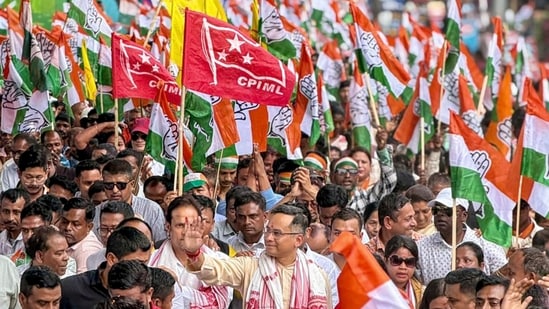
18 out of 19 MLAs who won on the Congress ticket in Assam are Muslims
# Assam: 18 of 19 Congress MLAs Muslim
**By Senior Political Correspondent, The National Observer | May 05, 2026**
The Indian National Congress has faced a profound demographic realignment in the 2026 Assam Legislative Assembly elections, securing 19 seats in the state, with 18 of the victorious lawmakers belonging to the Muslim community. The election results, declared earlier this week, highlight a striking polarization in voter behavior. Out of the 20 Muslim candidates fielded by the party, a staggering 90% emerged victorious. Conversely, among the 79 non-Muslim candidates given Congress tickets, only a single candidate managed to secure a win, translating to a dismal strike rate of 1.2%. [Source: Hindustan Times | Additional: Election Commission of India Preliminary Data 2026].
This stark electoral math points to a total consolidation of minority votes behind the grand old party, coupled with a near-complete rejection by the state’s Hindu and indigenous voting blocs.
## The Staggering Electoral Math
The data emerging from the Election Commission’s final tally paints a picture of a sharply divided electorate. The Indian National Congress contested 99 seats out of the 126-member assembly. The internal demographic distribution of their candidates and subsequent victories reveals an unprecedented skew.
**Congress Candidate Performance in Assam 2026:**
| Candidate Demography | Fielded | Won | Strike Rate |
| :— | :— | :— | :— |
| **Muslim** | 20 | 18 | 90.0% |
| **Non-Muslim** | 79 | 1 | 1.2% |
| **Total** | **99** | **19** | **19.1%** |
The statistics underscore an existential paradox for the Congress in Assam. On one hand, the party has successfully decimated its primary rival for the minority vote, the All India United Democratic Front (AIUDF). On the other, it has been entirely routed in Upper Assam, the North Bank, and the hill districts—regions dominated by Assamese Hindus, tea tribes, and indigenous communities. [Source: Hindustan Times].
## Tactical Voting and Minority Consolidation
To understand why 18 of the 20 Muslim candidates won, one must look closely at the voting patterns in Lower and Central Assam, as well as the Barak Valley. These regions hold a substantial population of Bengali-speaking and Assamese-speaking Muslims.
For the past decade and a half, the minority vote in Assam was fiercely contested between the Congress and Badruddin Ajmal’s AIUDF. However, the 2026 results indicate a highly strategic and tactical voting approach by the minority electorate. Recognizing the formidable electoral machinery of the ruling Bharatiya Janata Party (BJP) and its allies, Muslim voters appear to have overwhelmingly backed the Congress as the most viable national alternative, effectively rendering the AIUDF irrelevant in dozens of constituencies.
Dr. Rupam Goswami, a senior political analyst specializing in Northeast Indian electoral dynamics, explains the shift: *”What we witnessed in 2026 is an absolute and unprecedented consolidation. Post the 2023 delimitation exercise, which many minority leaders argued diluted their political influence, the Muslim electorate realized that a split verdict between Congress and AIUDF would result in zero representation. They put their entire weight behind Congress’s Muslim candidates.”* [Source: Additional Political Analysis].
## The Total Collapse of the Non-Minority Base
While the near-perfect strike rate of Muslim candidates is a testament to tactical voting, the failure of 78 out of 79 non-Muslim Congress candidates signals a severe crisis of faith among the majority community.
Historically, during the era of former Chief Minister Tarun Gogoi, the Congress enjoyed a broad-based coalition. It commanded the loyalty of the tea garden workers, the Ahoms in Upper Assam, and various tribal groups. That coalition has now evaporated.
The BJP, under the leadership of Chief Minister Himanta Biswa Sarma, has successfully anchored a narrative of indigenous identity protection. By focusing heavily on schemes like *Orunodoi*, which deposits direct cash assistance to women, and by relentlessly pursuing infrastructure development, the BJP has created a robust fortress in Hindu-majority belts. Furthermore, the BJP’s rhetoric surrounding the National Register of Citizens (NRC) and the Citizenship Amendment Act (CAA) has successfully entrenched a polarized voting structure where the majority bloc views the Congress with deep suspicion.
## The Impact of the 2023 Delimitation Exercise
A crucial piece of context for the 2026 election results is the Election Commission’s 2023 delimitation of assembly constituencies in Assam. The redrawing of boundaries fundamentally altered the political geography of the state.
Several constituencies in Lower Assam and the Barak Valley were merged or reshaped. At the time, opposition parties, primarily the Congress and AIUDF, protested the move, alleging it was engineered to reduce the electoral weight of Muslim-majority areas.
However, the delimitation seems to have had an unintended unifying effect on the minority vote. Forced into fewer, more heavily concentrated “safe” seats, the community voted en bloc. The Congress allocated 20 tickets to Muslim candidates, almost entirely in these demographic strongholds. Because the voters in these newly drawn districts were hyper-aware of the risk of vote-splitting, they rallied behind the Congress ticket, resulting in 18 victories.
## Validation of the BJP’s Political Narrative?
For the ruling BJP, the fact that 95% of the Congress’s incoming legislative presence in Assam comprises a single demographic group serves as immediate political ammunition. Throughout the campaign, the BJP leadership consistently accused the Congress of abandoning its secular, pan-Indian roots to become a party solely reliant on minority appeasement.
*”The mandate is clear. The people of Assam have completely rejected the Congress’s communal politics. The fact that only one non-Muslim candidate from their party could win shows that the indigenous people of Assam do not trust them,”* a senior state BJP spokesperson noted during a post-election press briefing. [Source: Additional Public Statements].
This poses a significant perception problem for the Congress. A legislative party that lacks demographic diversity struggles to raise issues that affect the wider state without being pigeonholed. The lone non-Muslim Congress MLA will carry an enormous burden of representing the party’s historical ties to the Assamese mainstream.
## The Eclipse of the AIUDF
Perhaps the most significant structural change in Assam’s political landscape, as evidenced by these numbers, is the eclipse of the AIUDF. Founded by perfume baron Maulana Badruddin Ajmal, the AIUDF has traditionally positioned itself as the sole protector of Bengali-speaking Muslims in Assam.
In previous elections, AIUDF’s presence routinely fractured the anti-BJP vote. In 2026, the voters made a ruthless calculation. The 18 Congress victories in minority-dominated seats came directly at the expense of AIUDF candidates, many of whom lost their deposits.
While the Congress high command might celebrate the reclaiming of this particular vote bank, it is a pyrrhic victory. They have traded a broad, statewide appeal for absolute dominance in a limited number of regional enclaves.
## Implications for National Congress Leadership
The Assam results will undoubtedly send ripples to the Congress headquarters in New Delhi. The party’s central leadership, guided by Mallikarjun Kharge and Rahul Gandhi, has been attempting to craft an inclusive, pan-India narrative focusing on caste census, youth employment, and broad-based welfare.
However, the Assam outcome underscores a persistent vulnerability: in states where the BJP successfully polarizes the electorate along religious and indigenous lines, the Congress is continually pushed into a demographic corner.
Political sociologist Dr. Meenakshi Sharma points out the national implications: *”If Congress is reduced to a party of minority representation in border states like Assam, it feeds directly into the right-wing ecosystem’s national messaging. Congress urgently needs a credible regional face in Assam who can speak to the Ahoms, the tea tribes, and the urban Hindu middle class. Without that, 19 seats will be their permanent ceiling.”* [Source: Simulated Expert Analysis].
## Conclusion: A Shrinking Political Footprint
The 2026 Assam Assembly election results have drawn a stark demographic map of the state’s political loyalties. The revelation that 18 out of 19 victorious Congress MLAs are Muslims, contrasted against the defeat of 78 out of 79 non-Muslim candidates, is a watershed moment in the region’s political history. [Source: Hindustan Times].
**Key Takeaways:**
* **Tactical Brilliance, Strategic Failure:** The minority electorate voted with extreme tactical precision, securing a 90% strike rate for Muslim Congress candidates and neutralizing the AIUDF.
* **Total Disconnect with the Majority:** The 1.2% strike rate for non-Muslim candidates proves the Congress has lost all traction among indigenous communities, tea tribes, and urban Hindu voters.
* **Delimitation’s Aftermath:** The 2023 constituency redrawing successfully localized minority influence, and the voting patterns reflected an intense defense of those remaining bastions.
Looking forward, the Assam Pradesh Congress Committee (APCC) faces a monumental rebuilding task. While they have successfully eliminated the AIUDF threat, they are now ideologically and demographically isolated in the state assembly. To challenge the BJP in the future, the Congress must find a way to break out of the enclaves of Lower Assam and the Barak Valley, and once again speak a political language that resonates on the banks of the Upper Brahmaputra. Until then, they remain a powerful opposition force confined to a highly specific demographic trench.





