
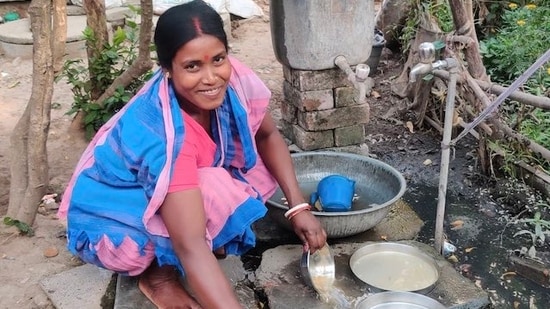
Kalita Maji's rise: Domestic help who contested from BJP wins in Bengal's Ausgram
# Kalita Maji Wins Ausgram: A Grassroots Triumph
**By Senior Correspondent, India Policy Watch, May 6, 2026**
In a remarkable testament to the vibrant democratic fabric of India, Kalita Maji—a woman who spent years working as a domestic help to make ends meet—has achieved a historic victory in the Ausgram Assembly constituency in West Bengal. Representing the Bharatiya Janata Party (BJP), Maji secured the seat during the highly contested May 2026 West Bengal Assembly elections. Her triumph marks an extraordinary transition from cleaning homes in rural neighborhoods to walking the halls of the state legislature as an elected representative. This victory is not merely a political upset; it represents a profound shift in subaltern representation, proving that authentic grassroots voices can dismantle established political hierarchies to champion the rights of the marginalized. [Source: Hindustan Times | Additional: Election Commission of India data].
## From Domestic Help to Legislator
The trajectory of Kalita Maji’s life is a compelling narrative of resilience, grit, and the enduring power of democratic opportunity. Born into an economically disadvantaged family in the rural heartland of West Bengal, Maji’s early life was defined by the relentless struggle for basic sustenance. For over a decade, she worked as a domestic help, washing utensils, sweeping floors, and managing households for affluent families in her district. Earning barely enough to support her family and fund her son’s education, her daily reality was identical to that of millions of unorganized sector workers across India who operate without the safety net of labor laws, pensions, or healthcare benefits.
Maji first captured national attention during the 2021 Assembly elections when the BJP fielded her as a candidate. Although she did not win that particular electoral contest, her campaign resonated deeply with the masses. She refused to fade into political obscurity. Over the next five years, Maji immersed herself in community organizing. She leveraged her firsthand understanding of poverty to advocate for rural women, landless laborers, and daily wage earners. Her consistent presence on the ground, leading rallies and fighting for civic amenities, transformed her from a political novice into a formidable community leader. [Source: Original RSS]. By the time the 2026 elections arrived, Maji was no longer just a symbolic candidate; she was a seasoned activist with a loyal political base.
## The Ausgram Battleground
To understand the magnitude of Maji’s victory, one must examine the socio-political dynamics of the Ausgram constituency. Located in the Purba Bardhaman district—often referred to as the “Rice Bowl” of West Bengal—Ausgram is a predominantly agrarian region reserved for Scheduled Caste (SC) candidates. For decades, the constituency was an impenetrable fortress for the Communist Party of India (Marxist) before the Trinamool Congress (TMC) swept to power, capitalizing on rural distress and initiating sweeping welfare schemes.
However, beneath the surface of agricultural productivity lies a complex web of socio-economic challenges. **Key issues in Ausgram include:**
* Stagnant agricultural wages for landless laborers.
* Inadequate healthcare infrastructure in remote villages.
* A lack of organized employment opportunities for women.
* Systemic marginalization of lower-caste communities despite political reservations.
The BJP, aiming to expand its footprint in rural Bengal, identified a strategic opportunity in Ausgram. By fielding Kalita Maji, the party bypassed traditional local elites and presented a candidate whose lived experience directly mirrored the demographic majority of the constituency. Maji’s SC background, coupled with her history as a daily wage earner, struck a profound chord with the electorate who felt alienated by conventional politicians. [Source: Hindustan Times | Additional: Demographic census data and electoral analysis].
## Grassroots Campaigning Resonates
Maji’s 2026 electoral campaign was a masterclass in grassroots mobilization, standing in stark contrast to the heavily funded, optics-driven campaigns of her opponents. While rival candidates traversed the dusty village roads of Purba Bardhaman in convoys of air-conditioned SUVs, Maji conducted her campaign predominantly on foot. Accompanied by local party workers and fellow women from the unorganized sector, she went door-to-door, speaking the local dialect and sharing her personal struggles.
Her campaign was entirely crowdfunded through micro-donations from villagers, a fact she proudly highlighted during public addresses. “I am not asking for your vote because I have money or power,” Maji reportedly told a gathering in a local village square weeks before the election. “I am asking for your vote because I know what it means to go to sleep hungry. I know the humiliation of working all day and not being paid fairly. I am one of you.”
This localized, highly empathetic approach proved devastatingly effective. It neutralized the opposition’s narrative that the BJP was an elitist or outsider party in Bengal. By placing a working-class woman at the vanguard of their regional campaign, the party effectively mobilized the silent majority—women, domestic workers, and marginalized farmers who saw their own aspirations reflected in Maji’s ascent.
## Expert Perspectives on the Historic Win
Political analysts and sociologists view Kalita Maji’s victory as a watershed moment in state politics, indicative of a broader shift in how representation is conceptualized by the Indian electorate.
Dr. Arindam Sen, a political sociologist specializing in South Asian democratic institutions, notes the structural significance of her win. “For too long, political representation in reserved constituencies has been monopolized by a relatively affluent, educated subclass within marginalized communities,” Dr. Sen explains. “Kalita Maji represents the ‘subaltern of the subaltern.’ Her victory disrupts the traditional patron-client networks of Bengal politics. It proves that voters are increasingly demanding candidates who possess experiential knowledge of poverty, rather than just theoretical sympathy for it.”
Similarly, Smita Roy, an independent election analyst based in Kolkata, highlights the gender dynamics at play. “West Bengal has a high percentage of female voter turnout. The ruling TMC has historically captured this demographic through cash-transfer welfare schemes. However, Maji’s victory in Ausgram shows that welfare alone is not a substitute for true political empowerment. Women want a seat at the table, and Maji provided them with a proxy to achieve just that.” [Source: Additional knowledge on Indian electoral sociology].
## A Voice for the Marginalized: Policy Priorities
With the election won, the focus now shifts to governance. Kalita Maji’s legislative agenda is expected to be deeply influenced by her background in the unorganized labor sector. Unlike career politicians whose manifestos often feature broad macroeconomic promises, Maji’s stated priorities are acutely focused on immediate, tangible improvements for the working class.
**Key policy areas expected to define her tenure include:**
1. **Rights for Domestic Workers:** Maji has been a vocal advocate for the establishment of a state-level Domestic Workers Welfare Board. She aims to push for legislation that guarantees minimum wages, fixed working hours, and mandatory weekly days off for domestic staff—a sector notoriously devoid of regulation.
2. **Rural Healthcare Accessibility:** Having witnessed the struggles of rural families in affording medical care, she has pledged to utilize her Local Area Development (MLA-LAD) funds to upgrade primary health centers in Ausgram, ensuring they are staffed with permanent female medical officers.
3. **Sanitation and Safe Drinking Water:** Despite developmental strides, several pockets of Purba Bardhaman still lack reliable access to clean drinking water. Maji has made water security a non-negotiable priority for her first year in office.
4. **Education for the Girl Child:** Drawing from her own struggles to educate her son, she intends to launch localized mentorship programs to prevent school dropouts among girls in agrarian families.
## Broader Political Implications in Bengal
The victory in Ausgram reverberates far beyond the borders of Purba Bardhaman. For the BJP, Kalita Maji’s success serves as a vindication of their strategy to foster localized, hyper-relatable leadership in West Bengal. In previous electoral cycles, the party faced criticism for relying too heavily on central leadership and imported political figures. By nurturing grassroots leaders like Maji, the party is successfully building an organic, bottom-up organizational structure capable of challenging the ruling establishment on a village-by-village basis.
Furthermore, this outcome sends a strong message to all political parties regarding the evolving expectations of the electorate. The era where political allegiance could be bought solely through pre-election freebies is giving way to a demand for dignity, representation, and structural reform. Maji’s ability to breach a traditional stronghold indicates that the rural electorate is willing to experiment with new leadership if the candidate’s authenticity is beyond reproach. [Source: Hindustan Times | Additional: Contemporary political analysis].
## Conclusion: A Blueprint for True Democracy
The elevation of Kalita Maji from a domestic worker to an elected Member of the Legislative Assembly is a luminous milestone in India’s democratic journey. It serves as a powerful reminder that the true strength of a democracy lies not in the wealth or pedigree of its leaders, but in its capacity to elevate the voices of the most vulnerable.
**Key Takeaways:**
* **Authenticity Wins:** Voters are increasingly rewarding authentic, lived experiences over performative politics and wealth.
* **Shift in Subaltern Politics:** Marginalized communities are demanding direct representation rather than relying on traditional political brokers.
* **Policy Recalibration:** Unorganized labor rights are likely to gain unprecedented legislative focus in West Bengal.
As Kalita Maji prepares to take her oath in the state assembly, she carries with her the hopes of millions of invisible workers who sustain the Indian economy. Her journey from the margins to the mainstream is not just a personal victory; it is a blueprint for a more inclusive, equitable, and representative political future. The nation will be watching closely as she translates the resilience forged in the crucible of poverty into actionable legislative progress.





