
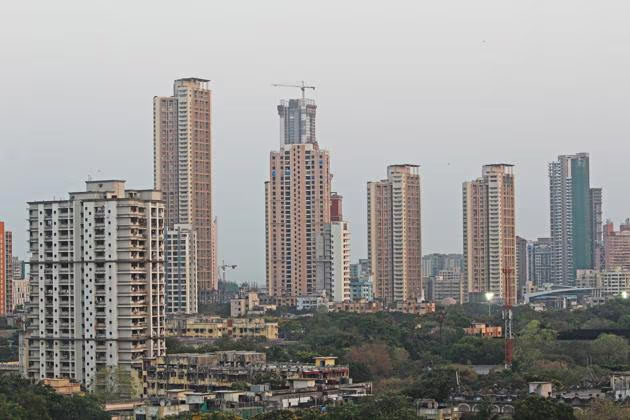
Mumbai has always been known as the financial and commercial capital of India. For decades, the city’s growth was driven by factories, mills, ports, and warehouses that provided jobs to lakhs of workers and helped build India’s industrial base. Cotton textile mills in Central Mumbai, engineering units, food processing plants, and manufacturing hubs across the suburbs shaped the city’s economy and identity. However, over the years, Mumbai has run out of space. With limited land and a rising population, the city has been forced to look inward and reuse what it already has.
Today, Mumbai’s skyline tells a very different story from the past. Where tall chimneys once stood, glass towers now rise. Where machines ran day and night, luxury homes and premium offices are coming up. This shift from industry to real estate has been slow but steady, and it reflects larger economic changes in India. Manufacturing has moved to cheaper locations outside the city, while Mumbai has positioned itself as a hub for finance, services, media, and corporate offices.
https://distrustuldistrustulproprietor.com/upj30178v8?key=4974c7d92916eda10d59ce1649b14da7
One of the most visible signs of this change has been the redevelopment of old textile mills in Central Mumbai. Areas like Lower Parel and Worli were once crowded with cotton mills that employed thousands of workers. As these mills shut down due to rising costs, outdated technology, and labour issues, their land became highly valuable. Over time, mill lands were redeveloped into upscale residential towers, shopping malls, hotels, and office complexes. This completely transformed the look and feel of these neighbourhoods.
The same trend is now being seen in other parts of the city as well. Old industrial plots in the suburbs, once used for manufacturing, storage, or processing, are being converted into commercial and mixed-use developments. Companies that once depended mainly on production are now finding that their land assets are worth far more than their factories. By redeveloping or selling these properties, they can raise huge amounts of money and invest it elsewhere.
The latest example of this shift comes from one of India’s most iconic consumer brands, Parle Products. The Parle-G biscuit is a household name across the country. For generations, it has been one of the most affordable and popular biscuits in India. Many Indians grew up eating Parle-G, and the brand is closely linked to Mumbai’s industrial history.
https://distrustuldistrustulproprietor.com/upj30178v8?key=4974c7d92916eda10d59ce1649b14da7
The original Parle-G factory is located in Vile Parle East, a well-known suburb in Mumbai. This factory is where the famous biscuit was first produced, making the site historically important not just for the company but also for the city. Over the years, however, Parle Products has gradually moved much of its manufacturing operations to other locations. As production shifted out and land prices in Mumbai rose sharply, parts of the company’s land were redeveloped earlier as well.
Now, according to a report by Hindustan Times, Parle Products is planning to redevelop its oldest manufacturing premises in Vile Parle East into a commercial complex. This marks another major step in the transformation of Mumbai’s industrial spaces into real estate projects.
The land parcel owned by Parle Products in Vile Parle measures about 5.44 hectares, which is roughly 13.45 acres. This is a large piece of land by Mumbai standards, especially in a prime suburban area with good connectivity. The proposed redevelopment plan includes a total built-up area of 1,90,360.52 square metres.
Out of this, 1,21,698.09 square metres will be developed under the Floor Space Index, or FSI. FSI refers to the amount of construction allowed on a given plot of land as per government rules. In addition to this, 68,662.43 square metres will be developed as non-FSI construction. Non-FSI areas usually include basements, staircases, certain common facilities, and other spaces that do not count towards the permitted construction limit.
The scale of the project shows how valuable industrial land in Mumbai has become. The estimated cost of the redevelopment project is around ₹3,961.39 crore, as mentioned in the report. This highlights the huge financial potential of redeveloping old factory sites in the city.
According to the plan, the redevelopment will consist of four buildings. Each of these buildings will have two basement levels, mainly used for parking and services. In the first three buildings, the A-wing is proposed to have six floors each.
For Building 1, the design includes both commercial and parking spaces. The B-wing of this building will have a mix of uses. The first, seventh, and eighth floors are planned for commercial activities such as shops and offices. The floors from the second to the sixth will mainly be used for parking. This kind of planning reflects the demand for both office space and parking facilities in a crowded city like Mumbai.
The commercial complex is expected to house retail outlets, restaurants, and food courts. Such facilities are common in modern commercial developments and are designed to attract office workers, visitors, and local residents. With its location in Vile Parle, close to residential areas and transport links, the project is likely to become a busy commercial hub once completed.
While Parle Products will continue its manufacturing operations at other locations, the redevelopment of its Vile Parle factory marks the end of an era. The site where one of India’s most recognisable biscuits was born will no longer be used for production. Instead, it will become part of Mumbai’s growing commercial real estate landscape.
This change reflects a broader reality facing Mumbai. As land becomes scarcer and more expensive, the city can no longer afford to use prime locations for low-value activities. Industrial units that need large spaces and generate heavy traffic are better suited to outskirts or other cities. In contrast, offices, retail spaces, and high-end residences generate more revenue and fit better into Mumbai’s current economic role.
However, this transformation also raises important questions. The shift from industry to real estate has reduced manufacturing jobs within the city. Many workers who depended on factories and mills had to find new livelihoods or move elsewhere. At the same time, rapid redevelopment has pushed up property prices, making housing less affordable for ordinary citizens.
Despite these concerns, the trend shows no signs of slowing down. With infrastructure projects like the metro, coastal road, and improved connectivity, suburban areas are becoming more attractive for large commercial developments. Old industrial plots are likely to be redeveloped further in the coming years.
The story of the Parle-G factory redevelopment is therefore not just about one company or one project. It is part of a larger story about Mumbai’s evolution. From being a manufacturing powerhouse to becoming a service-driven global city, Mumbai continues to reinvent itself. Its industrial legacy is being reshaped, not erased, as old landmarks give way to new symbols of growth and ambition.
Source: Hindustan Times





