
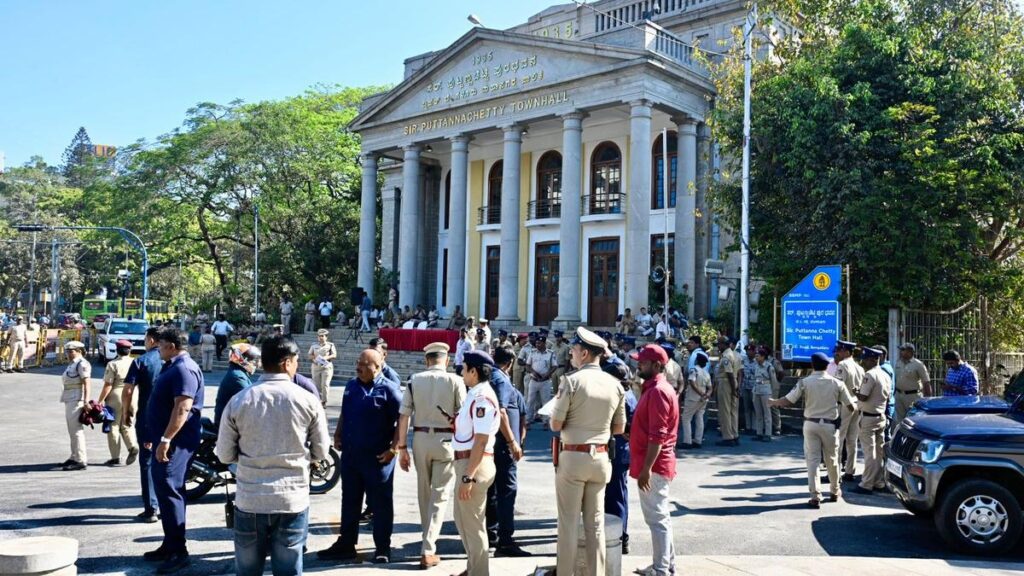
BENGALURU, February 12, 2026 The historic Town Hall in Bengaluru became the epicenter of a significant labor uprising today as thousands of workers, trade union activists, and representatives from diverse industrial sectors converged to protest the implementation of the four new Labour Codes. The demonstration, part of a nationwide general strike (Bharat Bandh) called by a coalition of over ten central trade unions, marked a critical moment in the ongoing friction between the workforce and the Union Government’s “ease of doing business” agenda.
The Convergence: Voices from the Industrial Heartland
From the early hours of Thursday, workers began streaming toward the city center from Bengaluru’s sprawling industrial corridors, including Peenya, Bommasandra, Electronic City, and Bidadi. The protest, organized under the banner of the Joint Committee of Trade Unions (JCTU), saw a rare unity between public sector employees from stalwarts like HAL, DRDO, and ITI, and unorganized sector workers, including garment employees, sanitation workers, and street vendors.
The atmosphere at Town Hall was charged with slogans demanding the immediate repeal of the four codes:
- The Code on Wages (2019)
- The Industrial Relations Code (2020)
- The Code on Social Security (2020)
- The Occupational Safety, Health and Working Conditions Code (2020)
While the demonstration remained largely peaceful, the police presence was heavy. By midday, as the crowd swelled, authorities moved to detain several key union leaders and hundreds of activists to prevent a total blockade of the city’s central business district.
Core Grievances: Why the Workers are Striking
The primary catalyst for this massive mobilization is the formal enforcement of these codes, which replaced 29 existing labor laws. Union leaders argue that these reforms, framed as “simplification,” are in reality a “frontal assault” on worker security.
1. The “Hire and Fire” Policy
A major point of contention is the Industrial Relations Code, which increases the threshold for establishments needing government permission for layoffs and retrenchment from 100 to 300 workers. Protestors at Town Hall highlighted that this move leaves the vast majority of India’s industrial workforce without job security, effectively institutionalizing “fixed-term employment.”
2. Dilution of the Right to Strike
The new codes mandate a 14-day notice period for strikes in all industrial establishments, a requirement previously limited to public utility services. “By the time the notice period ends and mandatory conciliation begins, the momentum of a strike is legally neutralized,” stated a representative from the Centre of Indian Trade Unions (CITU) during the rally.
3. Wage Definitions and Social Security
The Code on Wages has redefined “wages,” capping allowances at 50% of total remuneration. While the government claims this will increase long-term social security benefits like Provident Fund (PF), workers at the protest argued it leads to a significant reduction in take-home pay, especially for those in low-income brackets already struggling with inflation.
Impact on Industry and Public Life
While public transport in Bengaluru, including BMTC and KSRTC, continued to function with minor disruptions, the strike’s impact was most visible in the manufacturing and IT-BT sectors. Industrial production in the outskirts of the city saw a sharp decline as thousands of permanent and contract employees abstained from work.
Government Stance and Legal Perspectives
The Ministry of Labour & Employment has consistently defended the reforms, describing them as essential for “modernizing outdated laws” and extending social security to gig and platform workers. Government officials maintain that the codes bring transparency through digital inspections and “Inspector-cum-Facilitators” who prioritize guidance over harassment.
However, legal experts like retired Supreme Court Justice V. Gopala Gowda, who recently addressed a workers’ convention in the city, warned that the codes weaken the “tripartite” balance between labor, capital, and the state, potentially pushing the workforce into highly insecure and exploitative conditions.
Broader Demands
Beyond the repeal of the labour codes, the protestors at Town Hall presented a 10-point charter of demands to the Governor’s office, including:
- Restoration of the MGNREGA scheme with increased funding.
- Withdrawal of the India-US interim trade agreement, which farmers’ groups (Samyukt Kisan Morcha) claim will flood Indian markets with cheap imports.
- Cancellation of the Karnataka state notification intended to implement the central codes.
- Minimum wage revision to ₹26,000 per month (with some unions demanding up to ₹42,000).
Conclusion
The convergence at Town Hall serves as a stark reminder of the deep-seated anxieties within India’s labor force. As the government pushes for global competitiveness, the workers of Bengaluru are demanding that “progress” should not come at the cost of the fundamental rights and dignity earned through decades of struggle.





