
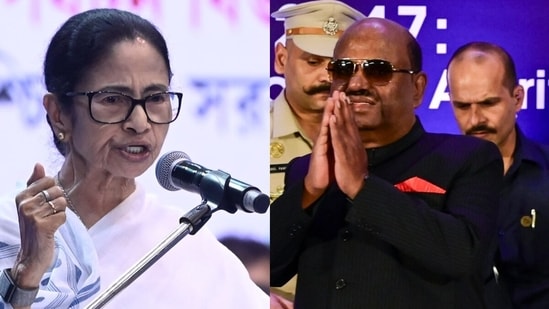
Mamata's 'forced to remove' barb at Ananda Bose evokes ex-Guv's response, fresh jibe at R N Ravi| India News
Bengal Governor’s Exit Ignites Fresh Centre-State Tensions
The recent departure of West Bengal Governor C.V. Ananda Bose from his post has swiftly ignited a fresh political firestorm across the state, prompting Chief Minister Mamata Banerjee to voice pointed allegations of central government pressure. This development, unfolding against the crucial backdrop of impending elections, has once again brought the often-strained relationship between the Centre and state administrations into sharp focus.
Mamata Banerjee’s immediate reaction was unambiguous. She claimed that the Bengal Governor may have been unduly pressured by the Union government to “serve certain political interests.” Such an assertion by a sitting Chief Minister is not merely political rhetoric; it strikes at the core of India’s federal structure and the constitutional impartiality expected of the Governor’s office. For many observers, this event is another chapter in the long-running saga of friction between Kolkata and New Delhi, particularly when Bengal’s political future is on the line.
To fully grasp the weight of these claims, it’s essential for any diligent citizen, even a 12th-standard student following the news, to understand the role of a Governor. In India, a Governor is not merely a figurehead. Appointed by the President of India, who acts on the advice of the central government, the Governor serves as the constitutional head of a state. They are expected to act as a bridge between the state and the Centre, upholding the Constitution, giving assent to bills, and sometimes playing a crucial role in government formation or dissolution, especially in times of political instability. Critically, their office is meant to be apolitical, safeguarding constitutional principles without bias.
However, in practice, the Governor’s office has frequently become a contentious battleground. When the party at the Centre differs from the ruling party in a state, tensions can escalate. Governors have often been accused by state governments of acting as agents of the Centre, particularly when their actions or pronouncements appear to align with the central government’s political agenda rather than the state’s elected representatives. Mamata Banerjee’s current accusation echoes a sentiment that has frequently been expressed by leaders of non-BJP ruled states.
The specific context of “certain political interests” ahead of elections is paramount here. With various polls on the horizon – be it local panchayat elections, assembly elections, or the looming general elections – every political maneuver, every statement, and every institutional action is scrutinized through a highly charged political lens. A Governor, with their power to influence state administration and their voice in public discourse, holds significant sway. If perceived to be acting under central pressure, their impartiality is immediately questioned, potentially affecting the credibility of the electoral process itself.
Local news reports and community discussions often highlight how residents view such developments. Many wonder if the constitutional office is truly independent or if it becomes a pawn in a larger political chess game. This constant questioning can erode public trust in institutions, which is a dangerous trend for any democracy.
Omni 360 News understands that the nature of “pressure” is rarely explicit. It often manifests subtly – through delayed approvals, public statements that critique the state government, or even informal communications that signal displeasure or a desired course of action. While direct evidence of central coercion might be elusive, the perception of it, especially when articulated by a seasoned political leader like Mamata Banerjee, creates a significant political narrative. This narrative suggests that the Centre might be attempting to destabilize or influence the political landscape in Bengal through constitutional channels, rather than through direct electoral competition.
This situation raises serious concerns about the sanctity of India’s federal structure. The balance of power between the Centre and states is fundamental to India’s diversity and democratic health. When a constitutional office is seen as compromised, it not only affects the state in question but sets a troubling precedent for Centre-state relations nationwide. It underscores the urgent need for a clear, transparent framework governing gubernatorial appointments and conduct, ensuring their actions are always seen to be in service of the Constitution, not partisan interests.
Key Takeaways:
* The Governor’s exit has deepened political distrust between Bengal’s state government and the central administration.
* Mamata Banerjee alleges the Centre influenced the Governor for political gains, especially with elections drawing near.
* The Governor’s role is vital and should be impartial, acting as a constitutional guardian, not a political player.
* Such incidents highlight ongoing tensions in India’s federal system, where state autonomy often clashes with central authority.
* Maintaining the neutrality of constitutional offices is crucial for upholding democratic principles and public faith.
The unfolding events in Bengal demand careful observation. The accusations leveled by the Chief Minister are not minor; they speak to fundamental questions about democratic accountability, constitutional propriety, and the spirit of federalism that underpins the Indian Republic. As the political temperature continues to rise, how these allegations are addressed, and the implications for the Governor’s office, will undoubtedly shape the political narrative in West Bengal and beyond.





